



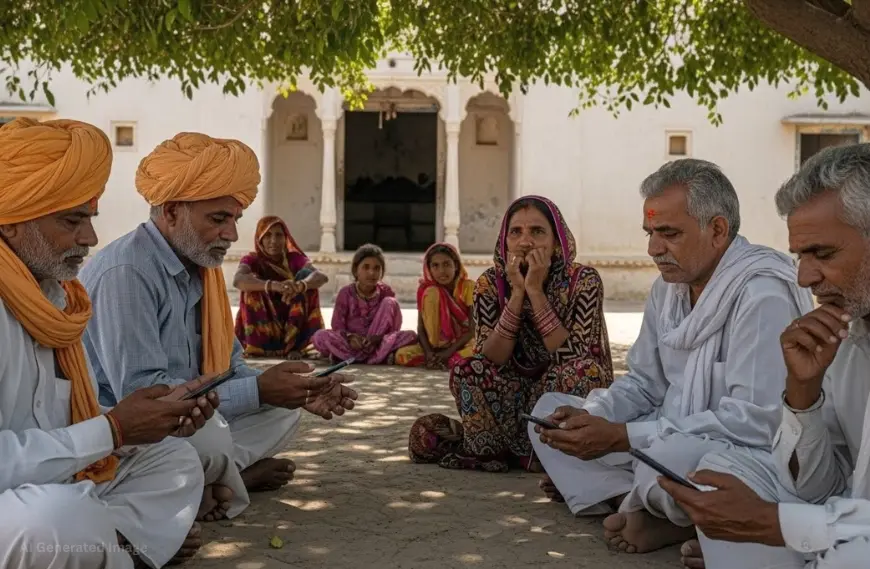
When village elders in Rajasthan’s Jalore district briefly moved to restrict women from using smartphones, the decision triggered a swift backlash that eventually forced a retreat. Yet beyond the withdrawal itself, the episode has reopened a deeper debate on how access to technology is regulated along gender lines in parts of rural India.
The proposed restriction, announced during a community meeting on December 21 in Gazipur village, sought to limit smartphone use by daughters and daughters-in-law across 15 villages of the Sundhamata Patti region. Although the elders later clarified that the decision was advisory rather than binding, the language and scope of the announcement placed women and girls squarely at the centre of digital control.
By December 25, following criticism from multiple quarters, a meeting of village elders unanimously reversed the move. However, the reasoning offered by community leaders, centred on child welfare and online safety, has done little to quiet questions about why women, rather than all family members, were singled out in the first place.
According to statements made by community representatives, the concern stemmed from complaints by women themselves. Elders said mothers had expressed anxiety that children were spending excessive time watching videos on smartphones after school, neglecting meals and studies, and experiencing potential harm to eyesight and mental development. Cyber fraud and online exploitation were also cited as risks.
Yet the structure of the proposed restriction revealed a clear gendered pattern. Women were advised to give up smartphones altogether, while being permitted to keep basic feature phones for calls. School-going girls were allowed limited smartphone access for studies, but only within the confines of their homes. Carrying phones to weddings, social gatherings or neighbours’ houses was expressly discouraged.
No similar guidance was publicly issued for men or boys.
For gender rights advocates, this asymmetry is the story’s defining feature. Control over women’s access to technology, they argue, reflects longstanding social norms where women are positioned as gatekeepers of morality, family discipline and child behaviour — even when the issue at hand is a household’s digital habits.
In many rural settings, smartphones represent more than communication tools. They provide access to information, financial services, education resources and social networks. Limiting women’s use of these devices can therefore have consequences that extend far beyond screen time.
Experts studying digital inclusion note that women in rural India already lag behind men in smartphone ownership and internet access. Decisions like the Rajasthan smartphone ban on women, even when framed as temporary or advisory, risk reinforcing this gap by normalising the idea that women’s digital presence requires supervision.
Village elders involved in the decision insist that gender discrimination was not the intention. Natharam Chaudhary, a member of the community leadership, said the proposal was meant as a one-month observation period and was misunderstood. According to him, if the measure had gained broad acceptance, it might have been implemented from January 26. Instead, opposition grew quickly.
The episode underscores the power informal community institutions continue to wield. Although such panchayat-style gatherings have no legal authority to impose bans, their pronouncements can carry significant social pressure, particularly for women who may face stigma or censure for defying collective norms.
For policy researchers, the Rajasthan smartphone ban on women illustrates how digital governance increasingly intersects with traditional authority structures. As smartphones become central to daily life, debates over their use are being absorbed into older frameworks of control, respectability and obedience, frameworks that often place disproportionate responsibility on women.
The withdrawal of the decision suggests that these informal authorities are not immune to public scrutiny. Increased media attention and criticism appear to have played a role in forcing reconsideration, highlighting the limits of community power in an era of wider connectivity.
However, the language used by elders after the reversal, emphasising “misunderstanding” rather than acknowledging gender bias, indicates that the underlying attitudes may remain unchanged.
As India pushes forward with digital inclusion initiatives, such localised controversies reveal the challenges on the ground. Ensuring equal access to technology will require more than infrastructure and affordability; it will also demand confronting the social norms that quietly dictate who gets to stay connected, and who does not.
The Rajasthan smartphone ban on women may have been withdrawn, but the questions it raised about gender, authority and digital freedom remain unresolved.
Subscribe Deshwale on YouTube
