



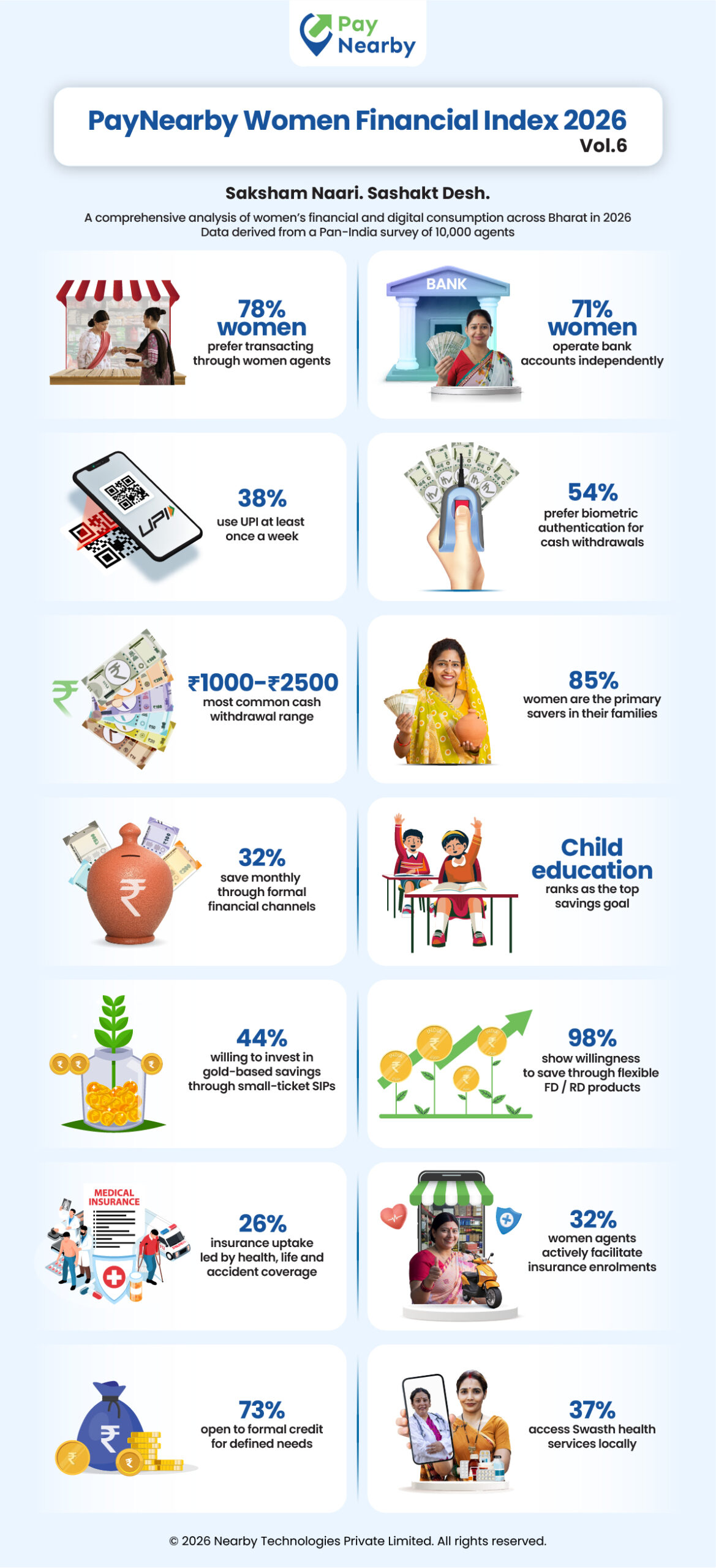
Digital payments are becoming a routine part of everyday life for women in rural and semi-urban India. A new report by PayNearby shows that 38 per cent of women in these regions now use Unified Payments Interface (UPI) at least once a week for daily essentials such as groceries, utility bills and mobile recharges.
The findings come from the sixth edition of the PayNearby Women Financial Index 2026, based on a survey of 10,000 women agents who deliver digital and financial services across rural and semi-urban Bharat. The report highlights how women are increasingly participating in financial systems and adopting digital tools for everyday transactions.
Women Emerging as Primary Savers
The survey reveals that women are playing a central role in household financial management. About 85 per cent of women said they are the primary savers in their families. At the same time, 71 per cent operate their bank accounts independently, particularly in the 18 to 40 age group, reflecting growing financial confidence.
Savings habits are also becoming more structured. Around 32 per cent of women now save through formal financial channels such as fixed deposits and goal-based savings accounts. Education for children, medical emergencies and household purchases remain the top savings priorities.
Growing Interest in Investment Options
The report also highlights rising interest in investment products. Nearly 44 per cent of women expressed willingness to invest in gold-based savings products through small-ticket SIPs when supported by local service providers. Gold continues to hold strong social acceptance as a reliable savings instrument.
Flexible deposit products are especially popular. As many as 98 per cent of women said they would prefer saving through small-ticket deposits such as recurring deposits or fixed deposits that allow easy withdrawals. However, awareness of mutual funds remains low, with fewer than 10 per cent familiar with the investment category.
Trust in Women Agents Driving Adoption
Trust plays a key role in financial adoption. The survey found that 78 per cent of women prefer transacting through women agents, citing comfort and ease of interaction. These community-based agents are helping women adopt financial services beyond basic transactions.
Cash withdrawals remain essential for managing daily expenses. About 54 per cent prefer biometric authentication methods, including face authentication, when withdrawing money. The most common withdrawal range falls between ₹1,000 and ₹2,500.
Insurance, Credit and Health Services Expand
Insurance adoption is gradually increasing, with 26 per cent of women now holding health, life or accident coverage. Meanwhile, 73 per cent expressed openness to formal credit, mainly for healthcare, education, agricultural needs and small businesses.
Healthcare services are also gaining traction. Around 37 per cent of women access health-related offerings such as telehealth consultations and sanitary products through community service points.
Overall, the report shows that women across Bharat are steadily strengthening their financial independence through digital payments, savings and access to formal financial services.
Subscribe Deshwale on YouTube
