



Prologue: echoes from the Marina
Political Analysis | Tamil Nadu | Strategic Affairs
From the salt-kissed shores of Marina Beach, where Periyar’s statues gaze eternally upon the Bay of Bengal and the ghosts of Anna Durai’s rationalism stir in every fisherman’s net, the gathering storm of Tamil Nadu’s 2026 assembly elections takes vivid shape. This is a land where cinema scripts revolutions and caste whispers louder than manifestos. Chief Minister M.K. Stalin’s Dravida Munnetra Kazhagam alliance, a colossus with 133 seats from 2021 and Congress as its steadfast flank, eyes a second term buoyed by welfare largesse and anti-Hindi fervour. The Bharatiya Janata Party, in alliance with a fractured AIADMK under Edappadi K. Palaniswami, proclaims dominion, with Home Minister Amit Shah thundering in Madurai that BJP rule is certain, invoking Odisha’s template as his proof of possibility.
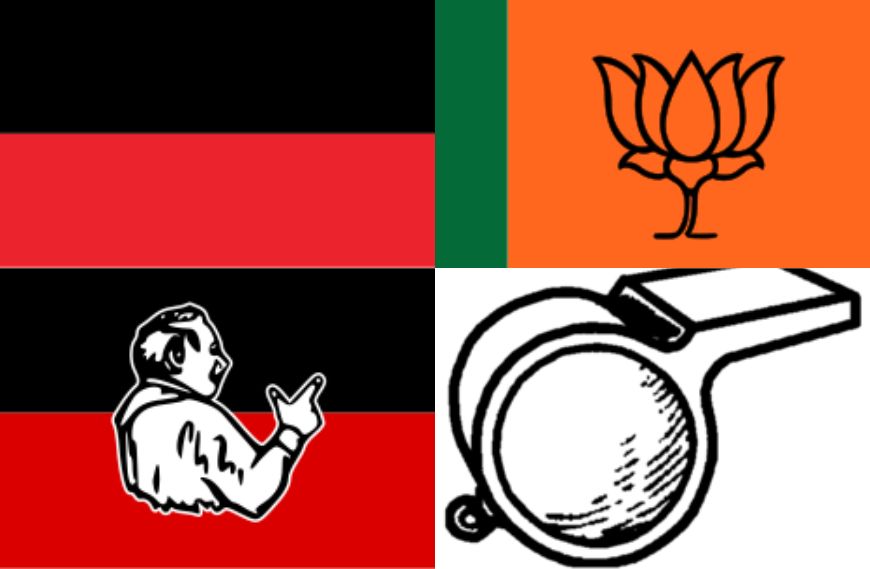
Yet the true disruptor is actor Joseph Vijay’s Tamilaga Vettri Kazhagam, launched in 2024 and now a meteor streaking across the political firmament. Vijay, Thalapathy to millions and the whistle-blowing icon of mass heroism, rejects alliances entirely, vowing a solo sweep for Tamil tears wiped clean and framing the polls as a direct war against DMK’s corruption. In Thanjavur’s sun-baked grounds, he evoked oceanic emotion, declaring that the whistle will resound in every booth and likening TVK to Tamil Nadu’s invincible cricket side trouncing Delhi’s pretenders. With the BJP eyeing 65 winnable seats and TVK plotting a candidate blitz, with 80 names already in the offing following Congress’s DMK pact, this three-cornered contest portends serious disruption in a 234-seat arena requiring 118 for supremacy.
In a polity where MGR’s charisma endures and Karunanidhi’s legacy looms, the assets are formidable yet fatally flawed.
The BJP’s bastion: central leverage and alliance gambits
The BJP strides into 2026 with sharpened instruments, its national resources functioning as a Trojan horse for Tamil Nadu’s heartland. Foremost is the AIADMK pact, sealed in April 2025 despite EPS’s lingering bitterness over the 2024 Lok Sabha debacle in which the BJP managed only a solitary Coimbatore win. This union, brokered by Shah and in-charge Piyush Goyal through sustained shuttle diplomacy, cedes EPS the chief ministerial face while BJP claims 65 constituencies: urban redoubts on Chennai’s fringes and western Ghats pockets where Hindutva sentiment simmers. In these constituencies the party banks on anti-incumbency, pointing to DMK’s sand mining scandals, NEET impositions, and the unhealed scars of the 2023 floods, with surveys hinting at a five to ten percent urban Hindu swing.
Modi’s developmental pitch, branded Viksit Tamil Nadu, dangles substantial carrots: Rs 10,000 crore in PMAY housing, AIIMS expansions, and semiconductor hubs in Coimbatore, all targeted at the state’s 40% urban middle class that has grown weary of Dravidian patronage politics. Organisationally, state president K. Annamalai’s En Mann En Makkal yatra has woven RSS shakhas into OBC networks, with particular focus on Vanniyars and Thevars who are key to approximately 30 seats in the north. Shah’s strategic calculus draws from the Delhi template: softer Hindutva, no temple agitations, but subtle references to appeasement via CAA tweaks, potentially consolidating 15 to 20% upper-caste votes.
Vijay’s entry into the contest, ironically, bolsters the BJP indirectly. TVK’s anti-DMK rhetoric, echoing Vijay’s Vellore rally declarations on corruption wars, siphons youth and Dalit voters from Stalin’s base, fragmenting the secular vote in 40 to 50 seats. As N. Ram has observed, the BJP remains a junior player in this theatre. But in a splintered field, its 2024 Lok Sabha uptick from zero to one seat signals momentum, with the party now eyeing 40 to 50 seats if EPS delivers. Yet these are footholds on granite, not conquests.
The abyss of alienation: cultural chasms and Vijay’s vortex
Beneath the BJP’s tactical veneer lies a chasm of disconnection, deepened by Dravidian disdain and TVK’s tidal pull.
Chief among the party’s structural weaknesses is cultural incompatibility. Tamil Nadu’s rationalist soul, forged in Periyar’s atheism and Anna’s federalism, recoils at majoritarian undertones. Annamalai’s Hindi pushes and temple-centric rallies evoke North Indian imposition, alienating the 70% non-Brahmin base. Polls place the BJP’s ceiling at 10 to 12% statewide, confining it to Coimbatore’s Brahmin pockets. The AIADMK alliance, once a Jayalalithaa bulwark, now carries the odour of desperation. EPS’s 2023 split and the 2024 rout in which the alliance won zero Lok Sabha seats have rendered him a spent force, his Thevar loyalty steadily eroded by TVK’s ingress of disgruntled cadres.
Vijay’s TVK exacerbates this fragility, functioning as a double-edged sword for the BJP. The actor’s solo foray, eschewing all pacts and eyeing contests in Virugambakkam and North Chennai, channels MGR-esque populism around anti-corruption, women’s safety invoking Lakshmi’s legacy, and Tamil pride, drawing 20 to 25% youth support per C-Voter surveys. His whistle revolution, amplified by devoted fan armies and the considerable hype surrounding his post-poll film JanaNangan, fragments the anti-DMK space in ways that damage the saffron alliance materially. In urban belts, TVK poaches voters the BJP had targeted. In rural Delta constituencies, it dilutes AIADMK’s hold, potentially costing the saffron alliance 15 to 20 seats. Vijay’s Thanjavur declaration that TVK is Tamil Nadu ignites genuine frenzy, while BJP’s Tamilisai Soundararajan’s counter-messaging around development over emotions has struggled to gain equivalent traction.
Welfare warfare widens the rift further. DMK’s Amma Unavagam redux and free bus rides for women, reaching approximately 50% of female voters, outflank the BJP’s centrally administered schemes, which are widely dismissed as Delhi doles. Organisationally, the BJP’s booth-level cadre pales against DMK’s youth wings and TVK’s viral mobilisation through reels and mass rallies. With TVK projected to claim 30 to 40 seats if fan frenzy converts to ballot box reality, it effectively hands DMK a working plurality and confines the BJP to junior status. As Vijay eyes a chief ministerial bid, the saffron dream dissolves in a Dravidian deluge.
Epilogue: whistles over saffron flames
In Tamil Nadu’s inexorable political rhythm, where Kollywood eclipses conventional campaigning and federal feuds fuel folklore, the BJP’s 2026 odyssey is a quixotic quest: armed with alliances yet armoured against its own otherness.
Vijay’s TVK does not merely compete for the same space. It reconfigures the entire board, siphoning Stalin’s flanks while simultaneously starving BJP’s ambitions of the oxygen they require. Shah’s certainties ring hollow against Marina’s tides. As N. Ram has observed, national interlopers remain footnotes in Dravidian epics.
The whistle may blow across Tamil Nadu’s constituencies. But in this analyst’s reckoning, green and red endures, saffron simmers at the margins, and Vijay’s thunder heralds not conquest but kaleidoscopic contention in a political saga that Tamil Nadu is scripting entirely on its own terms.
Subscribe Deshwale on YouTube
