








By: Pratyush Bardoliwala
Octopuses are fascinating creatures. They are fast, flexible and highly intelligent. But beyond these remarkable abilities lies something even more extraordinary: an octopus has three hearts, and its blood is blue rather than red. Many octopuses can also produce and release a dark ink from inside their bodies when threatened, using it as a defence against predators. Sounds crazy, right? There is, however, a fascinating scientific explanation behind these unusual features.
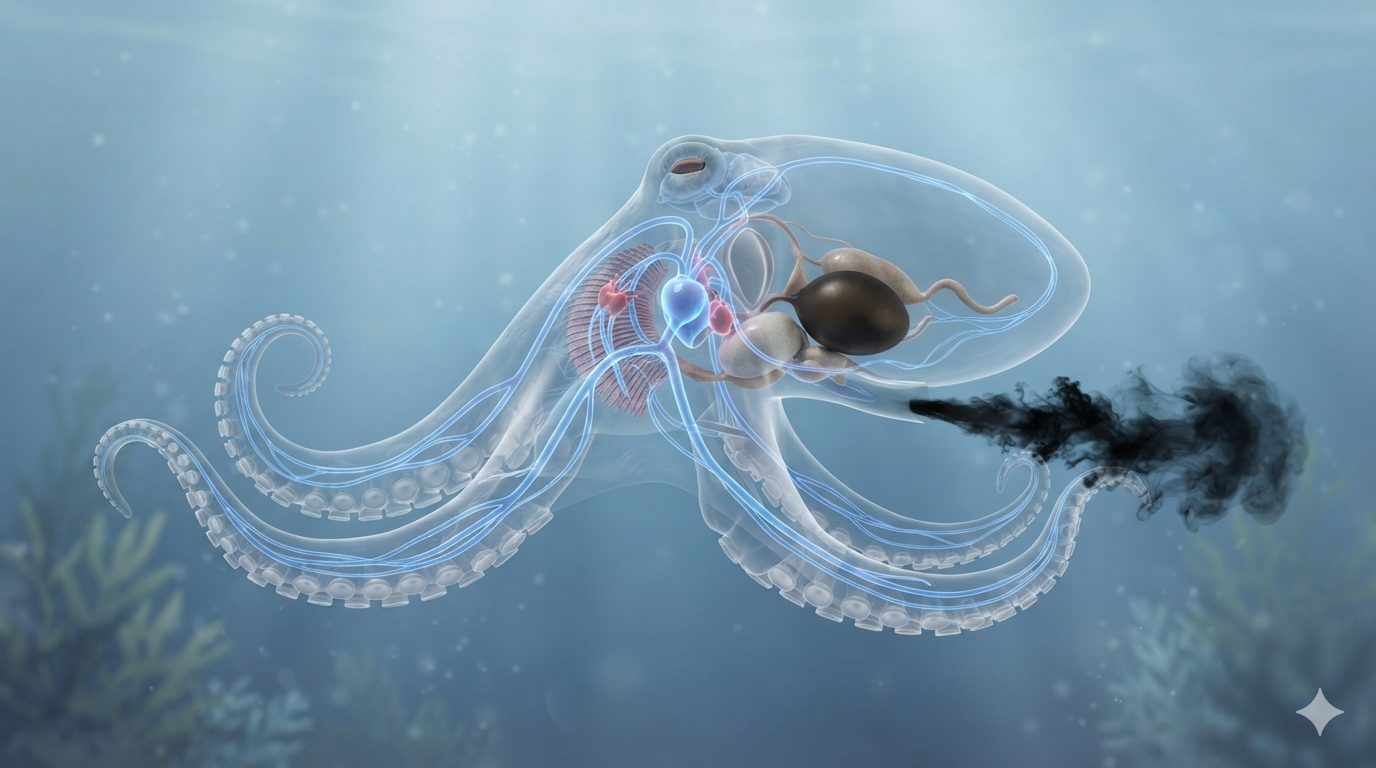
The answer begins with the way an octopus breathes. Unlike humans, octopuses do not have lungs. They use gills to extract oxygen from water. Their circulatory system contains two branchial hearts and one systemic heart, each with a specific role. The two branchial hearts pump oxygen depleted blood through the gills, where it picks up oxygen. The systemic heart then pumps this oxygenated blood throughout the body. This specialised arrangement allows the octopus to maintain circulation through its gills and deliver oxygen to its tissues, supporting its active way of life.
This naturally raises another question: what happens if one of an octopus’s hearts stops working? The answer depends on which heart is affected. If a branchial heart fails, blood flow through the associated gill can be disrupted, affecting oxygen uptake. If the systemic heart fails, the circulation of oxygen rich blood to the rest of the body is severely compromised. Because the three hearts have different but connected roles, a serious failure of one can have major consequences for the animal. Rather than functioning as three interchangeable hearts, they form different parts of one specialised circulatory system.
Then comes another remarkable feature: blue blood. The colour comes from a respiratory protein called haemocyanin, which carries oxygen through the bloodstream. Humans use iron containing haemoglobin for oxygen transport, giving our blood its familiar red colour. Octopuses and other cephalopods use copper containing haemocyanin instead. When oxygen binds to this protein, it produces the characteristic blue colour. In simple terms, humans rely on iron for oxygen transport, while octopuses rely on copper.
But the octopus has another fascinating ability that has nothing to do with its circulatory system: it can produce ink. In ink producing octopuses, the ink is stored in a specialised ink sac and released through the animal’s funnel when it is threatened. The dark material can form a cloud that obscures a predator’s view, giving the octopus an opportunity to escape. The ink can also form a concentrated, mucus rich structure called a pseudomorph, which can resemble the escaping animal and potentially distract a predator. So, what looks like a simple cloud of dark fluid is actually a specialised defensive strategy.
At this point, another question may come to mind: are the octopus’s three hearts, blue blood and ink connected? The answer is no. They perform completely different functions. The three hearts are part of the circulatory system, while haemocyanin is the oxygen carrying protein responsible for the blue colour of oxygenated blood. Ink, meanwhile, is primarily a defence mechanism against predators. The reproductive system is separate from all of these as well. Although these features exist within the same animal, they are specialised biological systems rather than different parts of one single mechanism.
And the octopus is certainly not the only animal with unusual biology. Take the horseshoe crab, for example. Its blood is also blue because it uses copper based haemocyanin rather than iron based haemoglobin for oxygen transport. Starfish provide another unusual example. Unlike vertebrates, they do not have a centralised heart. Instead, they have a water vascular system that plays important roles in movement, feeding and other functions. These differences may seem bizarre from a human perspective, but they are normal biological features of the animals that possess them.
The octopus is fascinating not simply because it has three hearts, blue blood or the ability to release ink. What makes it remarkable is how these different systems work together within an animal adapted to life in the ocean. Its hearts circulate blood, haemocyanin transports oxygen, its flexible body allows it to move through tight spaces, and its ink can help it escape predators. These are not random oddities. They are specialised biological traits shaped over evolutionary time. The octopus therefore offers a striking reminder that nature does not follow one universal blueprint. Different animals can develop remarkably different solutions to the challenges of survival, and sometimes, those solutions can look completely extraordinary to us.
Subscribe Deshwale on YouTube


