 Deshwale
Some Stories Are Hidden in the Most Ordinary Things
In brief · AI summary The article argues that ordinary objects such as salt, railway tickets, bricks and black pepper can reveal history and daily life. It notes that in 1930 salt became a symbol of protest in India, when Mahatma Gandhi picked up natural salt at the shore on 6 April during his march to Dandi. It also explains that the first passenger train in India ran in 1853, and that Indus Valley bricks and Malabar pepper point to planning, trade and early links between distant cultures.
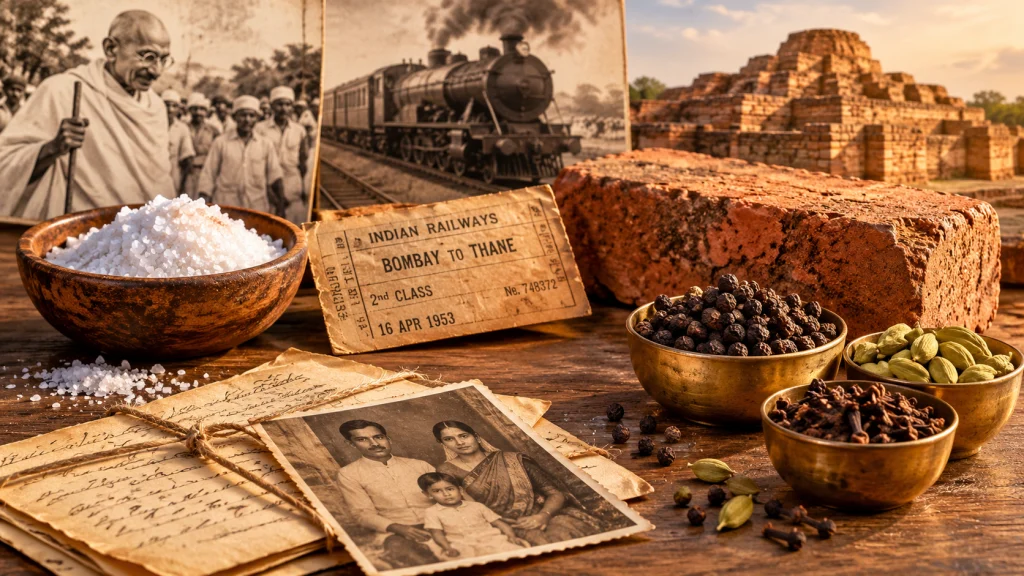
Every day, we pick up objects without a second thought. A steel tumbler, a house key, a bus ticket, a worn-out notebook. They seem too plain to matter. Yet history, and often the truth about how people really lived, hides in exactly such things. Big events get statues and textbook chapters, but daily life is usually kept alive in small, humble items. If we look closely, an ordinary thing can tell us who we were, what we feared and what we hoped for.
Take salt. It sits in every kitchen and is so common that we hardly notice it. But in 1930, it became one of the most powerful symbols in Indian history. The British government held a monopoly on salt and taxed it, even though every family, rich or poor, needed it to eat. On 12 March 1930, Mahatma Gandhi began a march from Sabarmati Ashram near Ahmedabad towards Dandi, a village on the Gujarat coast. The journey was about 385 kilometres, or roughly 240 miles. On 6 April, he picked up a lump of natural salt at the shore. A simple kitchen item had become a sign of protest, and the story of the Salt March spread across the country and beyond.
Now think of a railway ticket. Today most of us treat it as a small piece of paper or a message on a phone. But the railways changed how Indians lived. The first passenger train in India ran on 16 April 1853, from Bombay to Thane, a distance of about 34 kilometres. Since then, trains have carried students to colleges, workers to cities, soldiers to their posts and families to weddings. Behind every old ticket is a journey, and behind every journey is a reason: a job, a marriage, a goodbye, a new beginning. If you find an old ticket in a drawer, you are holding a tiny record of someone’s life.
Even a brick can speak. About 4,500 years ago, the people of the Indus Valley built cities such as Harappa and Mohenjo-daro. Archaeologists have found that these towns used baked bricks of fairly uniform sizes and had well-planned drains. A brick does not look exciting. But the care with which such bricks were made and laid suggests that these early city dwellers cared about order, cleanliness and planning. We do not know every detail of their lives, yet these ordinary building blocks give us a peek into a society that thought carefully about how to live together.
Spices offer another example. Black pepper from India’s Malabar coast was prized in distant lands for centuries. Traders crossed seas and faced long, risky journeys to bring it home. For us, pepper is just something we shake over food. But its story is one of trade routes, shared tastes and early links between faraway cultures. A simple seasoning shows that the world has been connected for much longer than we sometimes imagine.
Not all hidden stories belong to nations and empires. Many are small and personal. A grandmother’s recipe, written in uneven handwriting, tells you what her kitchen smelled like and what her family loved to eat. A faded photograph shows the clothes people wore and the way they stood in front of a camera. A bundle of old letters can reveal worries about money and hopes for children that never made it into any official record. These things sit in trunks, cupboards and shoeboxes. They are the real memory of a family, and once they are lost, the stories go with them.
So why do we miss these stories? Mostly, we are in a hurry. We look for big headlines and dramatic moments, and we forget that big events are made of small things. Every great change began in someone’s ordinary day: a farmer worried about the rain, a teacher walking to a village school, a shopkeeper counting coins at night. These people never expected to be remembered, yet their lives make up the real fabric of history.
Journalists and writers know this well. Some of the best stories come not from press conferences but from simple observations. The rising price of vegetables at a local market can say more about the economy than a long speech. A closed shop on a familiar street can show how a neighbourhood is changing. The skill lies in asking one more question: why is this here, and who has used it before me?
You do not need to be a historian to do this. Start with your own surroundings. Look at the old clock on the wall, the cracked cup that nobody wants to throw away, the street name you walk past every day. Ask an elder where it came from, and listen to the answer. You may be surprised by how much is waiting behind a simple reply.
The next time you hold an ordinary object, pause for a moment. It may be older than you think, and it may carry more than you expect. History is not only written in big books. Sometimes it is quietly sitting on your kitchen shelf, waiting for someone to notice.
Subscribe Deshwale on YouTube