









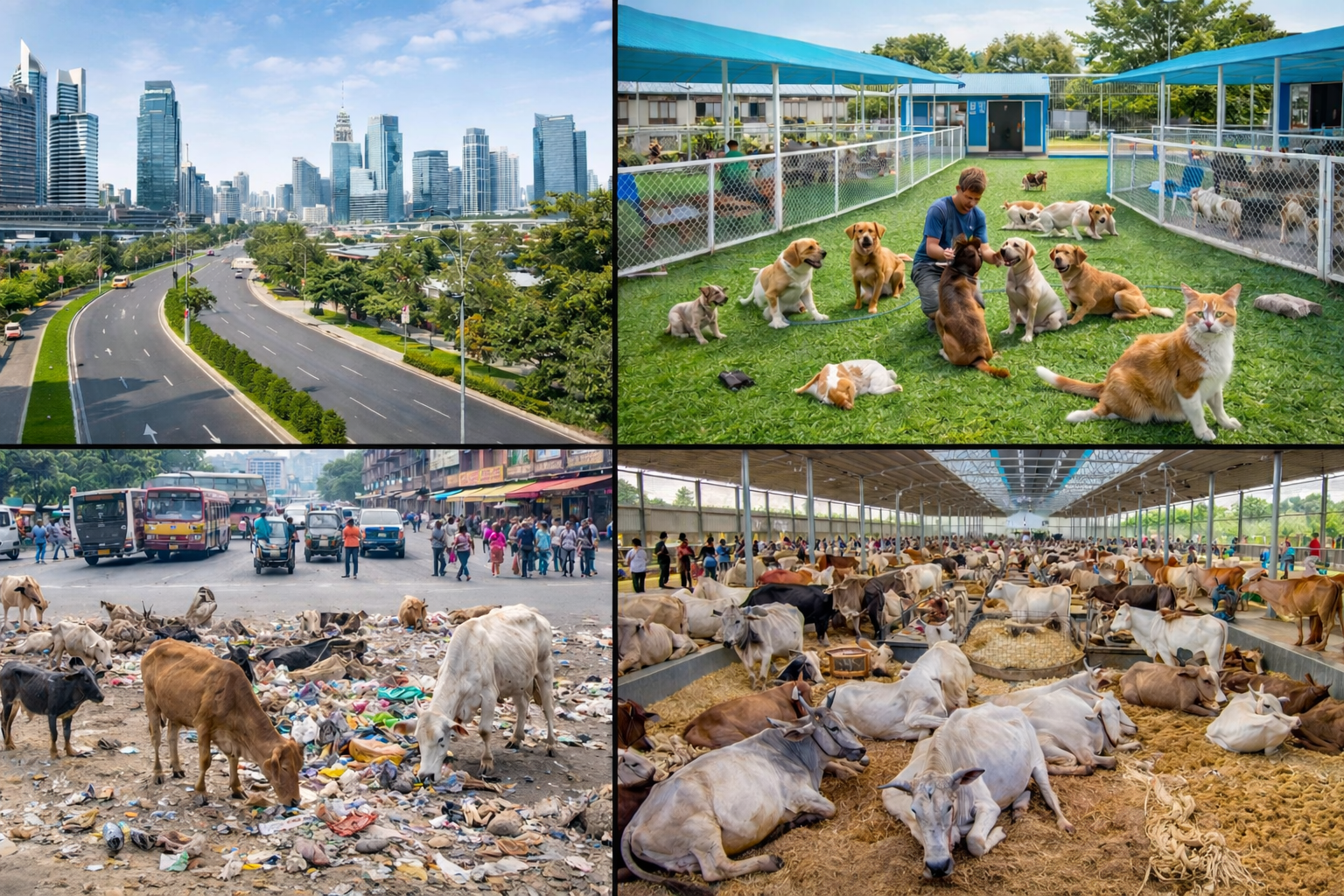
Stray dogs, stray cats and stray bovines roam many Indian streets. Some of these stray animals in India are abandoned by owners who no longer care for them. These animals leave excreta on streets and footpaths, inconveniencing pedestrians and reducing the aesthetic appeal of many cities. Stray animals also contribute to traffic hazards, as they wander on roads with parked vehicles, stalls and waste.
Many Indians have encountered stray dogs or cattle suddenly crossing roads. In such cases, drivers often brake unexpectedly or swerve. This causes accidents that injure both people and animals. According to the Ministry of Road Transport and Highways, over 97,000 animal-related road accidents occurred in India in 2022, leading to more than 14,000 fatalities and thousands of injuries. Animals on roads include dogs, cattle, goats and other livestock. These collisions remain a persistent safety concern.
Stray dogs in India are a serious issue. Recent figures estimate that India has millions of stray dogs nationwide, with Maharashtra alone reporting nearly 17 lakh stray dogs, including about 2 lakh in Nagpur city. This contributes to around 9.7 lakh dog bite incidents annually. Health officials warn of threats from rabies and other zoonotic diseases, especially among children.
In some cases, stray dogs cause severe injuries. In February 2026, a nine-year-old girl was critically mauled by a pack of stray dogs in Rajasthan, highlighting how vulnerable children and communities can be.
Stray cattle are also highly visible on India’s roads. The livestock census estimates more than 5 million stray cows and bulls wander public streets across the country. A police report from Chhattisgarh shows that 26,713 stray cattle were removed from roads and highways in one year in response to rising accidents and casualties. The same data also revealed that 404 people died and 129 were seriously injured in collisions with animals over five and a half years.
Urban local bodies have taken action. In Noida, authorities intensified cattle removal efforts after a bull injured a commuter. Officials impounded more than 125 stray cattle in December and 147 in January, imposing fines on confirmed owners. In Nagpur, more than 1,074 stray cattle were apprehended over two years, and over 500 unclaimed animals were relocated to shelters as part of a long-term project to build a world-class facility for livestock.
In Chennai’s Tambaram area, more than 600 stray cattle were impounded and fines were collected, though the city still lacks adequate shelter facilities. Plans are now underway to construct a permanent shelter to house impounded animals.
Public debate in India is often passionate and divided. One camp supports the existence of stray dogs and favours sterilisation and vaccination to control populations humanely. This view emphasises compassion and animal rights, even in crowded city spaces. Another camp argues that stray dogs should be eliminated from busy public areas, sterilised, vaccinated and relocated to professionally run shelters. Proponents also call for more world-class facilities for stray cattle, known as gaushalas, especially since many Indians regard cows as sacred. These world-class gaushalas could also serve as tourist centres, creating a sustainable ecosystem that benefits local communities. They could provide employment, generate income through tourism, and offer services linked to the bovine ecosystem, such as milk, dung-based products and veterinary care. Moreover, interacting with cows in these serene environments can support mental health and well-being, offering therapeutic benefits for people struggling with stress, anxiety, and other mental challenges.
India’s Supreme Court weighed in on the matter in late 2025 with major directives. The court ordered the removal of free-ranging dogs from schools, hospitals and other institutions, and instructed that stray cattle be cleared from highways to prevent fatal collisions. Local bodies were directed to capture, sterilise and shelter these animals and report progress to higher authorities.
However, there have been tensions between these groups, and even judicial interventions have been controversial. In New Delhi, the Supreme Court initially ordered the removal of all stray dogs to shelters, but later revised its position to focus on sterilisation, vaccination and community feeding zones while keeping only aggressive animals in enclosures.
Critics of large shelter-only approaches point to logistical and financial challenges. Building and managing enough shelters to house millions of stray animals in India would require substantial funds and professional staff. Some critics argue that sterilisation and vaccination programs, coupled with improved waste management and public education, may be more feasible than large-scale caging.
Supporters of improved animal housing say that well-run shelters could also become centres for education, tourism and employment. They argue that world-class gaushalas could provide dignified care for cattle and offer economic opportunities for local communities involved in their management.
Stray animals in India pose complex challenges that intersect public safety, animal welfare, culture and economics. The debate on how best to address these issues continues. What remains clear is that effective solutions will require careful planning, adequate funding and cooperation between authorities, animal welfare groups and the public.
Subscribe Deshwale on YouTube


