



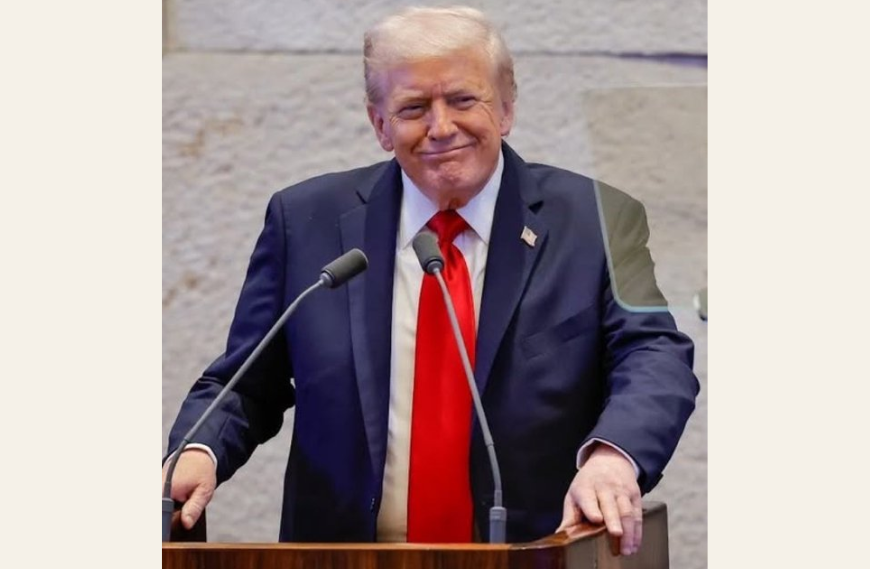
Former U.S. President Donald Trump recently lavished praise on India and its leadership during a global summit in Egypt, describing the country as “a great country with a very good friend of mine at the top.” Although he did not explicitly name Prime Minister Narendra Modi, the remarks were widely interpreted as a nod to him, reflecting the long-standing personal rapport between the two leaders.
The summit, convened in the aftermath of the Israel–Hamas ceasefire, saw Trump address an audience of world leaders with characteristic showmanship. He expressed optimism about India and Pakistan coexisting peacefully, stating, “I think India and Pakistan will live very nicely together.” His comments were accompanied by a nod toward Pakistan’s Prime Minister Shehbaz Sharif, who responded with a polite chuckle, highlighting the ceremonial nature of the exchange.
In addition to his praise for India, Trump complimented Pakistan’s leadership, referring to General Asim Munir, Pakistan’s army chief, as his “favourite field marshal.” Sharif, in turn, publicly acknowledged Trump’s role in promoting peace in the region, citing his “untiring and relentless efforts” and nominating him for the Nobel Peace Prize for his contribution to resolving hostilities between India and Pakistan.
Trump modestly waved off the nomination, claiming he had “resolved eight wars,” including the recent India–Pakistan confrontation. This assertion has been contested by Indian officials, who maintain that the ceasefire in May 2025 was the result of direct talks between the Directors General of Military Operations of both countries, without external mediation. The ceasefire followed a four-day exchange of drone and missile strikes, initiated by India’s Operation Sindoor, launched in response to a terror attack in Pahalgam that claimed 26 civilian lives.
While New Delhi has consistently dismissed claims of Trump’s mediation, his comments in Egypt have once again spotlighted his self-fashioned image as a global dealmaker. For South Asia, his remarks mix praise and provocation, reminding observers of his earlier efforts to position himself as a peacemaker between India and Pakistan.
Trump’s statements also underscore the complex dynamics of international diplomacy, where personal relationships and public declarations can influence perceptions, even if official accounts differ. By publicly highlighting India’s leadership and his personal ties to Modi, Trump appears to be both consolidating his legacy as a statesman and reminding the world of the influence he seeks to wield in global affairs.
As former leaders continue to shape narratives beyond their tenure, Trump’s words serve as a reminder of how individual diplomacy and media spectacle intersect, particularly in regions with longstanding geopolitical tensions.
