



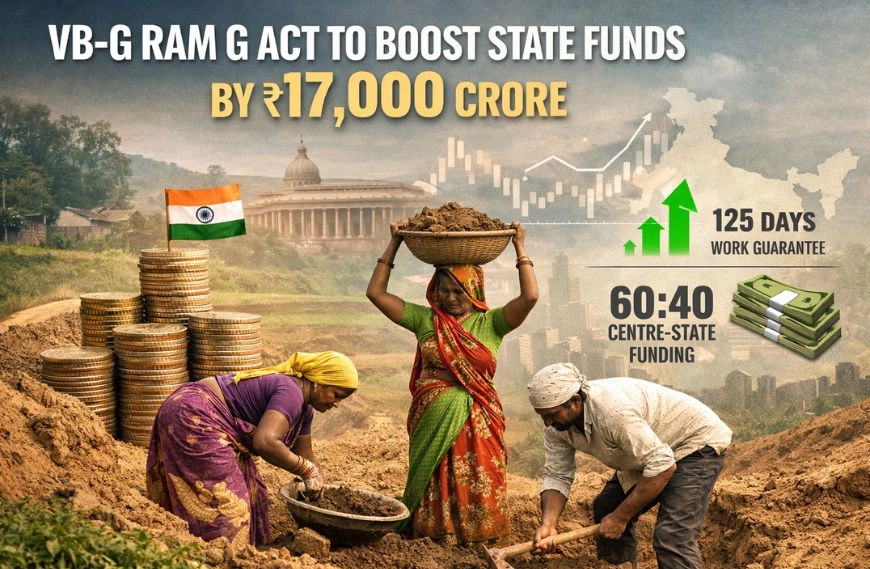
The recently enacted Viksit Bharat Guarantee for Rozgar and Ajeevika Mission (VB-G RAM G) Act is set to inject a substantial financial boost into India’s states, with projections indicating a collective gain of nearly Rs 17,000 crore. Analysts at the State Bank of India (SBI) suggest that despite concerns over revised funding ratios, most states are poised to remain net beneficiaries under the new framework.
Passed by Parliament during the winter session and receiving Presidential assent from Droupadi Murmu on December 21, the legislation guarantees 125 days of wage employment per rural household, an increase from the previous 100 days. The scheme targets adult members willing to undertake unskilled manual work, signalling an expansion of rural employment and livelihood support.
A key feature of the Act is the revised Centre–state funding ratio of 60:40, applicable to most states except the North-Eastern region, Union Territories, and Himalayan states. While critics have voiced apprehensions that this shift may strain state finances or compel additional borrowing, the SBI report indicates that these fears are largely unfounded. The analysis suggests that objective criteria and careful utilisation of the 40% state contribution can further enhance outcomes, particularly in states with robust administrative capacity.
Comparative data spanning fiscal years 2019–2025 (excluding FY21) indicates that, relative to allocations under the Mahatma Gandhi National Rural Employment Guarantee Act (MGNREGA), the new scheme represents a net gain for the majority of states. Only two states recorded minor losses, with Tamil Nadu’s apparent shortfall largely attributable to an anomalous FY24 allocation. Uttar Pradesh and Maharashtra are anticipated to benefit the most, followed by Bihar, Chhattisgarh, and Gujarat.
The VB-G RAM G Act’s design balances equity and efficiency, providing both developed and lagging states with opportunities to optimize fund distribution. Experts highlight that effective mobilisation of state contributions could magnify benefits while preserving fairness in resource allocation.
As India’s rural workforce navigates post-pandemic economic challenges, the enhanced wage guarantee under VB-G RAM G is expected to bolster income security and stimulate local economies. Policymakers and state administrations now face the task of translating legislative provisions into tangible outcomes for millions of rural households.
Subscribe Deshwale on YouTube
