











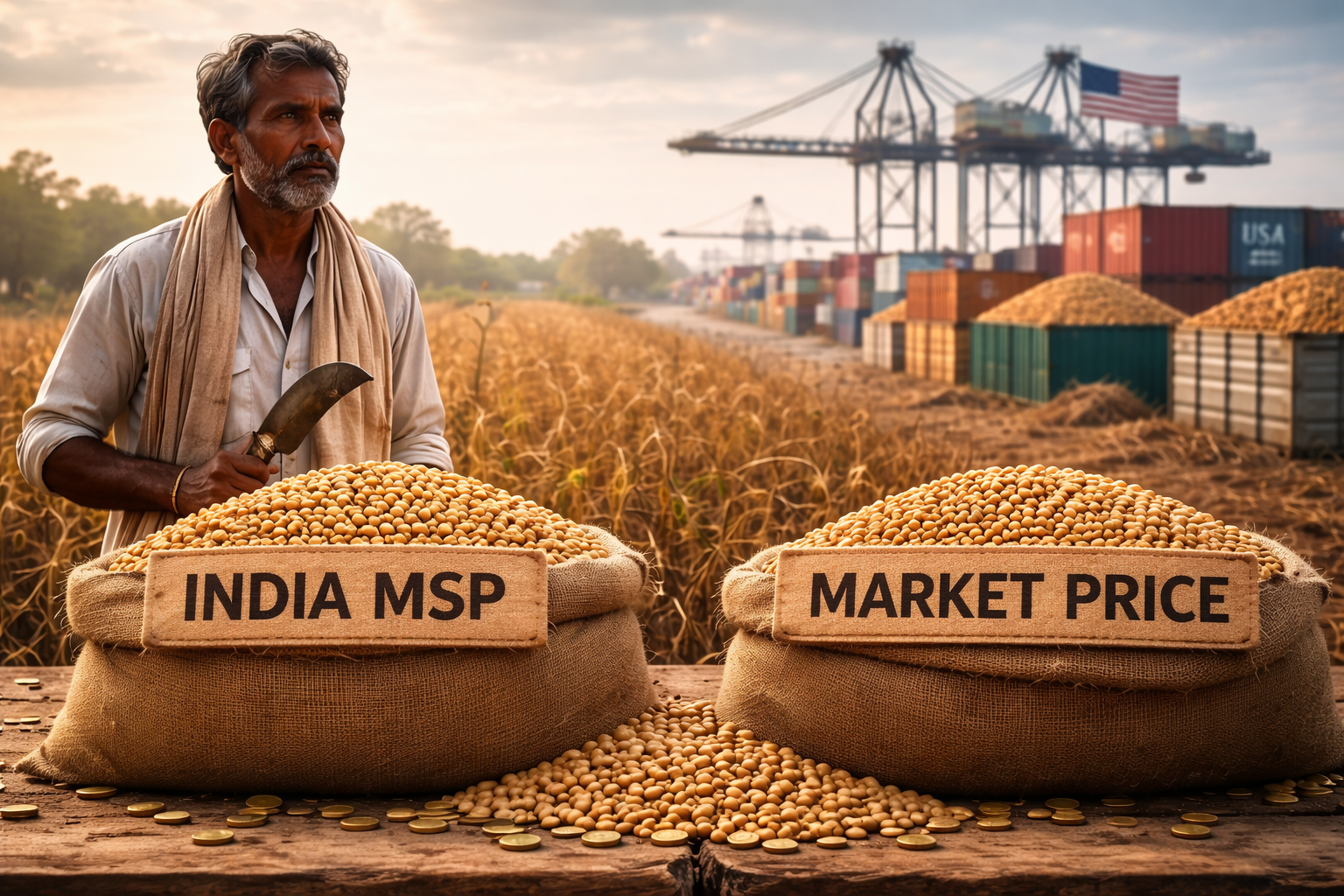
How a self-inflicted American agricultural crisis became India’s political problem, and why the humble soybean is the most honest measure of what the India-US trade deal actually costs
In October 2025, a farmer in Vidarbha sold his soybean harvest at Rs. 4,100 per quintal. The government’s Minimum Support Price was Rs. 5,328. The gap, Rs. 1,228 per quintal, was not a rounding error or a seasonal blip. It was the arithmetic of a broken promise, and it had been accumulating for years. Three states, Madhya Pradesh, Maharashtra and Rajasthan, together grow soybeans across 1.25 crore hectares, and in each of them, by October 2025, mandi prices trailed the MSP by between Rs. 1,000 and Rs. 1,500 per quintal. These farmers were already underwater when negotiators in New Delhi and Washington began talking about soybeans. The interim India-US trade framework announced on 7 February 2026 did not create their crisis. It arrived into one already in progress.
That context is what the trade deal’s cheerleaders on both sides of the Pacific have so far preferred to omit.
America’s Self-Made Shortage
To understand why Washington is pressing Delhi so insistently on agricultural market access, one must understand what Beijing did to Iowa. The United States harvests more soybeans by export value than any other crop, exceeding Rs. 2.05 lakh crore in 2024. China has historically absorbed more than half of that total, purchasing Rs. 1.06 lakh crore worth of American soybeans in 2024 alone, according to USDA figures. That concentration made the US soybean industry exquisitely, structurally vulnerable. When President Donald Trump’s second-term tariff escalation prompted Beijing to retaliate, China did not flinch: it simply stopped buying. From May 2025 through September, it purchased virtually no new-crop US soybeans and sourced replacements from Brazil and Argentina instead.
The numbers that followed were devastating. According to the American Farm Bureau Federation, US soybean exports to China from January through August 2025 totalled just 218 million bushels, down from 985 million bushels in the same period of 2024, a 78% collapse in volume. The USDA projects that total US agricultural exports to China in 2025 will reach only Rs. 1.43 lakh crore, a 30% drop from 2024 and the lowest since the previous trade war of 2018. US farm bankruptcies in 2025 surged approximately 50% above 2024 levels, according to Professor Chad Hart of Iowa State University. Caleb Ragland, president of the American Soybean Association, told the Senate Agriculture Committee that soybean farmers face losses of around Rs. 9,100 per acre in 2025, a figure that absorbs all margin and then some.
Brazil was the immediate beneficiary. As American supply backed up in storage and futures prices on the Chicago Board of Trade fell below production costs, Brazilian farmers, backed by Chinese infrastructure investment, accelerated their share of global soybean exports. USDA projections show Brazil produced 42% more soybeans than the US in the 2024-25 marketing year. To accomplish this at speed, Brazilian farmers razed Amazonian rainforest at pace. One country’s trade war produced another continent’s ecological wound.
This is the crisis Trump is attempting to offload. India, with 1.4 lakh crore consumers, a rapidly growing poultry industry and a structural dependence on imported edible oils, was always the logical destination for US agricultural redirection.
What the Deal Actually Says
The interim framework, announced jointly on 7 February 2026, commits India to eliminating or reducing tariffs on US soybean oil, dried distillers’ grains, red sorghum, tree nuts, and specified fresh and processed fruit, in exchange for Washington reducing its reciprocal tariff on Indian exports from 25% to 18%. India has pledged to purchase Rs. 41.9 lakh crore worth of US energy, technology and agricultural products over five years. The US will reduce the number, but not eliminate all, of its non-tariff objections. The Cato Institute noted pointedly that the EU, which signed its own India trade deal just days earlier, secured tariff elimination on 93% of Indian trade value, while the US framework’s real-world impact remains, in Cato’s words, “uncertain.”
Commerce Minister Piyush Goyal has drawn a careful line. Soybeans themselves are not included, he has said. Nor are maize, wheat, rice, dairy or poultry. Soybean oil is included, but India already imports record quantities of it, predominantly from Argentina and Brazil. In 2024-25, India imported 54.7 lakh tonnes of soybean oil, a historic high, with Argentina supplying 28.9 lakh tonnes and Brazil 11.4 lakh tonnes. The US was not a significant supplier before this deal, precisely because existing Indian duty rates of 27.5% on crude soybean oil and 36% on refined variants made American product uncompetitive.
The moment the framework was announced, Chicago Board of Trade soybean oil contracts surged 1.9% to their highest level since July 2025. The market understood something. If India shifts even a portion of its soybean oil procurement from South American to US origin, the trade advantage the deal creates is real, not theoretical.
The Soybean Bowl’s Complaint
The Alliance for Sustainable and Holistic Agriculture, known as ASHA-Kisan Swaraj, stated the position of farm groups in language that requires no translation: MSP for soybean is Rs. 5,328 per quintal; actual market prices in October 2025 averaged Rs. 3,942, nearly 26% below the floor. Government procurement has been, by its own figures, inadequate. “We question how the government plans to uphold its commitment to Minimum Support Price for Indian farmers,” the alliance said in a statement on the deal.
This is a sharper complaint than it first appears. The Shanta Kumar Committee estimated in 2015 that only 6% of Indian farmers benefit directly from MSP procurement, leaving the rest to sell into whatever the mandi will bear. Soybean growers in Madhya Pradesh and Maharashtra have operated in that unprotected majority for most of the past three years. When mandi prices dropped to Rs. 3,500 per quintal in September 2024, a full Rs. 1,800 below MSP, Madhya Pradesh reintroduced its Bhavantar Bhugtan Yojana, a compensatory scheme paying farmers the difference between MSP and their sale price. The scheme is a signal of how wide the gap has grown, not evidence that the gap has been closed.
The deeper risk the deal introduces is not in soybean grain imports, which remain protected, but in the competitive pressure DDGS places on soybean meal. In the US, DDGS is derived from genetically modified corn. Commerce Minister Goyal has addressed this by noting that “once a GM item is processed, the effects are no longer there.” FSSAI regulations require a non-GM origin certificate for food imports from 24 enumerated crops. Whether this regulatory standard survives trade pressure, or is reclassified as a non-tariff barrier in subsequent BTA negotiations, is the question farm unions are asking, and receiving no clear answer to.
India’s poultry industry, valued at approximately Rs. 2.5 lakh crore and growing at 8% annually, is the engine that drives soybean meal demand. If DDGS, now opening under a 5 lakh tonne quota as Goyal described, displaces even a fraction of that demand, soybean meal prices soften further. Farmers who are already selling below MSP absorb the compression.
The GM Frontier and Tomorrow’s Negotiating Table
Policy Circle, analysing the deal’s agricultural scope, stated the issue with precision: the real concern is not today’s concession list, it is the precedent. Tariff cuts on items that look harmless now create expectations of a broader opening later. The most sensitive categories, wheat, maize, dairy and poultry, where US productivity advantages are structural and in some cereals two to three times higher than India’s, remain protected in the interim framework. Whether they stay protected through the full Bilateral Trade Agreement, expected to be finalised after March 2026, is the live question.
Washington has listed India’s restrictions on genetically modified products among its principal non-tariff barrier complaints. Since more than 90% of US corn and soybeans are produced from genetically engineered varieties, according to the USDA Economic Research Service, the agricultural supply chain feeding DDGS is almost entirely GM-origin. Goyal’s regulatory assurance that processing neutralises GM status has no basis in FSSAI’s own import guidelines. Biotechnology experts at the Centre for Responsible AI and Environment have noted separately that traceability in bulk commodity supply chains, once mixing occurs at grain elevators, is effectively impossible to enforce at scale.
The comparison between the India-EU deal signed days before and the India-US framework is instructive. The EU eliminated tariffs on 96.6% of trade value; the US framework remains partial and legally unratified. The EU built in reciprocal agricultural carve-outs on its own soybeans, beef, sugar, rice and dairy. The US made no equivalent concessions. India’s negotiators appear to have yielded firmer commitments than they received in return, and farm groups pointing to that asymmetry are not wrong.
The farmer in Vidarbha who sold his soybeans at Rs. 4,100 per quintal did not structure his sowing decision around American trade policy. He planted based on the MSP the government declared and the rains that fell. What the India-US deal adds to his situation is not a resolution but a variable, one shaped by a crisis Washington created by weaponising a commodity its own farmers depend on, then sought to exit by finding buyers its diplomacy could reach. Whether India’s negotiators have adequately ring-fenced his livelihood from that exit strategy will not be known from a White House fact sheet. It will be known when the monsoon ends, the mandis open and the next crop arrives in a market that now operates under rules set partly in a city he has never been asked to visit.
Summary
- India’s soybean farmers in Madhya Pradesh, Maharashtra and Rajasthan were already selling their crop 26% below MSP in October 2025, with mandi prices averaging Rs. 3,942 per quintal against the declared support price of Rs. 5,328, before the India-US trade deal introduced any additional market pressure.
- The US soybean crisis is self-inflicted: Trump’s tariff escalation against China triggered a retaliatory boycott that collapsed US soybean exports to China by 78% in volume between January and August 2025, according to USDA data cited by the American Farm Bureau Federation.
- Brazil and Argentina are the structural beneficiaries of the US-China trade war; Brazil alone now produces 42% more soybeans than the US annually, cementing South America’s dominance in a market the US spent decades building.
- The India-US interim framework announced 7 February 2026 does not include soybeans, maize, wheat, rice, dairy or poultry directly, but opens soybean oil tariffs and a 5 lakh tonne DDGS quota, a corn ethanol byproduct that competes directly with Indian soybean meal in animal feed.
- India imported a record 54.7 lakh tonnes of soybean oil in 2024-25, almost entirely from Argentina and Brazil; the deal’s soybean oil concession creates a structural entry point for US supply, and Chicago futures markets responded immediately, rising 1.9% on announcement day.
- The Cato Institute’s comparison of the India-EU and India-US deals found the EU framework more comprehensive, covering 93% of trade value, with reciprocal agricultural carve-outs the US did not match.
- FSSAI regulations require a non-GM origin certificate for imports linked to 24 enumerated crops; since over 90% of US corn is genetically engineered and DDGS is derived from that supply chain, Goyal’s claim that processing neutralises GM-origin concerns contradicts the regulatory body’s own guidelines.
- The Shanta Kumar Committee estimated in 2015 that only 6% of Indian farmers benefit directly from MSP procurement; the remaining 94% sell into open markets that the deal will now make marginally more competitive for imported product.
- US farm bankruptcies rose approximately 50% in 2025 compared to the previous year, according to Iowa State University’s Professor Chad Hart, demonstrating that the crisis driving Washington’s market diversification push is acute, not hypothetical.
- The full Bilateral Trade Agreement, expected after March 2026, is where the real agricultural battles will occur; the interim framework’s inclusion of DDGS and soybean oil sets the precedent farm unions fear will be extended to wheat, maize and dairy in subsequent rounds.


