 Deshwale
What 26/11 Changed in India’s Security, and What Is Still Left to Do
In brief · AI summary On 26 November 2008, men from the Pakistan-based group Lashkar-e-Taiba attacked several sites in Mumbai over about 60 hours, and 166 people were killed. Afterwards, India created the National Investigation Agency, which began work in January 2009, and opened NSG regional hubs in Mumbai, Chennai, Hyderabad and Kolkata in mid-2009. The country also strengthened its coastal security, including 204 coastal police stations under the Coastal Security Scheme, though about 2.5 lakh boats under 20 metres still need tracking.
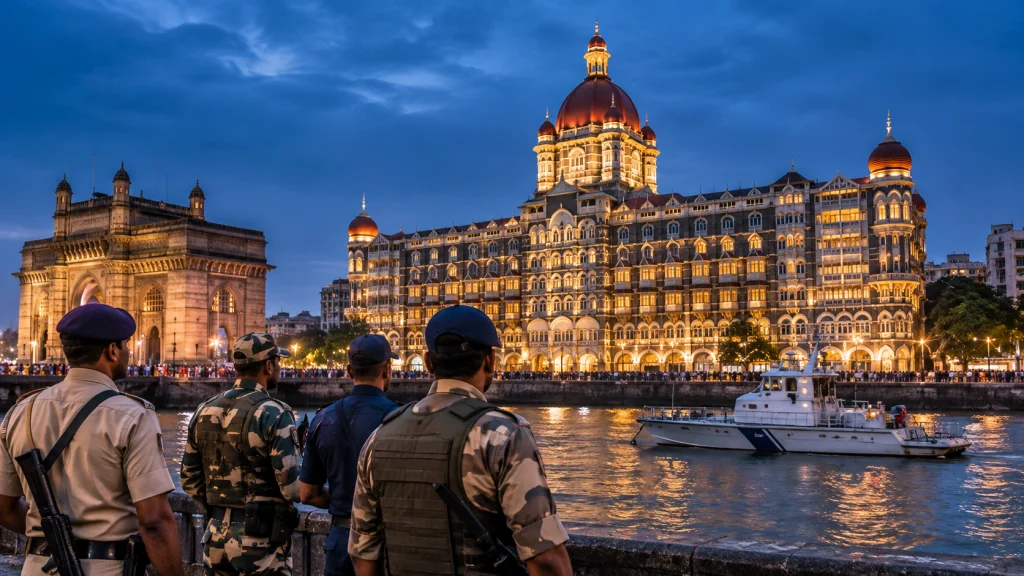
On the night of Wednesday, 26 November 2008, ten men came ashore in Mumbai after crossing the Arabian Sea. They belonged to the Pakistan-based group Lashkar-e-Taiba. They had hijacked an Indian fishing boat, the Kuber, and then switched to small inflatable boats to reach the city. Over the next 60 hours or so, they attacked the Chhatrapati Shivaji Terminus railway station, the Taj Mahal Palace hotel, the Oberoi Trident, Leopold Cafe, Nariman House and Cama Hospital. By the end, 166 people were dead. Nine of the attackers were killed, and one, Ajmal Kasab, was caught alive.
Many of the people who died that night were doing their job. Mumbai police officers Hemant Karkare, Ashok Kamte and Vijay Salaskar were killed. So was Tukaram Omble, an unarmed assistant sub-inspector who held on to Kasab’s rifle even as he was being shot, which is why Kasab was captured. Two commandos of the National Security Guard, Major Sandeep Unnikrishnan and Gajender Singh Bisht, also gave their lives. Eighteen years on, it is worth remembering that India’s security system today was shaped, in large part, by what these people paid for.
To understand what changed, you have to understand what went wrong. The attackers were not stopped at the sea, even though fishermen are said to have noticed the landing and told local police. Many police officers faced heavily armed attackers without the equipment to match them. The NSG, India’s elite commando force, was based near Delhi, and it took roughly nine to ten hours for the commandos to reach the city’s main sites under attack. Intelligence warnings existed, but a review later found it hard to turn them into coordinated action. The Maharashtra government’s Ram Pradhan committee said the attack was war-like and beyond the capacity of any ordinary police force, and it also criticised how the police leadership handled the night. The last attackers were finally killed at the Taj on 29 November, in an NSG operation called Black Tornado.
The first big change was legal and institutional. Before 26/11, a terror case that spread across state lines was a mess. Each state police force investigated its own piece, and the pieces did not always fit together. Parliament passed the National Investigation Agency Act on 17 and 18 December 2008, and the National Investigation Agency, the NIA, began work in January 2009. It is India’s central agency for terror cases, and it can take over an investigation from a state police force with the central government’s approval. An amendment in 2019 widened its reach to offences such as human trafficking and cyber terrorism, and to some offences committed outside India that affect Indian citizens. In the same week of December 2008, Parliament also amended the country’s main anti-terror law, the Unlawful Activities (Prevention) Act.
The second change was speed. India decided that commandos should not have to travel from far away. In mid-2009, the NSG opened regional hubs in Mumbai, Chennai, Hyderabad and Kolkata. Maharashtra built its own answer too. It created a state commando unit called Force One, which became operational in November 2009 with a first batch of 216 commandos. Other states set up special forces of their own.
The third change was about information. Investigators after 26/11 found that important clues had been sitting in different places, with different agencies, and nobody had put them side by side. The Multi Agency Centre, which lets intelligence agencies share information, was strengthened. A bigger idea was NATGRID, a system that lets approved agencies search many government databases at once. The Cabinet Committee on Security approved it in 2011, but it moved slowly. The Home Ministry told Parliament it went live at the end of 2020, although several accounts describe it as fully functional only in 2023 or 2024. It is now linked with the national crime records network, and since late 2025 with the National Population Register. Supporters say it saves precious time. Privacy concerns have followed the project from early on, and its makers say safeguards are in place.
The fourth change was the sea itself, because the attackers had arrived by water. The Navy was given the lead role in overall maritime security, with the Coast Guard watching India’s territorial waters and state marine police covering the near-shore. Under the Coastal Security Scheme, 204 coastal police stations have been set up, along with boats, jetties and check-posts. The Coast Guard’s chain of 46 coastal radar stations was approved in 2009, but it was not completed until December 2016, and 38 more stations were approved in 2018 to close the remaining gaps. The Coast Guard and marine police also patrol together. India now tests all this in a large exercise called Sea Vigil. The first one was held in January 2019, and the fifth edition ran from 11 to 19 November this year. It checks how well the Navy, Coast Guard, coastal police and customs work together, including against threats like hijacked fishing boats, port attacks and drones.
Fishermen, who see the sea more than anyone, were pulled into the system as well. Most fishermen have been given biometric identity cards, and boats are being registered. Larger vessels, those over 20 metres, must carry a tracking device. The harder part is the smaller boats. About 2.5 lakh boats under 20 metres still need tracking. A pilot with ISRO-made transponders began in Tamil Nadu, and in 2023 the Centre announced a plan to supply 3.5 lakh free transponders, with one lakh going to small boats in the first phase. According to a more recent reply in Parliament, about 45,000 transponders had been installed so far. That is progress, but it is still a fraction of the fleet, and it remains one of the open questions of India’s coastline.
Then there is the question of justice. Kasab was tried, convicted and hanged at Yerwada jail in Pune on 21 November 2012. David Headley, an American who scouted targets in Mumbai for the plotters, was sentenced to 35 years in prison in the United States in 2013. Another accused, Tahawwur Rana, was extradited from the United States to India on 10 April 2025. His case is being heard in a special NIA court in Delhi. It is still at the stage of arguments on the framing of charges, and the next hearing is set for 18 December. In Pakistan, seven men were charged in 2009, but the trial has crawled along for years. Zaki-ur-Rehman Lakhvi, named as a mastermind, was released on bail in 2015, and he was arrested again in January 2021 on separate terror-financing charges. India says the people who planned the attack from across the border have still not faced full accountability, and that is a wound that has not healed for the families.
So, 18 years later, is the job done? Honestly, no, and the clearest reason is that connecting information is still hard. In November 2025, a car bomb exploded near the Red Fort in Delhi and killed at least 13 people. Hours earlier, police had uncovered a suspected terror network and seized about 2,900 kg of explosives in Faridabad. The blast came as that network was being broken up. Some critics argue that the pieces were not joined fast enough, which is exactly the lesson 26/11 was supposed to teach. Others point out that the same agencies did uncover the network, and that stopping every plot is impossible. Both things can be true.
People are another gap. Having an agency on paper is not the same as having enough trained officers. In July 2025, the Minister of State for Home Affairs told the Lok Sabha that 541 of the NIA’s 1,901 sanctioned posts were vacant as of 30 June 2025, which is about 28 per cent.
Threats keep changing, too. Terror groups now use encrypted apps, online recruitment and digital money transfers, which are far harder to track than a boat crossing the sea. At sea, drones and unmanned vessels are a new worry, and many small boats without trackers remain hard to follow. Some analysts also say India still lacks a single long-term counter-terror plan, and that the country tends to tighten security in a hurry after a major attack and relax once the memory fades.
Perhaps the most honest way to put it is this. A country can add agencies, buy equipment and hold drills, and all of that is important. But security is not something you finish building. It is something people do every day: a police officer who passes on a tip, an analyst who spots a pattern, a fisherman who reports a strange boat. 26/11 taught India that the gaps between its agencies could be as dangerous as any weapon. Eighteen years later, some of those gaps have been narrowed. The test is whether the rest are closed before the next time they are needed.
Subscribe Deshwale on YouTube