 Deshwale
What Will Your Phone Tell Historians About You in 500 Years?
In brief · AI summary Phones hold far more detail about ordinary daily life than people in past centuries left behind, and historians would find this everyday evidence honest, though not everything on a phone is true. Digital files can still vanish because they depend on electricity, companies, software and passwords, while a clay tablet written about 3,700 years ago has survived. The article suggests saving important memories in more than one place, such as printed photos and handwritten letters.
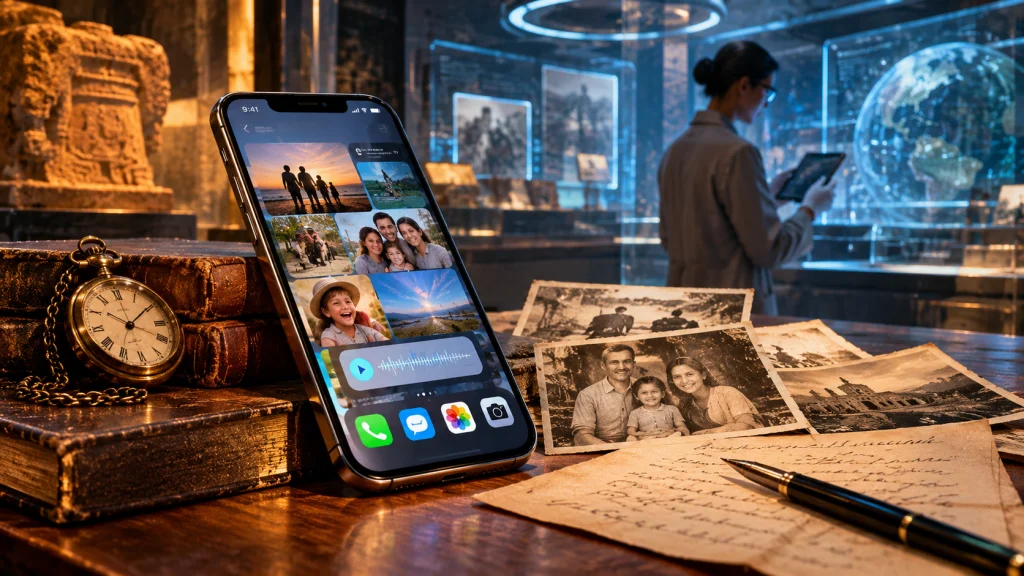
Pick up your phone and scroll for a minute. A photo of yesterday’s lunch. A screenshot of a recipe you will never cook. Forty unread messages. A voice note from your mother. Now imagine a stranger in the year 2526 holding a copy of everything inside it. What would they think of you? They would probably laugh at the lunch photo, wonder why you kept the recipe, and then stop at the voice note, because that is the one thing on the phone that sounds like a real person.
For most of history, ordinary people left almost nothing behind. Kings built monuments and wrote their own stories, while farmers, potters and traders vanished from the record. Historians had to piece together daily life from scraps, such as a broken pot, a tax receipt or a line in someone else’s diary. Our age is different. Never before have so many people recorded so much of their own lives, often without even meaning to. A single phone holds more detail about one person’s day than a whole town’s records held a few centuries ago.
Think about what your phone knows. It knows when you wake up, where you go and how many steps you walk. It knows the songs you play at midnight and the questions you are too shy to ask a friend. It knows which photo you took ten times to get the perfect smile, and which ones you deleted in a hurry. A historian in 500 years would not have to guess what an ordinary morning looked like. They could watch it: the alarm snoozed twice, the first look at the screen before even saying good morning, the arguments in the family group chat.
Here is the interesting part. Historians trust ordinary evidence more than grand speeches, because ordinary evidence is honest. A king’s speech tells you what he wanted people to believe, but a shopping list tells you what he actually ate. Your phone is full of shopping lists in this sense. Your search history would show your real worries, like a health scare, a job you feared losing, or a question about money at two in the morning. Your gallery would show who you love, because we photograph what matters to us. The number of pictures of a child, a parent or a friend would say more about your values than any speech you ever gave.
They would also catch our contradictions, and they might smile at them the way we smile at the odd habits of people from the past. We say family comes first, yet we sit in the same room as our family and look at our screens. We say we want peace, yet we spend hours reading angry arguments between strangers. We say we are too busy, yet we find forty minutes to scroll through videos we will not remember. A future historian might call us the most connected and the most distracted generation in history, and they might not be entirely wrong.
But not everything on our phones is true, and a careful historian would know it. There are edited photos, filtered faces, forwarded messages that no one checked, and jokes and exaggerations. Many of us show only the best version of ourselves online, with the holiday pictures and happy announcements, and hide the dull days and the bad ones. Just as we read old letters and ask who wrote them and why, they would ask why a photo was posted and who it was meant for. They might conclude that people of our time were performing for each other almost all the time. They might also notice how a single false message could race across a country in hours, while the correction crawled behind it. That may be one of the most important lessons about our age: information moved faster than the truth.
Now comes a twist most of us do not expect. Despite recording so much, we may leave behind less than people did long ago. Consider the clay tablets of ancient Mesopotamia. Thousands of years old, many of them can still be read today. One famous tablet is an angry complaint from a customer to a trader named Ea-nasir about poor-quality copper, written about 3,700 years ago. A complaint about bad service survived nearly four thousand years in the dust. Meanwhile, think of the last phone you owned. Where are its photos now? Many of us have lost pictures to a broken screen, a forgotten password or a memory card that no computer will open. Websites vanish and old links lead nowhere. Experts sometimes call this risk a “digital dark age”, a time when we leave strangely little behind because technology keeps changing and old files become unreadable.
The reason is simple. A clay tablet only needs to sit quietly somewhere. A photo in the cloud needs electricity, a company to keep its servers running, software that can open the file and a password someone remembers. If any one link in that chain breaks, the memory goes with it. This is why a printed photograph in a shoebox, a handwritten letter or a recipe in a worn notebook might outlive your phone by centuries. They do not need an update or a charger. They only need someone to keep them safe. If something truly matters to you, it is worth saving in more than one place. Print your best photos. Write down the story your grandmother tells, in her own words. Keep a few real letters.
So perhaps the best use of this question is to turn it around. If you knew someone would one day read your phone, what would you want them to find? Most of us would not choose the perfect poses. We would want them to find the blurry photo of the family laughing at the dinner table, or a message in which we said “I’m proud of you” or “I’m sorry” and meant it. We would want to be remembered as kind, curious people who tried to do well by others. We cannot control what survives, but we can choose what to make. Every message we send and every photo we take is a small piece of evidence about who we are. Most of it will fade. A little of it might last.
So the next time you pick up your phone, pause for a moment. Someone, somewhere, in a future we cannot imagine, may be curious about people like us. If you could leave them just one photo or one message, what would it be? Tell us in the comments.