








By: Pratyush Bardoliwala
At least once in your lifetime, you may have felt the hair on your body suddenly stand up. Maybe it happened in the cold, during a scary moment, or even while listening to a powerful song. But why does this happen? The answer lies in a fascinating scientific phenomenon known as goosebumps.
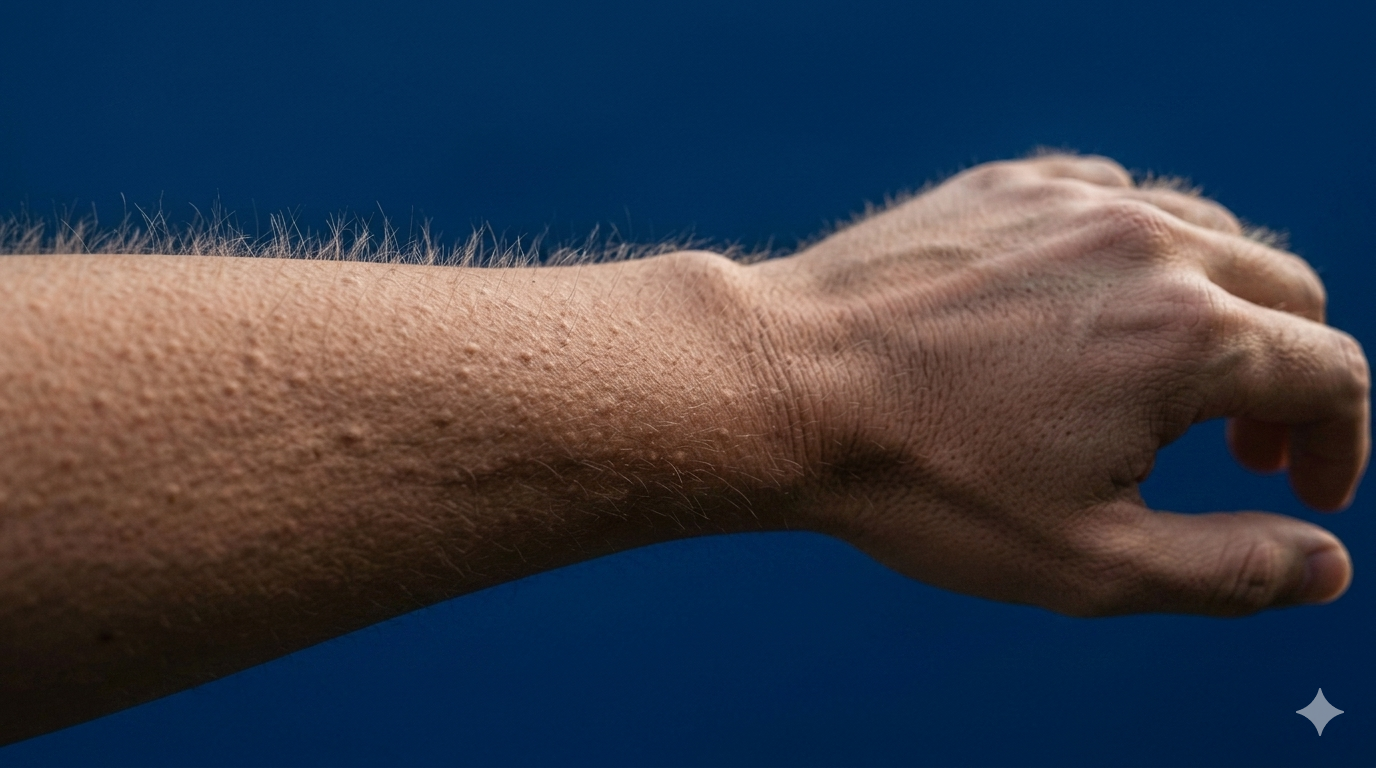
Goosebumps are a physical reaction triggered by cold, fear, excitement, stress and strong emotions. When this happens, tiny muscles attached to our hair follicles contract, making the hairs on our skin stand upright and creating the small bumps we see. This reaction is controlled by the autonomic nervous system, which manages many functions we do not consciously control. But why does our body have this reaction in the first place? The answer goes back to our evolutionary past.
For our ancestors, goosebumps may have served an important survival purpose. When body hair stands upright, it can trap a thin layer of air close to the skin, helping reduce heat loss in cold conditions. The same response can also make an animal’s fur appear thicker, which can make it look larger when facing a threat.
This response is still present in humans, although its practical benefits are much smaller today. Our bodies have far less hair than those of many mammals, so goosebumps do little to keep us warm or protect us from danger. Instead, they are largely considered a leftover of an ancient survival mechanism.
Humans are also not the only animals that experience this reaction. Many mammals can experience piloerection, the scientific term for hairs standing upright. Cats, dogs and other furry animals can raise their fur when they are frightened, threatened, excited or cold. A frightened cat, for example, may puff up its fur to appear larger and more intimidating to a potential threat.
Interestingly, goosebumps are not always linked to fear or cold. Strong emotions can trigger the same response. This is why some people get goosebumps while listening to powerful music, watching an emotional scene or experiencing a moment of awe. These experiences can activate the sympathetic nervous system, producing physical reactions such as changes in heart rate, breathing and skin sensation.
The name goosebumps itself comes from their resemblance to the skin of a plucked goose. The small raised bumps appear around individual hair follicles, giving the skin a texture similar to that of a goose after its feathers have been removed. The scientific term for the condition is cutis anserina, which literally refers to goose-like skin.
Goosebumps can also appear more noticeably on certain parts of the body, including the arms and legs. The response does not necessarily mean that something is wrong with the body. In most cases, it is simply an involuntary reaction to a physical or emotional stimulus and usually disappears once the trigger passes.
So, the next time the tiny hairs on your skin suddenly stand up, remember that your body is not doing something random. It is carrying out an ancient biological response that has remained with humans through evolution. What may seem like a strange reaction today is actually a small reminder of how closely our bodies are connected to our evolutionary past.
Subscribe Deshwale on YouTube


