



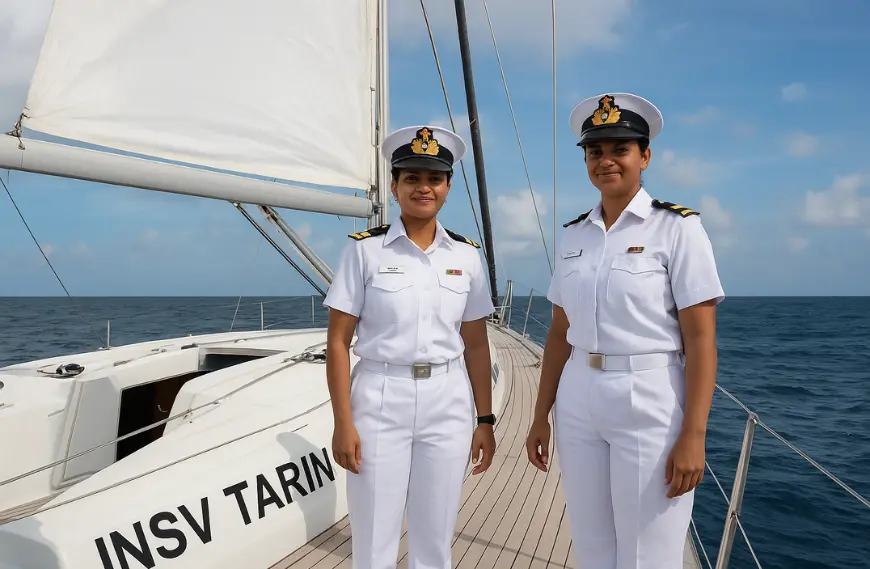
In a remarkable stride towards gender inclusivity, the Indian Navy marked a historic moment when two officers, Lieutenant Commanders Roopa A and Dilna K, successfully completed the Navika Sagar Parikrama II a circumnavigation of the globe aboard INSV Tarini. Their achievement is more than a maritime milestone; it reflects India’s evolving approach towards empowering women in the armed forces and breaking stereotypes in one of the most demanding professions.
The Expedition
The voyage began on October 2, 2024, from INS Mandovi, Goa, when the duo set sail on the 56-foot sailing vessel INSV Tarini. The mission lasted eight months, covering nearly 50,000 km across four continents, three oceans, and the three iconic Great Capes Cape Leeuwin, Cape Horn, and Cape of Good Hope.
Powered only by wind, the officers braved unpredictable weather, towering waves, and long stretches of isolation, relying solely on their skill, discipline, and teamwork. Their safe return on May 29, 2025, was celebrated as a proud chapter in India’s maritime history.
Training and Preparation
The journey was not undertaken lightly. Both officers went through two years of intensive training, which included endurance sailing, survival drills, mechanical handling, and mental conditioning. They participated in short and long-duration expeditions to familiarise themselves with real-time challenges of the sea from repairing equipment mid-ocean to navigating through storms.
Mentored by senior naval sailors and veterans of earlier circumnavigation missions, Roopa and Dilna prepared themselves for the physical demands and psychological pressures of extended ocean voyages. This rigorous preparation ensured they were not just participants, but confident leaders of their mission.
Significance and Impact
The Navika Sagar Parikrama II is more than a voyage; it is a symbol of change. For decades, the Navy was perceived as a male-dominated domain, but missions like these signal a cultural transformation. It highlights the Navy’s willingness to trust women with leadership in extreme conditions, reflecting an institutional commitment to equality.
For young women across India, this achievement sends a powerful message: careers in defence and adventure are no longer limited by gender. It inspires the next generation to pursue dreams in fields traditionally closed to them, proving that resilience and competence matter more than stereotypes.
The successful global circumnavigation by Lieutenant Commanders Roopa A and Dilna K stands as a testament to courage, discipline, and perseverance. It not only strengthens India’s reputation in the maritime world but also cements the role of women as pioneers of progress within the armed forces.
As the Indian Navy continues to encourage inclusivity and representation, this achievement will remain a shining example of how barriers can be broken at sea and beyond.
