



India’s shift from democracy to ‘Emocracy’ is weakening governance and economic stability, says Vice-President Jagdeep Dhankhar.
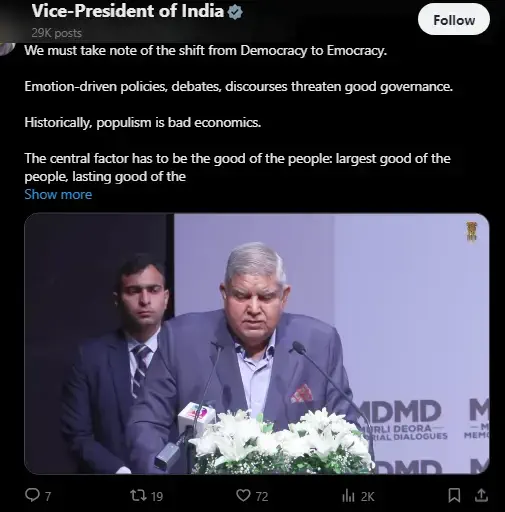
Vice-President Jagdeep Dhankhar has raised concerns over India’s governance being driven more by emotions than rational policymaking. Speaking at the inaugural Murli Deora Memorial Dialogues in Mumbai, he warned that the country is moving towards an ‘Emocracy’, where electoral compulsions and populist policies overshadow long-term economic and developmental goals.
Populism vs. Good Governance
Dhankhar cautioned that excessive electoral promises create financial stress, limiting the state’s ability to invest in essential infrastructure and economic growth. He emphasised that over-reliance on populist schemes could lead to an unsustainable economic model, harming the country’s overall progress.
Rising Appeasement Politics
The Vice-President also criticised the increasing trend of appeasement politics, highlighting that it has spread across the political spectrum. He noted that while elections are central to democracy, policymaking should not be dictated by short-term political gains at the cost of national development.
Affirmative Action vs. Appeasement
Clarifying his stance, Dhankhar differentiated between affirmative action for the marginalised and politically motivated appeasement. He reiterated that constitutionally mandated support for Scheduled Castes, Scheduled Tribes, and economically weaker sections is crucial for inclusive growth. However, he warned that indiscriminate appeasement policies could distort governance priorities.
Illegal Migration: A Growing Concern
Dhankhar also highlighted the burden of illegal migration, particularly its strain on public services and employment opportunities. He expressed concerns over the growing electoral influence of illegal migrants, stating that such demographic shifts could undermine India’s democratic framework.
Call for a National Debate
Concluding his address, the Vice-President called for a national debate to tackle these pressing issues. He urged political leaders to prioritise long-term national interests over short-term electoral gains, advocating for governance driven by rational policies rather than emotional populism.
