



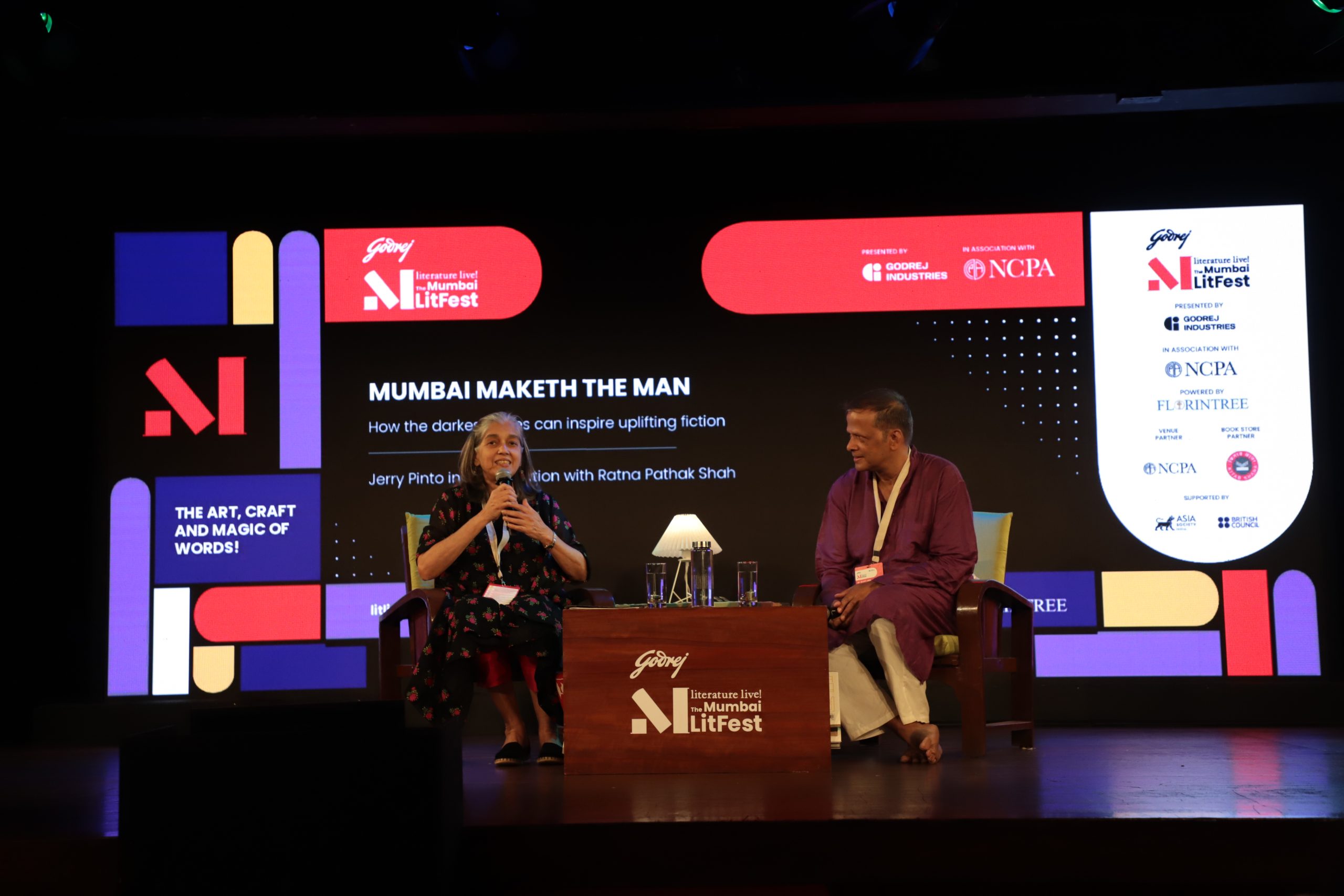
The power of literature to confront difficult histories, explore human emotions and find hope amid darkness took centre stage on the opening day of Godrej Literature Live! The Mumbai LitFest 2026 at the National Centre for Performing Arts (NCPA). Author Jerry Pinto and actor Ratna Pathak Shah came together for a session titled Mumbai Maketh The Man, discussing Pinto’s book Yuri And The City, the sequel to The Education of Yuri.
Set against the turbulent backdrop of the 1992 Babri Masjid demolition and its aftermath, Yuri And The City explores the complexities of family, friendship and life in Mumbai during a period of deep social unrest. The conversation examined how fiction can address painful realities while offering readers an opportunity to reflect on society, memory and the possibility of change.
Writing About Darkness With Hope
Reflecting on why writers choose to engage with difficult subjects, Pinto suggested that despair in literature does not necessarily mean an absence of hope. Instead, confronting uncomfortable truths can be a way of encouraging people to recognise problems and work towards change.
“No writer, however despairing, gives up hope,” Pinto said. He explained that when anger, darkness and despair appear in writing, they often come from a belief that discussing these realities might encourage people to act and move away from darkness.
His observations highlighted the role of literature beyond storytelling. By bringing difficult experiences into public discussion, writers can create space for readers to question existing realities and consider different perspectives.
There Is No Single Experience of Riots
The discussion also touched upon the 1992-93 riots and the difficulty of representing communal violence through fiction. Pinto emphasised that the experiences of people affected by the riots cannot be reduced to a single Hindu, Muslim or Christian perspective.
“It is not possible to talk about the Muslim experience or the Hindu experience of the riots, even the Christian experience of the riots, because there is no single experience,” he said.
According to Pinto, fear is deeply personal, shaped by individual circumstances and experienced differently by different people. His remarks underlined the importance of approaching stories about communal violence with sensitivity, recognising that even people living through the same event may carry very different memories of it.
The Challenge of Showing Uncomfortable Truths
Shah reflected on the reluctance to represent disturbing realities in art, particularly on stage. She observed that while painful events frequently occur in real life, their direct representation in theatre is often avoided.
“Real things happen, unhappily, offstage. But on stage, the event itself is rarely shown,” she said, pointing to what she described as a natural discomfort with representing the uncomfortable in art.
Her observation raised questions about how artists balance the responsibility to portray reality with the audience’s willingness to engage with difficult subjects.
Why Are Young People Borrowing Nostalgia?
The conversation also explored the growing nostalgia among younger generations for periods they never personally experienced. Shah suggested that nostalgia can offer an imagined refuge when the present makes it difficult to believe in a better future.
“At least we could buy into that lovely little dream world at that time. Now buying into any kind of dream is so hard. So you’re borrowing nostalgia,” she said.
The exchange brought together questions of history, memory and hope, highlighting how literature and performance can help audiences revisit the past while making sense of the present.
Subscribe Deshwale on YouTube
