



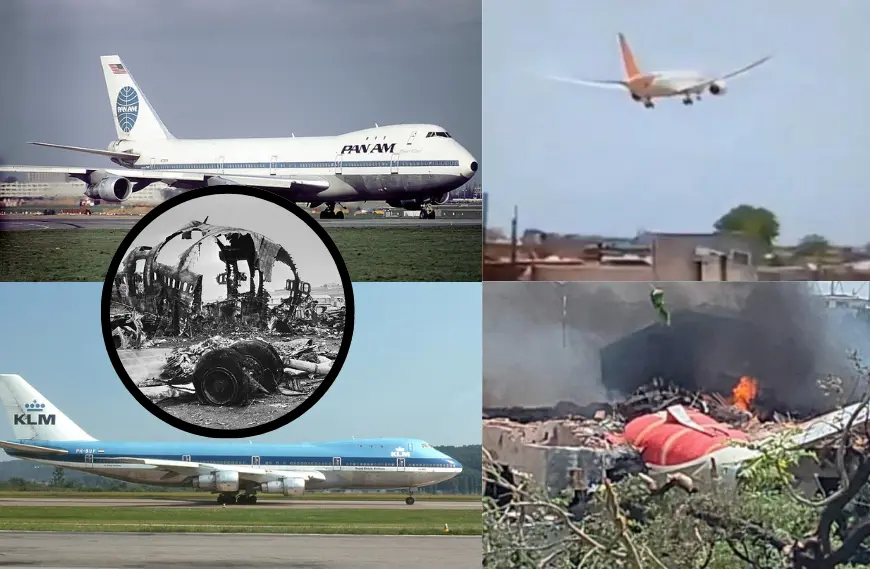
The sky has long symbolised our ambition to rise, to connect, to explore. But when it turns into a graveyard, it doesn’t just kill its scars. Plane crashes leave behind not just wreckage, but pain, questions, and the duty to prevent it from happening again
The Sky Is Not Always Safe: A Global and Local Wake-Up Call
The 1977 Tenerife crash, with 583 lives lost, remains the deadliest aviation disaster in history, largely due to human error.The 2025 Ahmedabad crash, claiming 241 lives, is India’s most tragic air accident in decades, with its cause still under investigation. Both events underline urgent lessons about global and Indian aviation safety.
The most harrowing events in aviation history: The 1977 Tenerife disaster, the world’s deadliest air crash, and the 2025 Ahmedabad tragedy, the worst in modern Indian aviation. These two moments, nearly 50 years apart, mirror each other in scary ways reminding us that even today, one small error can change hundreds of lives forever.
The 1977 Tenerife Disaster: The Day the Skies Fell Silent
On 27 March 1977, the island of Tenerife in Spain’s Canary Islands witnessed an unimaginable catastrophe. Due to a terrorist threat at nearby Gran Canaria airport, multiple planes were diverted to the smaller Los Rodeos Airport, leading to overcrowding. Thick fog blanketed the runway. Communication between pilots and air traffic control was garbled and rushed. Amid this chaos, a KLM Boeing 747 began takeoff without clear approval. Ahead of it, a Pan Am Boeing 747 was still taxiing on the same runway. The two giants collided at full speed.
The result was devastating. Fire engulfed both planes. 583 people died, making it the deadliest aviation accident in history. Only 61 passengers, all from the Pan Am flight – survived.
Investigators concluded that human error, poor visibility, and communication breakdowns were the key causes. This crash forever changed aviation. It led to global reforms, like the use of standardised English phrases in radio communication and stronger crew coordination practices, known as Crew Resource Management.
Tenerife became a textbook case of what can go wrong, and how to make it right again.
The 2025 Ahmedabad Crash: A Modern Tragedy That Hits Home
Fast forward to 12 June 2025, and the echoes of Tenerife are heard in Ahmedabad, India. Air India Flight AI-171, a Boeing 787 Dreamliner, took off from Sardar Vallabhbhai Patel International Airport, bound for London Gatwick. But within minutes, the aircraft lost control and crashed into a crowded residential area in Meghaninagar, striking a doctors’ hostel at BJ Medical College.
It was a scary sight. Smoke filled the air, everything was broken, and the whole city was in shock.
Of the 242 people on board, 241 were killed, including former Gujarat Chief Minister Vijay Rupani. Only one person survived, a British national of Indian origin, Vishwaskumar Ramesh, thrown from the plane through an emergency exit. The final death toll rose to over 260, after adding the lives lost on the ground.
India hadn’t seen a disaster of this scale since the 1996 Charkhi Dadri mid-air collision.The nation mourned. Prime Minister Narendra Modi visited the site and the lone survivor, vowing answers and reforms. Experts pointed to possible mechanical failure or pilot error, especially since the landing gear was reportedly still down during ascent. The black box is now under investigation by India’s Aircraft Accident Investigation Bureau. But no answer can undo the loss.
Tenerife and Ahmedabad: Two Tragedies, One Common Thread
What links Tenerife and Ahmedabad is not just the scale of death but the fragility of aviation systems in the face of pressure, fog, human fatigue, or infrastructure strain.
Both crashes happened during takeoff, a highly vulnerable phase of flight. Tenerife’s fog and rushed communication. Ahmedabad’s urban sprawl and rapid climb. The result is both: devastation.
The 2025 crash is not just another global headline. It’s personal. It’s Indian. Renjitha, a health worker heading to a family function in London, was one of the many who never made it. Families had their hopes, dreams, and futures ripped away.
It also reminded people of the 1988 Indian Airlines crash in the same city, where a Boeing 737 hit a residential area, killing 133. Then, as now, airports too close to crowded neighbourhoods proved fatal.
India’s Aviation Boom: Growth at What Cost?
India is one of the fastest-growing air travel markets in the world, handling over 15 crores passengers every year. But with growth comes cracks in the system, aging airports, overstretched air traffic controllers, and inadequate safety audits.
Ahmedabad airport, like many others in India, is surrounded by densely populated zones. That’s a disaster waiting to happen. While Europe and the US have restructured air corridors and moved airports away from cities, India lags behind.
Ahmedabad’s tragedy is a wake-up call.
Just as Tenerife forced the world to change, Ahmedabad must push India to upgrade aviation infrastructure, enforce stricter safety norms, and build resilience into the system.
Side-by-Side: A Comparison of Two Disasters
| Aspect | Tenerife (1977) | Ahmedabad (2025) |
| Date | 27 March 1977 | 12 June 2025 |
| Location | Los Rodeos Airport, Tenerife, Spain | Sardar Vallabhbhai Patel Airport, India |
| Aircraft | Two Boeing 747s (KLM and Pan Am) | One Boeing 787 Dreamliner (Air India) |
| Fatalities | 583 | 241 onboard, 260+ including ground victims |
| Cause | Miscommunication, fog, human error | Suspected mechanical/pilot error – ongoing |
| Survivors | 61 (from Pan Am) | 1 (Vishwaskumar Ramesh) |
| Outcome | Global communication and safety reforms | Potential trigger for Indian aviation reform |
A Final Reflection: Mourning With Purpose
The sky still calls to us. Planes still take off. But behind every ticket booked is a silent hope, that safety is never compromised. That families will reach, not grieve. Those mistakes won’t be repeated.
The stories of Tenerife and Ahmedabad are painful, but they offer something invaluable: clarity.
Tenerife taught the world to listen, to communicate better, to never underestimate the danger of rushed decisions. Ahmedabad urges India to modernise, to build with foresight, not just speed. If Tenerife reformed the world, Ahmedabad can reform India.
And in that hope, the grief becomes fuel. To protect every future flight. To ensure no family watches the news in terror, wondering if their loved ones were on board. To remind us all that ambition must always fly hand-in-hand with responsibility.
Let us mourn with dignity. But more importantly, let us learn.
Because the sky, while full of dreams, should never again fall silent like this.
Also Read: The Plane That Disappeared and Left the World Guessing
