



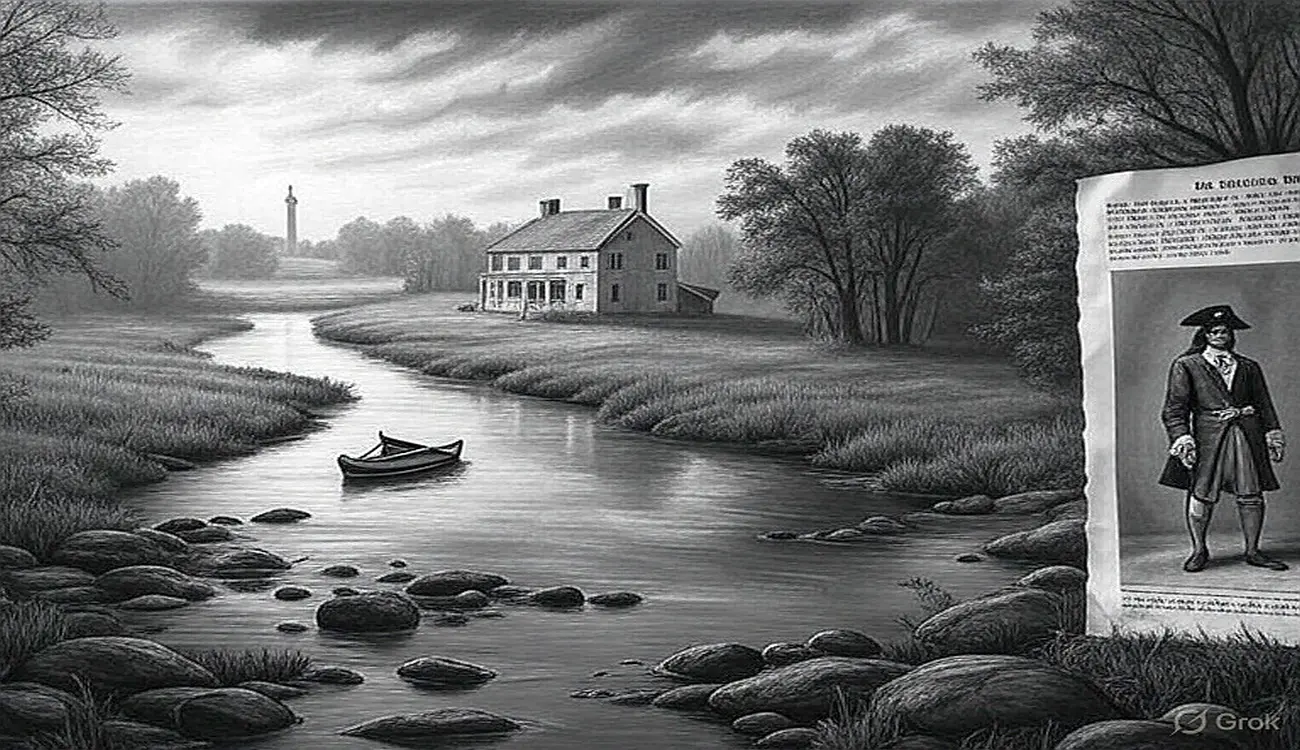
As 2026 approaches, the United States of America, the world’s richest and most powerful nation, will celebrate its 250th anniversary. This milestone highlights the country’s long history of freedom, which has contributed to its current status. In comparison, India gained independence more than seven decades ago, after enduring over 150 years of British rule that drained its wealth. Despite this, India has made significant progress. In 1947, India’s population was approximately 330 million or 33 crores, while the 13 American colonies in 1776 had a population of about 2.5 million or just 25 lakhs!
Let us delve into the past and examine the United States.
The Road to Revolution

In July 1776, the air in Philadelphia was thick, not just with summer humidity, but with the palpable weight of treason. In the Pennsylvania State House, a group of uneasy men, representing not a nation but thirteen fractious colonies, debated a document of extraordinary audacity. They were on the verge of declaring independence from the mightiest empire on earth, an act that could be tantamount to signing their own death warrants if they failed. This was not merely a political manoeuvre; it was a leap into the chasm of revolution, driven by a potent mix of Enlightenment ideals, simmering grievances, and raw, burgeoning nationalism. The story of American Independence is less a polished monument and more a sprawling, blood-stained canvas – a revolution born not solely in serene philosophy, but forged in the crucible of war, compromise, and profound contradiction.
To understand the Declaration’s birth cry, we must step back into the ferment of the 1760s and early 1770s. The Seven Years’ War, known in the colonies as the French and Indian War, had drained Britain’s coffers. Parliament believed that the colonies should shoulder part of the defence burden, as they ostensibly benefited from it. Consequently, Parliament enacted a series of revenue acts: the Sugar Act (1764), the Stamp Act (1765), and the Townshend Duties (1767). Each of these acts was met with escalating resistance, not just on economic grounds, but on the fundamental principle of consent.
The rallying cry “No Taxation Without Representation!” echoed from Massachusetts taverns to Virginia plantations. It wasn’t solely about the cost of tea or legal documents. It was about power, sovereignty, and the very nature of the relationship between the metropolis and its distant offspring. James Otis thundered against ‘taxation without representation is tyranny’. In 1775, Patrick Henry’s impassioned oratory in the Virginia House of Burgesses, “Give me liberty, or give me death!” crystallised the growing militancy. Colonial assemblies saw their traditional powers eroded by Parliamentary overreach and assertive Royal Governors.
The British response, however, proved catastrophically tone-deaf. The deployment of troops to Boston, culminating in the tragic clash known as the Boston Massacre (1770), became a potent propaganda tool for radicals like Samuel Adams. The Tea Act (1773), designed to bail out the struggling East India Company, led directly to the Boston Tea Party – an act of destruction celebrated by patriots as principled defiance, condemned by London as wanton vandalism. The Coercive (or “Intolerable”) Acts (1774) that followed, closing Boston Harbor and altering Massachusetts’ charter, were perceived not as punishment but as proof of a deliberate plot to enslave the colonies. The First Continental Congress convened in Philadelphia that September, a significant step towards unified resistance, yet still pleading for redress, not separation.
The Declaration of Independence
Reconciliation became a fading dream on the Lexington Green and at Concord’s North Bridge on April 19th, 1775. The British regulars marched to seize colonial arms; the Massachusetts militia stood their ground. Ralph Waldo Emerson, decades later, would poetically dub it “the shot heard round the world.” The skirmishes ignited a conflagration. The Second Continental Congress, assembled just weeks later, found itself suddenly governing a rebellion and commanding an army. George Washington, the Virginia planter with military experience and an aura of gravitas, was appointed Commander-in-Chief.
By early summer 1776, with King George III having declared the colonies in open rebellion and hiring Hessian mercenaries, the momentum for a formal break became unstoppable. Richard Henry Lee of Virginia presented a resolution to Congress on June 7th: “That these United Colonies are, and of right ought to be, free and independent states…”
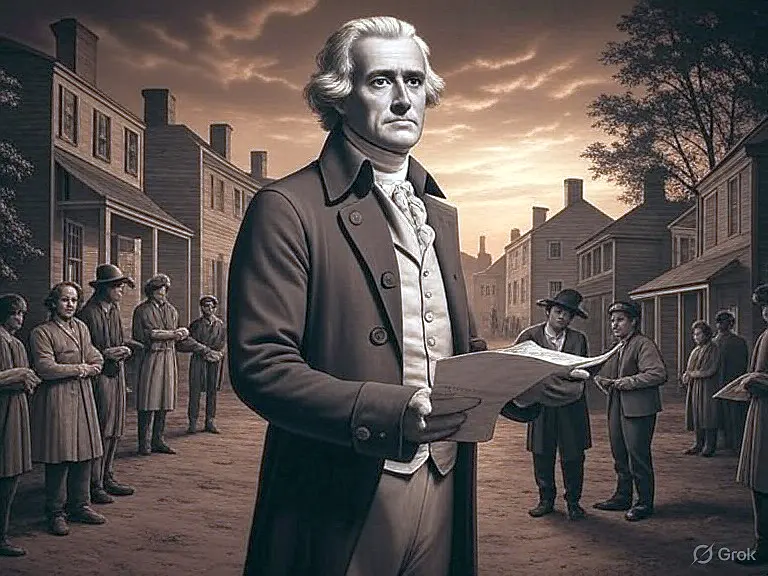
A committee of five was appointed to draft a declaration: Benjamin Franklin, John Adams, Roger Sherman, Robert Livingston, and a 33-year-old Virginian known more for his eloquent pen than his oratory, Thomas Jefferson. Jefferson, immersed in the works of Locke, Montesquieu, and the English Whig tradition, became the principal author. Over days in a rented room on Market Street, he distilled the essence of the revolutionary argument.
The Declaration of Independence, adopted by Congress on July 4th after intense debate and revision (notably removing Jefferson’s passionate condemnation of the slave trade), remains a foundational text of political philosophy. Its soaring preamble articulated universal principles that transcended the immediate conflict: “We hold these truths to be self-evident, that all men are created equal, that they are endowed by their Creator with certain unalienable Rights, that among these are Life, Liberty and the pursuit of Happiness.”
This was radical doctrine. It grounded government legitimacy not in divine right or tradition, but in a social contract, deriving “their just powers from the consent of the governed.” The right, indeed the duty, of the people to overthrow a government destructive of these ends was enshrined. The bulk of the document was a meticulous indictment of George III, listing twenty-seven specific grievances justifying the rupture – a legal and political bill of divorcement from the Crown.
Signing the parchment document (primarily done on August 2nd) was an act of profound courage. Benjamin Franklin, ever the pragmatist tempered by wit, is famously quoted as saying, “We must, indeed, all hang together, or most assuredly we shall all hang separately.” The stakes were that high. They were not just founding a nation; they were betting their lives on its survival.
The War for Independence
Independence declared was not independence secured. The war ground on for seven more gruelling years. Valley Forge’s bitter winter (1777-78) tested the Continental Army to its limits, embodying the sheer tenacity required. Victory at Saratoga (1777) proved pivotal, convincing France to formally ally with the Americans, transforming a colonial rebellion into a global conflict. The French navy’s role was decisive in trapping General Cornwallis at Yorktown in 1781, leading to the surrender that effectively ended major hostilities. The Treaty of Paris in 1783 formally recognised the United States of America as “free sovereign and independent states.”
But the revolution was more than battles and treaties. It was a social and political earthquake. Ancient hierarchies trembled. While far from universal, concepts of equality and liberty infused public discourse, challenging traditional deference. Women, though denied formal political rights, played crucial roles – managing farms and businesses, nursing the wounded, fundraising, and, like Abigail Adams, famously urging her husband John to “remember the ladies” in the new codes of law. Enslaved Africans seized upon the revolutionary rhetoric; thousands fled to British lines seeking freedom under Lord Dunmore’s Proclamation (1775) and subsequent British policies, though their fate post-war was often tragically uncertain. Native American nations, caught between empires and colonial expansion, largely sided with Britain, foreseeing the relentless westward push an independent America would unleash.
The Legacy of Independence
The bright flame of the Declaration’s ideals cast long, dark shadows. The starkest contradiction lay in the institution of chattel slavery, flourishing in the very republic founded on the principle that “all men are created equal.” Thomas Jefferson, the author of those immortal words, owned hundreds of enslaved people throughout his life. This hypocrisy was not lost on contemporaries. The British mocked it relentlessly. African Americans, both enslaved and free, petitioned legislatures and fought in the war, invoking the revolution’s own language to demand their freedom. The abolitionist movement found its moral grounding in this foundational contradiction. As Frederick Douglass would later sear into the national conscience on Independence Day, 1852: “What, to the American slave, is your 4th of July? I answer: a day that reveals to him, more than all other days in the year, the gross injustice and cruelty to which he is the constant victim.”
Furthermore, the revolution was far from universally popular. Historians estimate perhaps a third of the colonists remained loyal to the Crown (Loyalists), another third were actively revolutionary (Patriots), and a final third sought only to remain neutral amidst the chaos. The conflict was also a brutal civil war, pitting neighbour against neighbour, tearing families apart, and leading to the forced exile of tens of thousands of Loyalists.
The United States was born not as a perfected union, but as a bold, chaotic experiment. The Articles of Confederation proved inadequate, leading to the Constitutional Convention of 1787 and the creation of a stronger federal government – another revolution of sorts, achieved with ink and debate rather than muskets. The ideals enshrined in the Declaration – equality, liberty, consent of the governed, the right to revolution – became the nation’s aspirational soul, its “American Creed.”
Yet, the struggle to realise those ideals fully has been the central drama of American history. The Civil War, the long march for civil rights, the fights for women’s suffrage and LGBTQ+ equality, the ongoing debates over the role of government and the meaning of liberty – all are continuations of the conversation begun in Philadelphia in 1776. The revolution unleashed forces of democracy and individual rights that would ripple across the globe, inspiring countless other movements for freedom, even as the nation itself grappled, and continues to grapple, with the gulf between its professed ideals and its complex reality.
So, gaze upon that Fourth of July spectacle – the parades, the fireworks painting the night sky in ephemeral bursts of colour, the flags snapping in the breeze. Remember the parchment signed in the sweltering heat, thick with fear and audacious hope. Remember the frozen ground at Valley Forge, the roar of cannon at Yorktown, the silenced voices of the enslaved, the exiled Loyalist, the displaced Native. Remember Abigail’s plea and Jefferson’s tormenting paradox.
American Independence was not an endpoint, but a tumultuous beginning. It was a declaration not just of liberty, but for an ongoing struggle to define it, to expand its embrace, to reconcile its soaring words with the messy, often painful, realities of human society. The revolutionaries unleashed an idea – potent, dangerous, and enduring. The ink dried on the parchment long ago, but the work of the revolution, the unfurling of that dream of true and equal liberty, remains America’s perpetual, unfinished symphony. The echoes of that Philadelphia summer still resonate, a challenge whispered down the centuries: what does it mean to be truly independent, truly free? The answer, it seems, is written not in the past tense, but in the continuous, striving present.
