



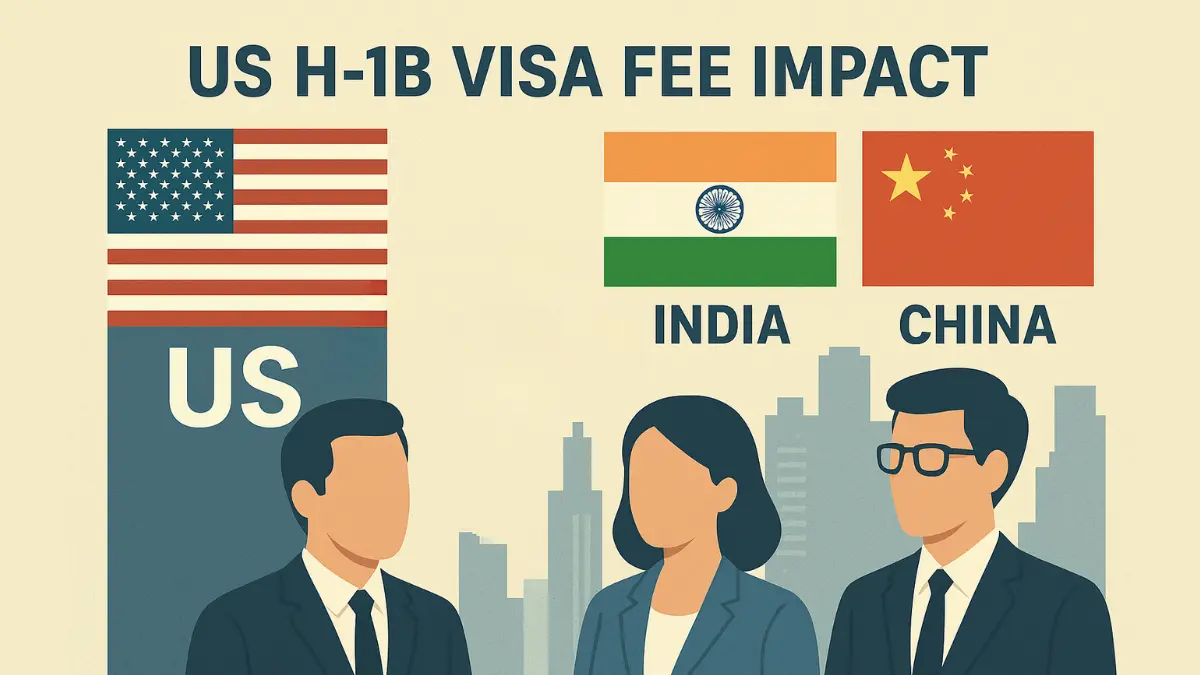
The United States, long seen as the gravitational centre of global talent and innovation, is on the verge of reshaping the world order. This time, it is not through military power or trade wars, but through what looks like a simple bureaucratic change: a proposed $100,000 fee for H-1B visas. Intended to prioritise American workers, this move could unintentionally open doors for countries like India, China, and others eager to attract the world’s brightest minds. By raising barriers to its own talent pool, the U.S. risks speeding up a multipolar innovation landscape where Asia, not Silicon Valley, may write the next chapter of technological progress.
A Wall That Redirects Rivers
The H-1B visa has long been central to America’s dominance, with more than 65 percent of its slots each year going to Indian and Chinese professionals, according to U.S. Citizenship and Immigration Services (USCIS). For engineers, coders, and scientists, it has been the escalator into the world’s richest innovation ecosystems, whether in Silicon Valley’s venture capital worth $150 billion in 2024 or Boston’s cutting-edge biotech labs.
But the proposed $100,000 fee, part of broader immigration reforms for 2025, changes everything. For mid-sized firms and startups, which rely on H-1B workers to make up 20 to 30 percent of their engineering teams, the cost becomes almost impossible to bear. Even tech giants like Google and Microsoft may think twice about sponsoring mid-level roles when per-hire costs shoot past $200,000.
This is more than just a financial barrier. It signals a retreat by America. A country that accounts for 40 percent of global R&D spending is now effectively telling the world’s talent to look elsewhere. And elsewhere is ready to welcome them.
China’s Prepared Nets
China, with its state-driven precision, is perhaps best positioned to seize this moment. For years, Beijing has invested heavily in luring back its “sea turtles” – Chinese professionals trained abroad. Through generous research grants, national laboratories, and policies that target semiconductors, artificial intelligence, and quantum computing, thousands have already returned.
A 2024 McKinsey report estimates that stricter U.S. visa rules could redirect 40 to 50 percent of Chinese STEM talent to domestic hubs such as Shenzhen or Shanghai. These cities offer not only jobs but entire ecosystems – supply chains, state-backed funding, and a clear mission of technological self-reliance. When a U.S. consulate says “no,” China’s welcome mat is already waiting.
India’s Restless Opportunity
India presents a very different picture. Its strength lies not in state-orchestrated power but in a restless and entrepreneurial spirit. The country produces 1.5 million engineering graduates each year and has long exported its best minds to the U.S. But with a $100,000 visa fee, McKinsey projections suggest 10 to 15 percent more of this talent could stay back, fuelling local innovation.
Bengaluru, often called the Silicon Valley of the East, is already home to 30 percent of India’s 125 unicorns. Global firms are expanding here too. Google employs more than 10,000 people in India, while Microsoft is growing its R&D base in Hyderabad. The visa fee could accelerate this trend, creating between half a million and one million high-value jobs in India by 2030, according to Deloitte.
Yet India faces its own hurdles. Unlike China’s top-down approach, India’s democracy must work through bureaucracy. Boosting R&D funding, currently only 0.7 percent of GDP, and streamlining regulations will be critical. If it succeeds, India could climb from its current 40th place in the Global Innovation Index into the top 20, positioning itself alongside the U.S. and China.
A Multipolar Innovation Race
Beyond Asia, other countries are also ready to benefit. Canada’s Global Talent Stream visa saw a 30 percent rise in applications from H-1B hopefuls in 2024. The UK’s tech visa uptake jumped 25 percent in the same period. Both countries offer English-speaking environments and closeness to U.S. markets, although they lack the massive scale of India or China.
At the same time, hubs like Singapore and Dubai are carving out space as neutral platforms where Indian, Chinese, and Western talent can work together without the baggage of geopolitics.
This global redistribution dilutes U.S. dominance. Every engineer who does not land in California becomes a patent, a startup, or a supply chain elsewhere. What America risks losing is not only talent but the network effect of innovation, those chance encounters and collisions that often spark major breakthroughs.
The Hidden Cost of Isolation
For the U.S., this visa fee is a gamble with enormous stakes. It may protect some domestic jobs in the short run, but it also risks fuelling a brain drain to its competitors. History has examples to learn from. Japan’s industrial boom after the Second World War and China’s tech surge after 2008 both thrived on global shifts in opportunity. India and China today stand at a similar turning point.
In trying to build a wall, America may end up handing its rivals the blueprints for the next technological age.
The truth is simple: talent behaves like water. Block one path, and it finds another. As the U.S. tightens its gates, nations such as India and China are not just waiting. They are busy building the future.
