



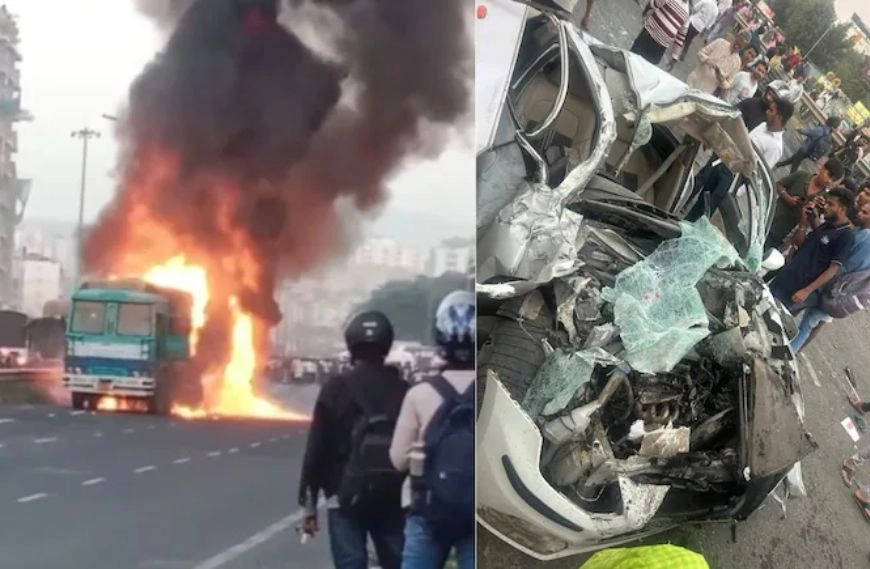
The Navale Bridge stretch on the Katraj–Dehu Road bypass near Pune has earned a worrying reputation for frequent and serious accidents. The latest crash, which involved two container trucks and a car that caught fire, has once again raised questions about why this part of the highway remains so dangerous. Many experts say the problem begins with the design of the road itself. The slope leading down to the bridge is steeper than what road safety standards recommend. This downhill gradient gives heavy vehicles extra speed, and drivers often struggle to slow down in time, especially when carrying large loads.
Another major issue is risky driving behaviour. Some truck drivers shift their vehicles into neutral while coming down the slope to save fuel. This puts extra pressure on the brakes, which can overheat or fail completely. Several accidents in the past have been linked to brake failure on this very stretch. Even though traffic police have repeatedly warned drivers, the habit continues, especially among long-distance truckers who pass through the area at night.
Authorities have made some attempts to fix the problem. Warning signs, rumble strips, and stricter police monitoring have been put in place. However, experts say these are only temporary measures. A detailed road safety audit highlighted deeper issues such as poor signage, weak crash barriers, and badly designed entry and exit points. While some short-term improvements have been made, many important engineering changes are still pending. Because of this, local commuters feel that the bridge continues to be unsafe.
Residents who regularly travel this route say they feel anxious each time they approach the slope. They point out that even small mistakes by drivers can lead to major accidents because the road does not offer enough time or space to recover control. Past incidents, including major crashes in 2022, have shown how quickly situations can turn fatal on this stretch. Despite the repeated warnings, serious accidents keep happening, which has created a sense of helplessness among local people.
To reduce risks, the authorities are currently widening service roads and relocating utilities like water pipelines and electric lines. But progress is slow, and the main slope remains unchanged. Many experts believe that real safety will only come when the gradient is redesigned to reduce the downhill speed of vehicles. They also suggest that national and local agencies should work together to improve road engineering, signage, and enforcement so that accidents can be prevented instead of simply being responded to.
The most recent tragedy has once again shown how dangerous this bridge can be if long-term solutions are not implemented. Until proper structural corrections are made, the Navale Bridge stretch is likely to remain an accident zone, putting thousands of daily commuters at risk.
Subscribe Deshwale on YouTube
