



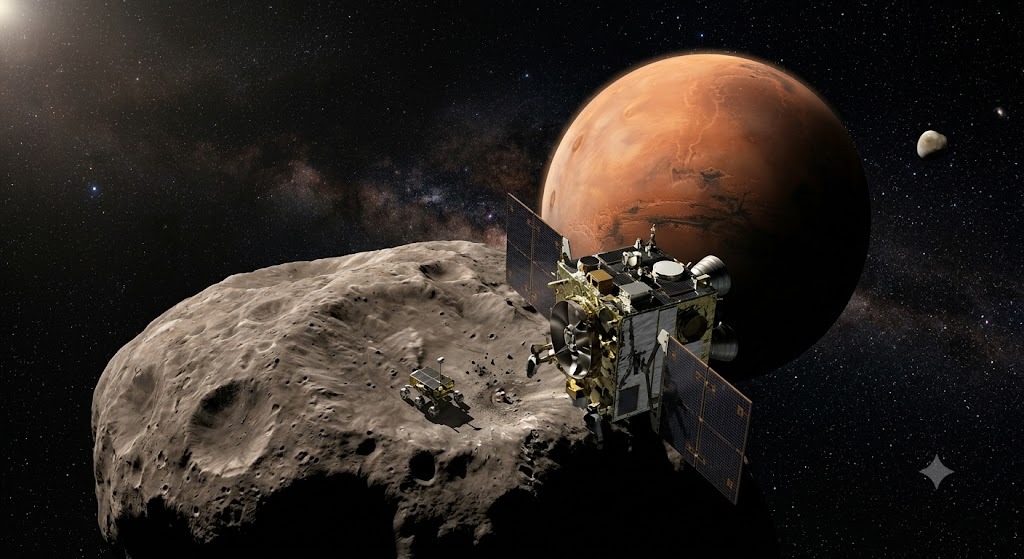
Japan has begun a long journey to investigate one of the Solar System’s unanswered questions. Its spacecraft is heading towards Mars, not to land on the Red Planet, but to study its two small moons and bring a piece of one of them back to Earth.
The Japan Aerospace Exploration Agency (JAXA) successfully launched its Martian Moons eXploration (MMX) spacecraft aboard an H3 rocket from the Tanegashima Space Center on 20 October 2026 (Japan time). The mission will explore Phobos and Deimos, the two moons of Mars. Its main goal is to collect a sample from Phobos and return it to Earth in 2031. If it succeeds, it will be the first mission to bring back material from a Martian moon.
Why Are Scientists Interested in These Moons?
At first glance, Phobos and Deimos may seem less exciting than Mars itself. However, these small, irregularly shaped moons could hold important clues about how planets and other celestial bodies formed.
Scientists have two leading explanations for their origin. One suggests that they were asteroids captured by Mars’ gravity. The other proposes that they formed from debris thrown into space after a large object struck Mars. Researchers have yet to settle this debate. Studying the moons’ composition and examining samples in laboratories on Earth could help determine which explanation fits the evidence best.
A Mission That Will Bring Space Material Home
MMX is expected to reach Mars in August 2027 and enter orbit around Phobos, the larger moon, the following month. A small rover named IDEFIX, built by France’s space agency CNES and the German Aerospace Center (DLR), will be released to explore Phobos’ surface.
Sample collection is planned for 2029. Japan aims to bring back at least 10 grams of surface material. Even a few grams can provide valuable information when examined with advanced laboratory equipment. After leaving Phobos, the spacecraft will make flybys of Deimos, then send a return capsule towards Earth. It is scheduled to land in Australia in 2031.
What Could This Mean for Our Understanding of Space?
The mission is about more than collecting rocks. Understanding how Phobos and Deimos formed could help scientists reconstruct the early history of Mars and how planetary systems develop.
The mission brings together international expertise. NASA has contributed two instruments, including MEGANE, which will measure the elemental composition of Phobos. ESA is providing deep-space communication equipment, while CNES and DLR built the rover. Japan brings experience from its Hayabusa and Hayabusa2 missions, which showed the value of returning material from small celestial bodies.
A Small Sample, A Much Bigger Question
Space exploration often focuses on distant planets, dramatic photographs and the search for life. MMX offers a different perspective: sometimes the smallest objects can help answer the biggest questions.
The material from Phobos may reveal whether Mars’ moons are captured asteroids or remnants of a violent collision. It will not settle every mystery, but it could provide evidence that photographs alone cannot. If the mission succeeds, a small quantity of dust and rock from a moon hundreds of millions of kilometres away could help us understand how our cosmic neighbourhood took shape. Its most important discovery may fit inside a sample container.
Subscribe Deshwale on YouTube
