



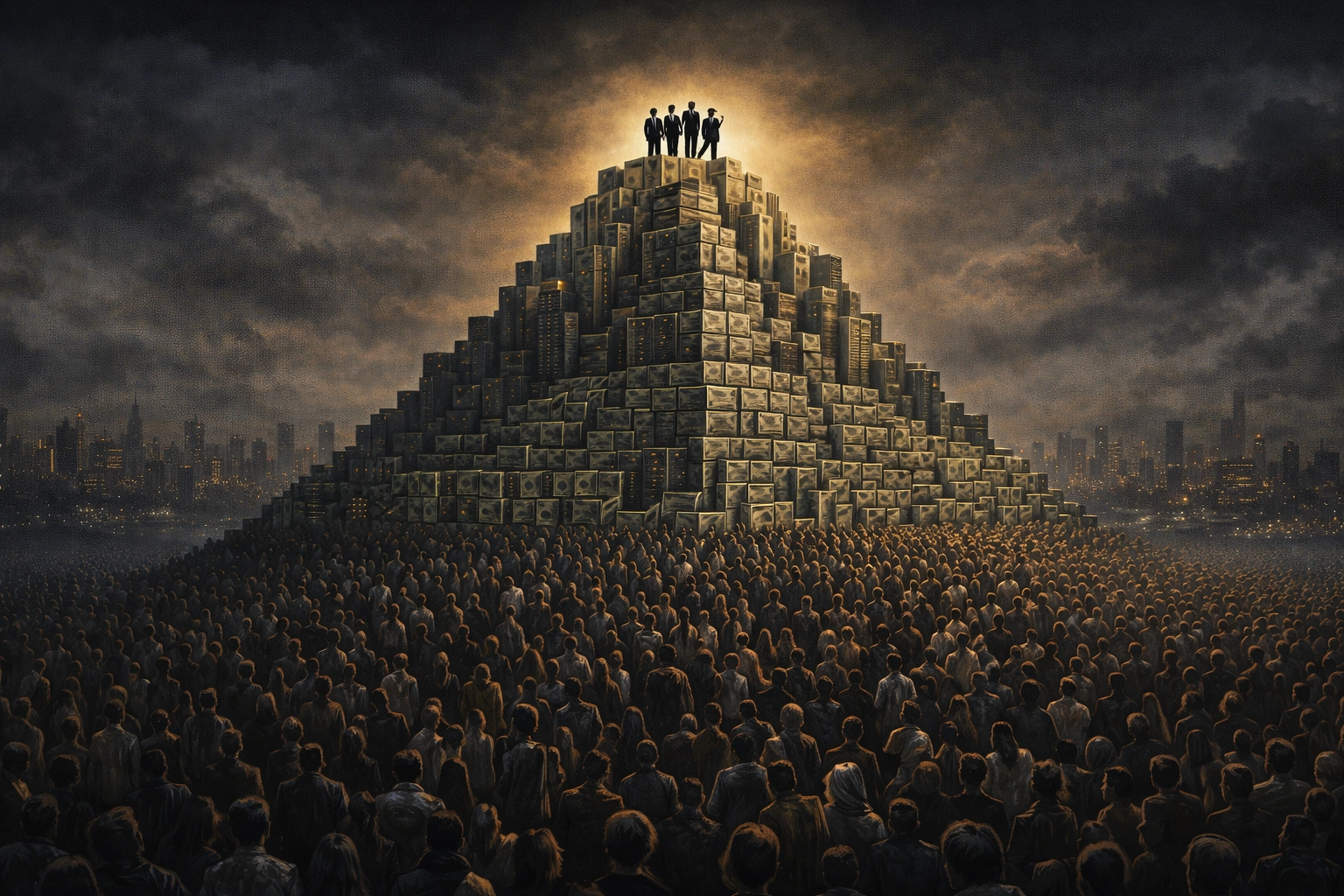
In the grand narrative of human advancement, the past century has been marked by breathtaking technological progress, the expansion of global trade, unprecedented growth in life expectancy and the affirmation at least rhetorically of universal human rights. Yet beneath the surface of these achievements lies a stark paradox: the material fruits of progress are distributed so unevenly that, for most of the world’s population, they may as well be a mirage. The structural chasms of inequality today are not peripheral anomalies; they are central determinants of political instability, social fragmentation and economic stagnation.
In 2025 and early 2026, the data on global wealth and income distribution paint a sobering picture. According to the latest World Inequality Report, the richest 10 % of the global population now control roughly three-quarters of all personal wealth, leaving the bottom 50 % with barely two per cent of the world’s assets. The situation is even more extreme at the very top: the wealthiest 0.001 % fewer than 60,000 individuals own three times more wealth than the poorest half of humanity combined.
If the promise of globalisation was that economic integration would lift all boats, the reality is that only a narrow slice of humanity has propelled forward at speed. On average, the top decile not only dominates wealth but captures more than half of total global income. The bottom half of the world’s population receives only around 8 % of global income and this figure reflects pre-tax earnings, before accounting for social transfers that, in many low-income countries, are minimal or non-existent.
These macro-level aggregates do not merely quantify disparity; they provide a structural lens on social experience. When billions struggle for basic economic security while a tiny minority accumulates extraordinary wealth, the social contract that implicit agreement between citizens and the state that underpins legitimacy begins to erode. A polity in which the bottom half holds almost no assets has little cushion against economic shocks, limited access to quality education and health care, and scant political influence relative to those at the apex of wealth hierarchies.
Domestic inequalities are equally stark. Take the example of India, one of the world’s fastest-growing large economies. The same World Inequality Report notes that the top 10 % of earners in India capture about 58 % of national income, while the bottom half receives only 15 %. Wealth distribution within the country is similarly skewed, with the richest decile holding roughly 65 % of total wealth and the richest 1 % alone controlling about 40 %.
This pattern is not unique to India. Across many parts of Asia, Latin America, Africa, and even in advanced economies, disparities remain entrenched. South Africa, for instance, exhibits one of the most extreme national inequality profiles globally, with the top 10 % controlling about 85 % of wealth. And these figures are not static historical artifacts; they reflect ongoing dynamics in which wealth accumulates disproportionately faster at the top than any meaningful redistribution occurs at the bottom.
The implications of such inequality are profound and multifaceted. Economically, concentrated wealth dampens broad-based consumption, as affluent households have a lower marginal propensity to spend. Politically, extreme inequality correlates with diminished democratic responsiveness, as powerful elites wield disproportionate influence over policy agendas. Socially, the gap between rich and poor fosters resentment, fuels identity politics and sows fertile ground for polarisation.
Equally troubling is the environmental axis of inequality. While the poorest half of humanity accounts for only a tiny fraction of emissions connected to private capital ownership, the richest decile is responsible for the overwhelming majority, an estimated 77 % of such emissions. The few who profit most from the status quo are often least exposed to the environmental costs, while those who contribute least to global warming suffer its worst impacts.
These disparities extend beyond income and wealth into access to human capital and opportunities. Differences in education spending per child can be dramatic: in parts of Sub-Saharan Africa, per-child education expenditure is a tiny fraction of what is spent in North America or Europe, compounding inequality across generations.
From the vantage point of public policy, the tools that might counteract these trends progressive taxation, universal social protections, quality public services face powerful resistance. Wealthy individuals and corporations often possess the resources to influence tax codes, regulatory frameworks and political institutions to their advantage, entrenching their position and circumscribing the policy space for redistributive reforms. As some reports have noted, the political will to implement wealth taxes, robust social safety nets or truly progressive fiscal systems remains glaringly absent in much of the world.
This is not to suggest that inequality is purely a matter of static numerical distribution; it interacts dynamically with other systemic forces. Technological change, particularly in automation and artificial intelligence, threatens to widen gaps unless access and opportunity are broadened beyond the elite economies that control these innovations. The World Trade Organization has warned that AI could deepen global inequality if developing countries fail to secure equitable access to its benefits, reinforcing historic patterns of advantage rather than diminishing them.
Yet the persistence of deep inequality raises questions that extend beyond economic policy to the moral foundations of global society. How can the claim of universal human progress be sustained when billions lack basic economic security? How can assertions of prosperity cohere with the reality that a tiny fraction of humanity controls a disproportionate share of wealth and economic power? And perhaps most provocatively: what does it mean for global stability when such inequalities increasingly intersect with political disaffection and societal fracturing?
In many ways, the unequal structures of wealth and opportunity are not merely outcomes of policy choices; they are drivers of broader instability. Mass unemployment, entrenched poverty, lack of upward mobility and the erosion of public trust in institutions all create fertile ground for conflict not just armed conflict, but political unrest, social movements and systemic disillusionment. The crises on battlefields around the world are only one manifestation of deeper fractures that inequality both exacerbates and exploits.
As with the global conflict landscape examined in Part I of this series, the persistence and intensification of inequality in 2026 expose a fundamental disconnect between the rhetoric of progress and its lived reality for most of humanity. What appears on the surface as economic growth is often growth that is captured disproportionately by the few, leaving the majority precarious and disempowered.
The structural interlinkages between inequality, political instability and social division point to a broader truth: peace cannot be sustained in a vacuum of prosperity and fairness. A world in which wealth is ever more concentrated and opportunity ever more constrained cannot be immune to the tensions that arise when such disparities persist. Thus the promise of peace or even of political and economic stability remains elusive without confronting the underlying matrix of inequality that shapes the contemporary global order.
In the next part of this series, we will delve deeper into how these economic disparities play out not only between nations but within them, examining the lived realities of societies where wealth and power concentrate while vast majorities struggle. We will explore how this dynamic affects social cohesion, democratic legitimacy and the prospects for meaningful, inclusive development and why these domestic fissures matter as much to global stability as the battlefields themselves.
