



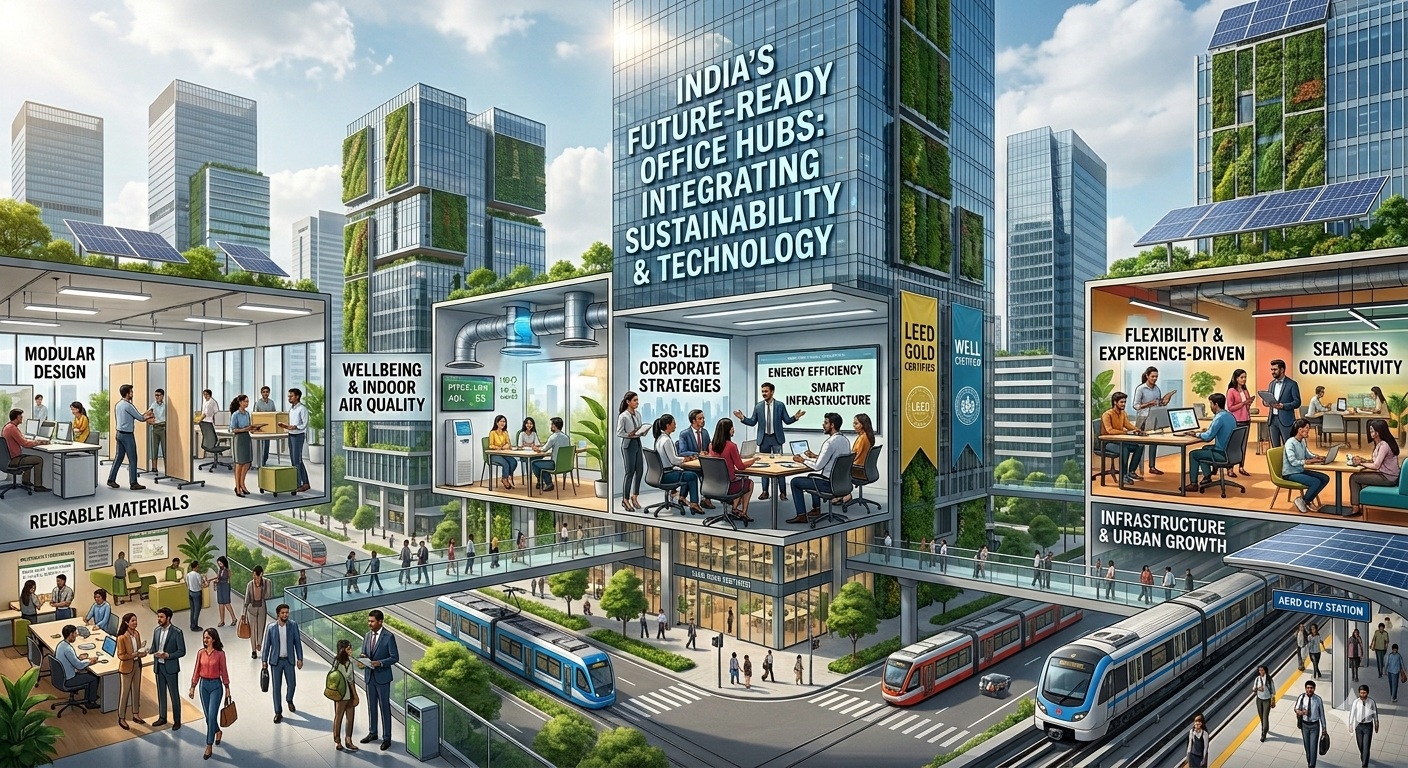
India’s commercial real estate sector is undergoing a major shift as businesses increasingly move towards future-ready office hubs that offer much more than traditional workspaces. Companies today are no longer looking only for office space. They are searching for integrated business environments that combine technology, sustainability, employee wellbeing and operational efficiency under one ecosystem.
Driven by changing workforce expectations, rapid technological advancement and infrastructure-led urban growth, developers across the country are redesigning commercial spaces to meet the evolving demands of modern businesses.
A growing emphasis on sustainability is playing a major role in this transformation. According to a report by Savills India titled “The Circular Leap: Reimagining India’s Office Fit-Outs”, adopting modular designs, reusable materials and lifecycle-based planning can significantly reduce carbon emissions at the project level. The report estimates that such measures could lower embodied carbon emissions by 25 to 55 percent depending on the level of material reuse and low-carbon interventions implemented.
The report further highlighted that the built environment contributes nearly 30 to 40 percent of global annual carbon emissions. In some cases, emissions generated through interior fit-outs can equal or even exceed those produced during a building’s core construction. As a result, developers and occupiers are increasingly prioritising environmentally responsible office infrastructure.
Alongside sustainability, health and wellness are emerging as major deciding factors in office leasing. Businesses are paying greater attention to indoor environmental quality, particularly air quality, as studies continue to show its direct impact on employee health, cognitive performance and workplace productivity.
Modern office developments are now integrating advanced air purification systems, AI-driven infrastructure and wellness-focused technologies to create healthier work environments. Industry experts believe this trend is reshaping how commercial spaces are designed and managed.
Shilpin Tater, Managing Director of Superb Realty, said the growing demand for future-ready office hubs is being driven by infrastructure development, changing workforce expectations and the need for greater operational efficiency.
According to him, businesses now prefer workspaces that combine smart building technologies, sustainable design, seamless connectivity and wellness infrastructure. He added that indoor environmental quality has become an increasingly important consideration in commercial real estate because of its direct relationship with employee productivity and wellbeing.
The rise of ESG-led corporate strategies is also influencing office market trends. Green-certified buildings equipped with energy-efficient systems, intelligent air infrastructure and advanced digital capabilities are witnessing stronger demand from both domestic and multinational companies.
Developers are responding by creating office ecosystems that align with corporate sustainability goals while offering long-term business value.
Rohan Shukla of DGS Group said companies are now focusing equally on sustainability, employee wellbeing and business continuity. He noted that intelligent infrastructure, collaborative office environments, energy-efficient systems and strong digital connectivity are becoming key attractions for occupiers.
He also pointed out that the emergence of new business districts supported by large-scale infrastructure projects is creating opportunities for developers to build next-generation office ecosystems capable of meeting evolving business needs.
Flexibility is another defining feature of the modern office market. Businesses increasingly prefer adaptable office formats that support scalability, collaboration and operational agility. This has encouraged developers to create commercial spaces with flexible floor layouts, co-working integration, advanced technology systems and enhanced social infrastructure.
Nihar Jayesh Thakkar, founder of The Mandate House Pvt. Ltd., said organisations today want office spaces that support innovation, attract talent and improve productivity. He added that developments offering integrated amenities, digital readiness, sustainability-focused infrastructure and strong connectivity are witnessing significant traction in the market.
Industry experts believe India’s expanding economy, growing startup ecosystem and increasing global business interest will continue driving demand for high-quality commercial destinations in the coming years.
As businesses increasingly prioritise employee wellbeing, sustainability and long-term operational efficiency, future-ready office hubs are expected to become the cornerstone of India’s next phase of commercial real estate growth.
Subscribe Deshwale on YouTube
