



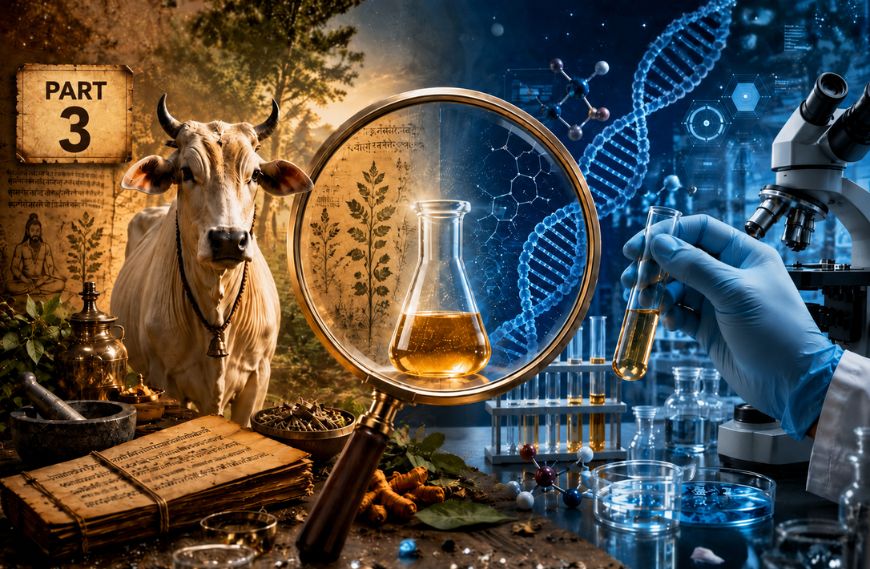

“A treatment does not become medicine because it is ancient. Nor does it become medicine because it is natural. It becomes medicine only after repeated, rigorous evidence demonstrates that its benefits outweigh its risks.”
This is the point where many promising substances fail. Thousands of compounds have shown remarkable results in laboratories, yet only a handful have survived the journey into hospitals.
Cow urine, or more precisely Gomutra Ark and other carefully prepared formulations, now stands at this crossroads. The question is no longer whether it contains interesting chemicals. It is whether it can improve the health of real patients under scientifically controlled conditions. That is an entirely different standard.
The evidence pyramid
Not all scientific studies carry equal weight. Modern medicine ranks evidence according to how likely it is to reflect the truth.
At the base sit laboratory experiments, followed by animal studies. Above them come observational studies in humans, and near the top sit randomised controlled trials, where participants are assigned by chance to receive either the treatment or a comparison such as a placebo, often without either side knowing who received what.
At the very top sit systematic reviews and meta-analyses, which critically evaluate and combine results from multiple high-quality studies. This hierarchy exists to minimise error and bias. A single positive study rarely settles a medical question.
What human studies exist?
Researchers in India have published human studies examining preparations containing cow urine for a variety of conditions, and some have reported encouraging findings in certain symptoms or laboratory measures.
However, many of these studies share the same limitations. Sample sizes tend to be small, most come from a single centre, follow-up periods are short, preparation methods are inconsistent, and independent replication is limited.
These limitations do not mean the findings are wrong. They mean the findings need confirmation before firm conclusions can be drawn. In evidence-based medicine, promising and proven are not the same thing.
Cancer: The claim that demands the strongest evidence
Perhaps no claim has generated more headlines than the assertion that gaumutra can cure cancer, and this is also where scientific caution must be greatest.
Some laboratory and animal studies have explored whether compounds in cow urine distillate might influence cancer cells or modify responses to certain treatments. That research is scientifically interesting, but it is not equivalent to demonstrating that cow urine cures cancer in people.
Establishing that would require large, carefully designed clinical trials showing improvements in survival, disease progression or quality of life compared with standard treatment. At present, there is no high-quality clinical evidence that cow urine or Gomutra Ark can replace proven cancer treatments such as surgery, chemotherapy, radiotherapy, immunotherapy or targeted therapy. Patients should never delay or stop proven cancer treatment based on unsupported claims.
Diabetes, arthritis and other chronic diseases
Claims are frequently made that gaumutra treats diabetes, arthritis, asthma, thyroid disorders and many other chronic illnesses. Some preliminary studies have explored effects related to inflammation, metabolism or oxidative stress.
For these conditions too, the available human evidence remains limited. Doctors practising evidence-based medicine generally look for multiple independent trials, adequate sample sizes, standardised preparations, reproducible results and clear evidence of safety before accepting a therapy. Until that evidence exists, broad claims remain unconfirmed.
COVID-19: A lesson in scientific responsibility
The COVID-19 pandemic showed how quickly medical misinformation can spread. Numerous traditional remedies from around the world, including cow urine, were promoted by some as preventive or curative measures.
To date, there is no reliable clinical evidence that cow urine prevents or cures COVID-19. Public health experts consistently advised that vaccination, appropriate medical care and proven preventive measures should remain the foundation of pandemic management. The episode is a reminder that extraordinary claims made during health emergencies demand especially rigorous scrutiny.
Safety is as important as effectiveness
A medicine is judged not only by whether it works but also by whether it is safe, since even effective medicines can cause adverse effects. That is why every potential therapy undergoes safety evaluation.
With cow urine preparations, quality control remains a real concern. Without strict hygienic manufacturing, contamination can occur, and medicinal products need pharmaceutical-grade standards to be trusted.
Standardisation is another open question. Different animals, diets, collection methods and processing techniques produce different chemical compositions, which makes comparing studies difficult. Traditional Ayurvedic practice often uses purified, processed or distilled preparations in carefully chosen contexts, so assuming all forms are interchangeable is scientifically unsound.
Why doctors remain careful
Some people read medical caution as hostility toward traditional medicine, but that is a misunderstanding. Doctors routinely adopt therapies once convincing evidence exists, and many modern medicines trace their origins to plants or traditional knowledge.
The issue was never whether a treatment is traditional. It is whether it has been convincingly shown to be effective and safe. If future high-quality clinical trials demonstrate clear benefits for specific conditions, the medical community would have strong reasons to take notice.
What about ayurveda?
Ayurveda and modern biomedicine rest on different conceptual frameworks. Ayurveda evaluates health through principles such as doshas, agni and prakriti, while modern medicine relies on anatomy, physiology, biochemistry and clinical trials.
These systems need not be viewed as enemies. But when a claim concerns treating a disease recognised by modern medicine, modern standards of clinical evidence are necessary to establish efficacy and safety. Respect for traditional knowledge does not remove the need for scientific validation.
What would settle the debate?
If India wanted to answer the gaumutra question definitively, the path is clear enough. It would take pharmaceutical-grade standardized preparations, independent multicentre trials with hundreds or thousands of participants, randomised placebo-controlled designs where appropriate, transparent publication of both positive and negative results, and independent replication by researchers with no commercial or ideological stake.
Only then could strong medical recommendations follow. Science does not fear being proved right, nor does it fear being proved wrong. It simply seeks reliable answers.
The cost of exaggeration
The greatest harm to any potentially useful traditional therapy is exaggeration. When supporters claim that one substance cures dozens of unrelated diseases without robust evidence, public confidence declines.
Equally, dismissing all traditional remedies without investigation risks overlooking genuinely valuable discoveries. History offers examples of both mistakes. Scientific credibility grows through precision, not hyperbole.
India possesses one of the world’s richest traditions of medical knowledge. That heritage deserves neither blind acceptance nor casual ridicule. It deserves careful research.
The evidence available today suggests that cow urine and certain distilled preparations have shown biologically interesting findings in laboratory work and some preliminary human research. At the same time, there is currently insufficient high-quality clinical evidence to support broad claims that they are proven treatments for major diseases such as cancer, diabetes or COVID-19.
Those two statements are not contradictory. They are the essence of honest scientific reporting. Knowledge advances one carefully tested step at a time, and that is how any traditional remedy, including gaumutra, must ultimately earn its place.
Subscribe Deshwale on YouTube
