



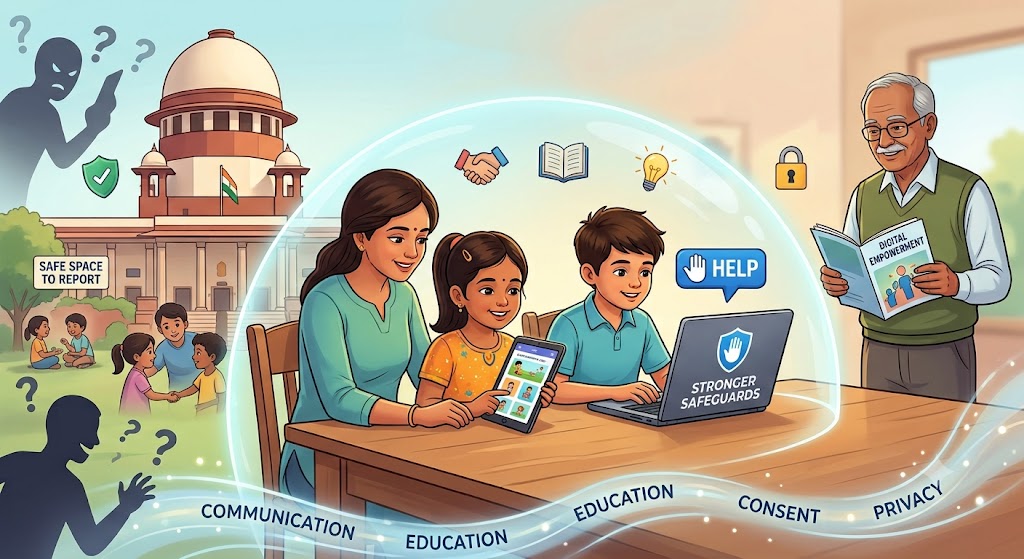
For a child facing online harassment, a threatening message or unwanted contact from a stranger, the internet can be both the source of fear and the place where help is found. But what happens when that child is also afraid of being punished at home for using the internet in the first place?
This is one of the important questions raised by the Supreme Court of India while examining children’s access to the digital world. The court has rejected the idea of denying children internet access altogether simply because online platforms can expose them to harm. Instead, it has called for stronger safeguards that protect children without taking away their fundamental rights.
The observation brings a fresh perspective to a debate often centred on screen time, social media addiction and age limits. Keeping children safe online is essential, but restricting their access may not address the dangers they face.
When Fear Stops Children From Speaking Up
One of the most significant concerns raised by the court is that blanket restrictions could discourage children from reporting online abuse.
Consider a child who receives threatening messages from an unknown person or is pressured into sharing private photographs. If the child has been using a platform despite an age restriction, the fear of losing internet access or facing punishment at home could make it harder to seek help.
The child might remain silent, even when the situation becomes frightening.
The Supreme Court cautioned that children who are enticed, threatened or exploited online may hesitate to approach parents, guardians or trusted adults if they fear being punished for violating restrictions. Such a situation could undermine the very purpose of protecting children from abuse.
This raises an important question for families and policymakers: does a rule genuinely protect children if it makes them less willing to report the dangers they encounter?
A safer digital environment must allow children to speak openly about their experiences without automatically turning their own internet use into a reason for blame.
The Internet Is More Than Social Media
Much of the discussion about children’s internet use focuses on social networking platforms, but the digital world serves several other purposes.
For students, it can provide access to educational resources, learning materials and information that may not be readily available in their immediate surroundings. Children in remote areas, in particular, may depend heavily on the internet to explore subjects beyond their school curriculum.
The court also highlighted the importance of digital access for children with special needs. Online spaces can help them connect with others who share similar experiences, particularly when such connections are difficult to establish in their immediate surroundings.
A blanket restriction could therefore affect children differently depending on where they live, what resources their schools provide and whether they have access to supportive communities offline.
For a child with several educational opportunities nearby, losing access to a particular platform may be manageable. For another child who depends on online resources to study or communicate, the consequences could be much greater.
This is why the debate cannot be reduced to whether children should or should not use the internet. It must also consider what they use it for and what they could lose if access is removed entirely.
Should Children Bear the Cost of Platform Failures?
The Supreme Court’s observations also shift attention towards the companies and institutions responsible for making digital spaces safer.
Online abuse cannot be addressed simply by asking children to stay away from the platforms where it occurs. Harmful material must be identified and removed, abusive behaviour must be addressed, and effective systems must be available to report threats and exploitation.
The court stressed that measures intended to protect children should target harmful content and those responsible for it, rather than placing the entire burden on children themselves. It also called for stronger efforts to detect and remove child sexual exploitation and abuse material online.
This approach raises questions about the responsibilities of technology companies. How quickly can they respond to reports of abuse? Are their safety tools accessible to younger users? Can children report suspicious contact without navigating complicated procedures? And do platforms take sufficient action against accounts involved in exploitation?
These questions deserve attention alongside discussions about age limits.
Parents and schools have important roles to play, but they cannot independently monitor every online interaction or compensate for every weakness in a platform’s safety systems. Effective protection requires cooperation between families, educators, technology companies and public authorities.
A Safer Internet, Not Simply a Smaller One
Rejecting blanket restrictions does not mean allowing children unrestricted access to every online service or type of content.
The Supreme Court discussed more targeted safeguards, including a dedicated child mode for social media accounts. Possible measures include making children’s accounts private by default, limiting contact from unknown adults and applying tighter controls to advertising and the content shown to young users. The court also referred to proportionate ways of verifying parental consent for pre-teens, leaving the implementation details to the Union government.
It clarified that its observations would not prevent restrictions on specific categories of content or services that are inherently harmful to children, such as adult-content websites.
Such measures offer a different way of thinking about online safety. Instead of treating every child as equally vulnerable in every digital situation, safeguards can be designed around the risks associated with particular platforms, interactions and content.
However, these protections will need to work in practice. Privacy settings, reporting systems and parental controls are useful only when they are accessible, effective and difficult to bypass.
Age verification also requires careful consideration because identifying every user’s age can involve collecting sensitive information and create privacy risks.
Teaching Children to Recognise Danger
Technology alone cannot solve the problem. Children also need to understand how online manipulation works, why personal information should be protected and when an interaction has crossed a boundary.
The court emphasised the importance of age-appropriate education about consent, healthy relationships, online privacy, sexual extortion and ways to report abuse. It linked digital safety with sex education, underlining the need to equip children with knowledge rather than relying solely on restrictions.
For parents, this means creating an environment in which children can discuss uncomfortable online experiences without immediately fearing punishment. For schools, it means treating digital awareness as an essential part of preparing students for everyday life.
The Supreme Court’s observations do not suggest that the internet is harmless. They point towards a more difficult but necessary task: making access safer while preserving the opportunities it provides.
The real test of child protection is not simply how effectively adults can keep children offline. It is whether children can learn, communicate and seek help online without being left vulnerable to exploitation.
A ban may keep a child away from a platform, but it cannot by itself remove the person trying to cause harm. That is why the responsibility for a safer internet must extend far beyond the children who use it.
Subscribe Deshwale on YouTube
