



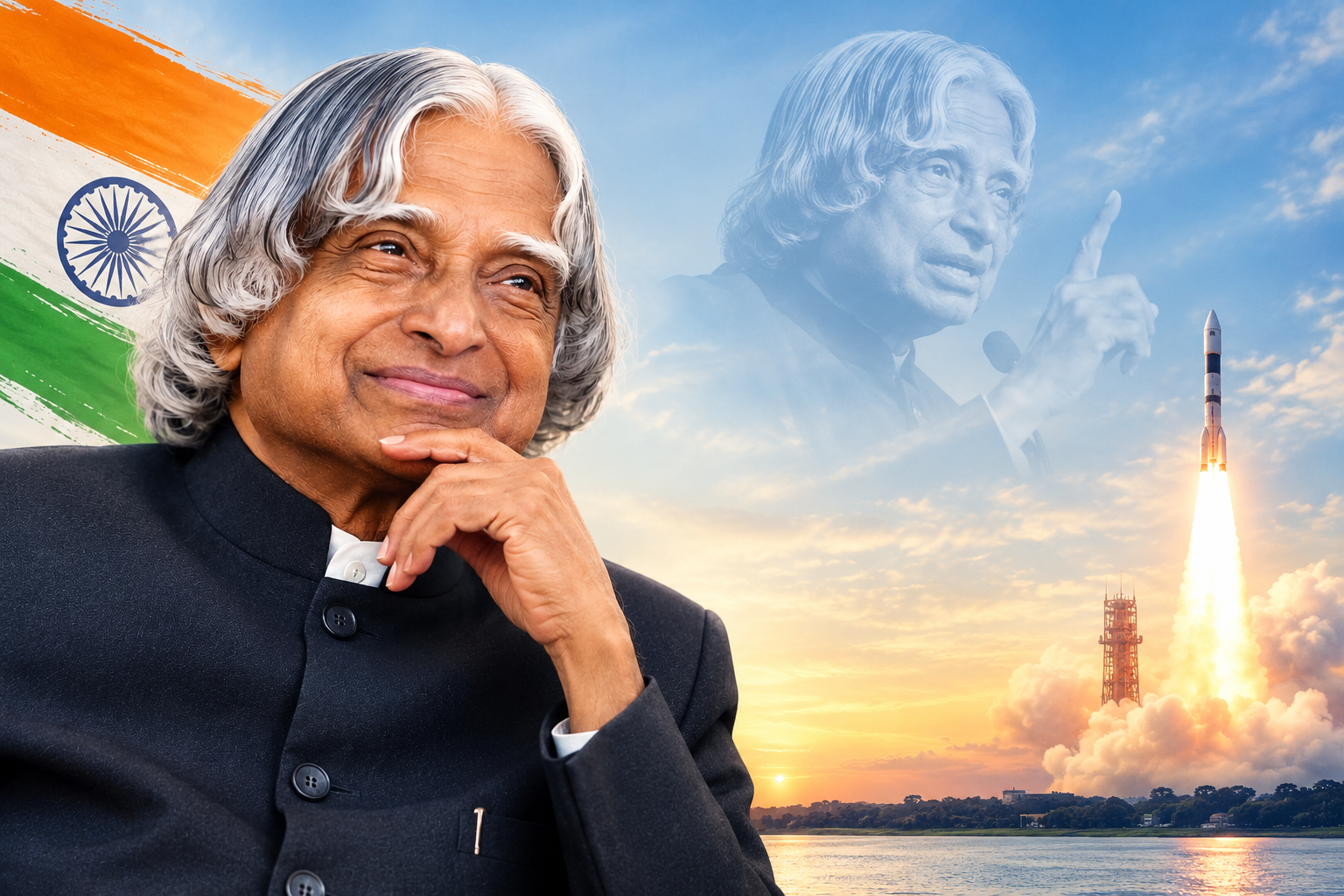
On his 95th birth anniversary, Dr APJ Abdul Kalam’s journey reminds us that success is not just about reaching the top, but about helping others rise.
What does it take for a boy from a modest family in a small Tamil Nadu town to become the President of India? For Dr Avul Pakir Jainulabdeen Abdul Kalam, the answer lay in curiosity, hard work and an enduring belief in the power of education.
Born on 15 October 1931 in Rameswaram, Kalam grew up in a humble household. His father, Jainulabdeen, owned a boat, while his mother, Ashiamma, managed the home. Financial challenges were part of his early life, but they did not stop him from pursuing his ambitions. His journey from Rameswaram to Rashtrapati Bhavan would eventually become an inspiration for millions of young Indians.
The scientist who helped india dream bigger
Kalam studied physics at St Joseph’s College in Tiruchirappalli before specialising in aeronautical engineering at the Madras Institute of Technology. His interest in flight led him into a career that would help shape India’s scientific and defence capabilities.
At the Indian Space Research Organisation (ISRO), he served as project director of the Satellite Launch Vehicle III (SLV-III). In July 1980, the vehicle successfully placed the Rohini satellite into near-Earth orbit, marking an important milestone in India’s space programme.
He later led the Integrated Guided Missile Development Programme at the Defence Research and Development Organisation (DRDO), contributing to the development of the Agni and Prithvi missile systems. His work earned him the title ‘Missile Man of India’.
Kalam also played a significant role in the Pokhran-II nuclear tests in 1998. His contributions to science and defence were recognised with several honours, including the Bharat Ratna in 1997, India’s highest civilian award.
Yet, his interests extended beyond laboratories and defence projects. In collaboration with cardiologist B. Soma Raju, he helped develop the Kalam-Raju Stent, reflecting his belief that scientific innovation should also serve people’s everyday needs.
A president who felt more comfortable among students
When Kalam became India’s 11th President in 2002, he brought a distinctive approach to the office. Widely known as the People’s President, he made interacting with students and encouraging young minds an important part of his public life.
He believed that education should nurture curiosity, creativity and the confidence to solve problems. Through books such as Wings of Fire, Ignited Minds and India 2020, he encouraged readers to think about personal growth and the country’s future.
After completing his presidential term in 2007, Kalam returned to teaching, writing and meeting students. His vision of a developed India rested not only on technological progress, but also on better education, healthcare, agriculture and rural development.
A legacy That goes beyond awards
On 27 July 2015, Kalam collapsed while delivering a lecture at the Indian Institute of Management Shillong. He died at the age of 83.
His final moments came while he was doing something he had devoted much of his later life to: sharing knowledge with students.
On his 95th birth anniversary, Kalam’s life offers a reminder that a person’s lasting influence cannot be measured only by titles or achievements. It can also be seen in the young person encouraged to pursue science, the teacher who inspires independent thinking and the researcher who works to solve a problem affecting ordinary people.
India remembers Kalam as a distinguished scientist and former President. But his most enduring legacy may be the belief he carried throughout his life: a nation’s future becomes brighter when its young people are given the knowledge, confidence and opportunity to shape it.
Subscribe Deshwale on YouTube
