



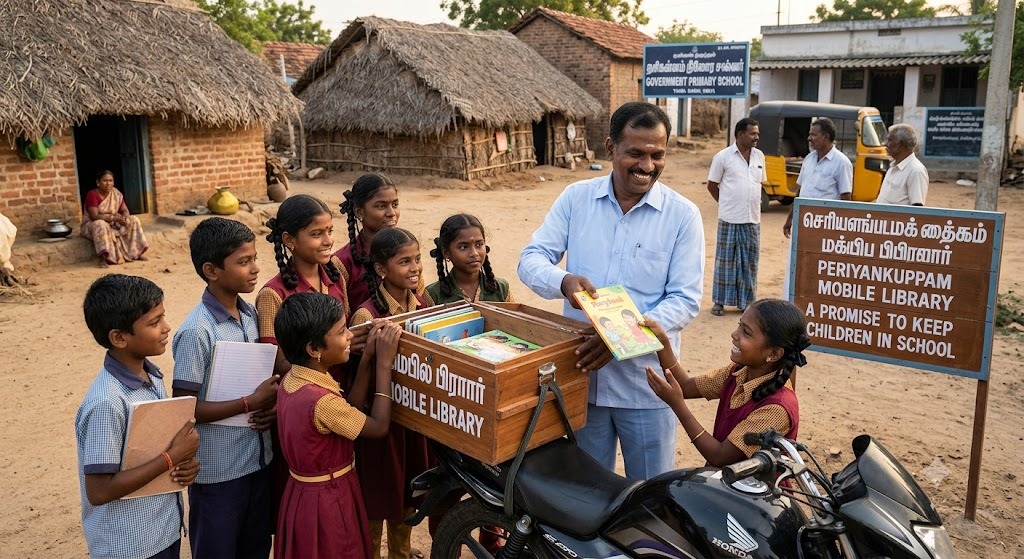
In Tamil Nadu, government schoolteacher Saravanan is taking books to children in a marginalised settlement. But his bigger mission is to help them stay in school and believe in their future.
For children in the Periyankuppam settlement in Tamil Nadu’s Tirupattur district, the sound of a motorcycle engine brings more than excitement. It signals the arrival of storybooks, notebooks and a teacher who wants them to keep learning.
Saravanan, a 44-year-old government schoolteacher from Ambur, carries a box of books strapped to his motorcycle. When he arrives, children gather around him, eager to discover what he has brought. Some look for mathematics notebooks, while others ask for stories that take them beyond their everyday surroundings.
His initiative began with 250 children’s books worth ₹10,000, gifted to him by the National Book Trust of India in recognition of his work. At his wife Shalini’s suggestion, he decided to donate them to children in a nearby Narikuravar settlement, a community that continues to face social and economic challenges.
The children’s excitement gave him another idea. Instead of waiting for them to find a library, why not take the books to them?
That simple thought became a mobile library.
Taking books beyond the classroom
Saravanan has spent 20 years teaching in government schools and was among five teachers from Tamil Nadu shortlisted for the National Teachers’ Award in 2025. Yet, his work in the settlement addresses a challenge that cannot be solved by classroom teaching alone.
For children with limited access to books, a visit from the mobile library offers an opportunity to explore stories, practise reading and discover subjects beyond their textbooks.
Saravanan selects books according to the children’s interests. When one child asks for a storybook, he searches his box and hands her a Tamil title from the Thumbi series.
His aim is to expand their interests a little more with every visit. But he knows that giving children books is only the first step.
The barriers children still face
Education remains difficult to access for some families in the settlement. According to residents, children once had to walk around five kilometres to reach school. This distance contributed to school dropouts. Volunteers have since arranged an auto to help children travel to school.
The challenge does not end with transport. More than a dozen children aged six to 14 attend the Periyankuppam government primary school, while some older teenagers have either continued their studies elsewhere or dropped out.
Girls also face social restrictions that can limit their choices. Madhubala, a resident of the settlement, hopes her daughter will be able to continue her education even after puberty. Her words reflect a wider concern: children need family and community support to pursue their studies.
A promise beyond books
Saravanan wants to bring parents and younger community members together to discuss the importance of education. His longer-term goal is to establish a permanent library where children can read in a safe environment and receive career guidance.
During one visit, he learns that two boys, Thavasi and Manikandan, have stopped attending school. Thavasi explains that he left Class 9 partly because his friend was no longer going to school.
Saravanan encourages both boys not to give up and asks whether they will study if he helps them enrol in Class 10 in the next academic year. They promise they will.
That exchange reveals the real purpose of his work. The books matter, but so does the personal attention that can encourage a child to return to school.
A mobile library cannot remove every obstacle facing these children. However, each visit creates another chance to read, learn and reconsider a future that might otherwise seem out of reach.
For Saravanan, the journey is far from over. His motorcycle carries a box of books, but the promise behind every visit is much bigger: that no child should have to give up on education simply because opportunity has not reached their doorstep.
Subscribe Deshwale on YouTube
