



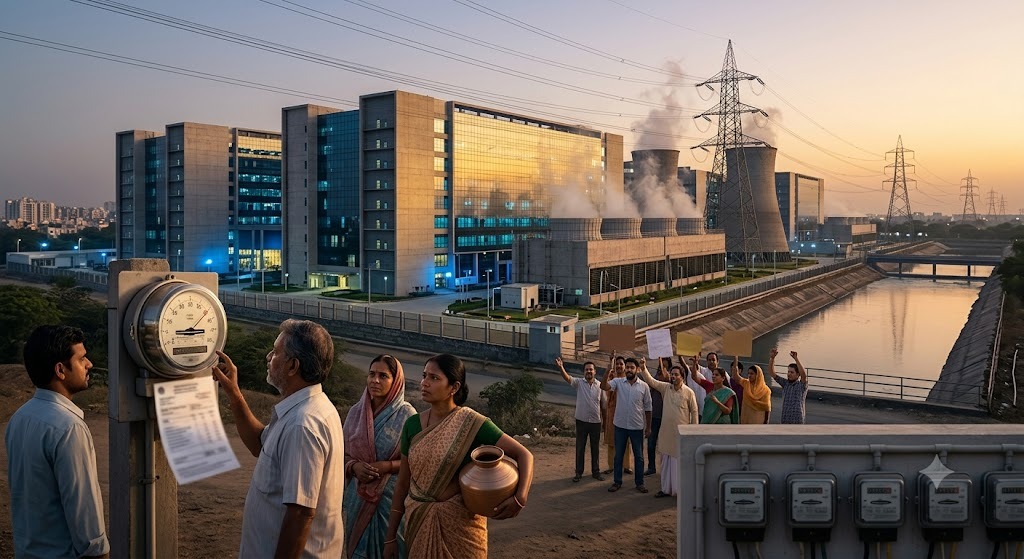
India wants to become a global hub for data centres, but rising electricity demand and concerns over water use are raising an important question: can the country expand its digital infrastructure without putting extra pressure on ordinary consumers?
Every time we save photographs online, watch a video or use an artificial intelligence (AI) tool, data centres help make it possible. These facilities house powerful computer systems that store, process and manage digital information.
However, keeping these systems running requires electricity, while their cooling systems may also need water. As India’s digital economy expands, managing these resources is becoming an important challenge.
Why is india planning a new policy?
On 14 October, Junior IT Minister Jitin Prasada announced that the government was preparing a dedicated policy for data centres. He said India wanted to prevent the sector’s growing electricity demand from putting additional financial pressure on consumers.
India currently regulates data centre projects under existing environmental and building rules, while some states offer incentives to attract investment.
The government sees the industry as a major economic opportunity, with the potential to attract $200 billion in investment. However, the minister did not specify what the proposed policy would include or when it would be introduced.
The announcement highlights the need to balance the country’s digital ambitions with the availability and affordability of essential resources.
The growing demand behind our digital lives
India’s data centre industry has expanded rapidly. According to information published by the Ministry of Electronics and Information Technology in August 2026, the country’s installed data centre capacity had grown from 375 megawatts in 2020 to approximately 1,575 megawatts.
The expansion is being driven by growing demand for cloud computing, AI and other digital services.
These facilities need reliable electricity supplies to operate continuously. If demand grows faster than the infrastructure needed to support it, planning power generation, transmission and distribution becomes increasingly important.
The government has also highlighted energy efficiency, renewable electricity and improved cooling technologies as ways to support the sector’s growth while reducing resource consumption.
Why local communities are raising questions
The debate is not limited to electricity bills.
Residents near an Amazon data centre site outside Mumbai have protested over concerns about power and water use, as well as noise. Environmental concerns have also been raised about Google’s proposed $15 billion data centre project in Visakhapatnam, including its potential impact on wildlife and questions surrounding the use of temple land.
Google and Amazon have denied wrongdoing and said their facilities use advanced technologies to minimise resource consumption.
These differing positions underline why transparent approvals, environmental safeguards and meaningful engagement with local communities matter when large infrastructure projects are planned.
Growth must work for everyone
Data centres can strengthen India’s digital infrastructure, attract investment and support the services that people and businesses increasingly depend on. Their expansion, however, needs careful planning.
The proposed policy could provide an opportunity to establish a clearer framework for managing electricity demand, encouraging efficient cooling systems and protecting local resources.
Its real value will depend on the measures eventually introduced and how effectively they are implemented.
India’s digital future should not be measured by investment figures alone. It should also be judged by whether technological growth remains sustainable, communities are protected and electricity continues to be affordable for ordinary households.
The challenge is not simply to power India’s digital revolution. It is to make sure that its benefits reach people without placing an avoidable burden on them.
Subscribe Deshwale on YouTube
