



Every October, Khadi gets its big moment. The Khadi Mahotsav runs from 2 to 31 October, shops put up banners, and everyone is asked to buy local. This year the sales figure arrived just in time for the celebration. According to the Khadi and Village Industries Commission (KVIC), its products sold for ₹1,87,105 crore in 2025-26, the highest ever. In 2013-14, that number was ₹31,154 crore. Sounds like a victory lap, doesn’t it?
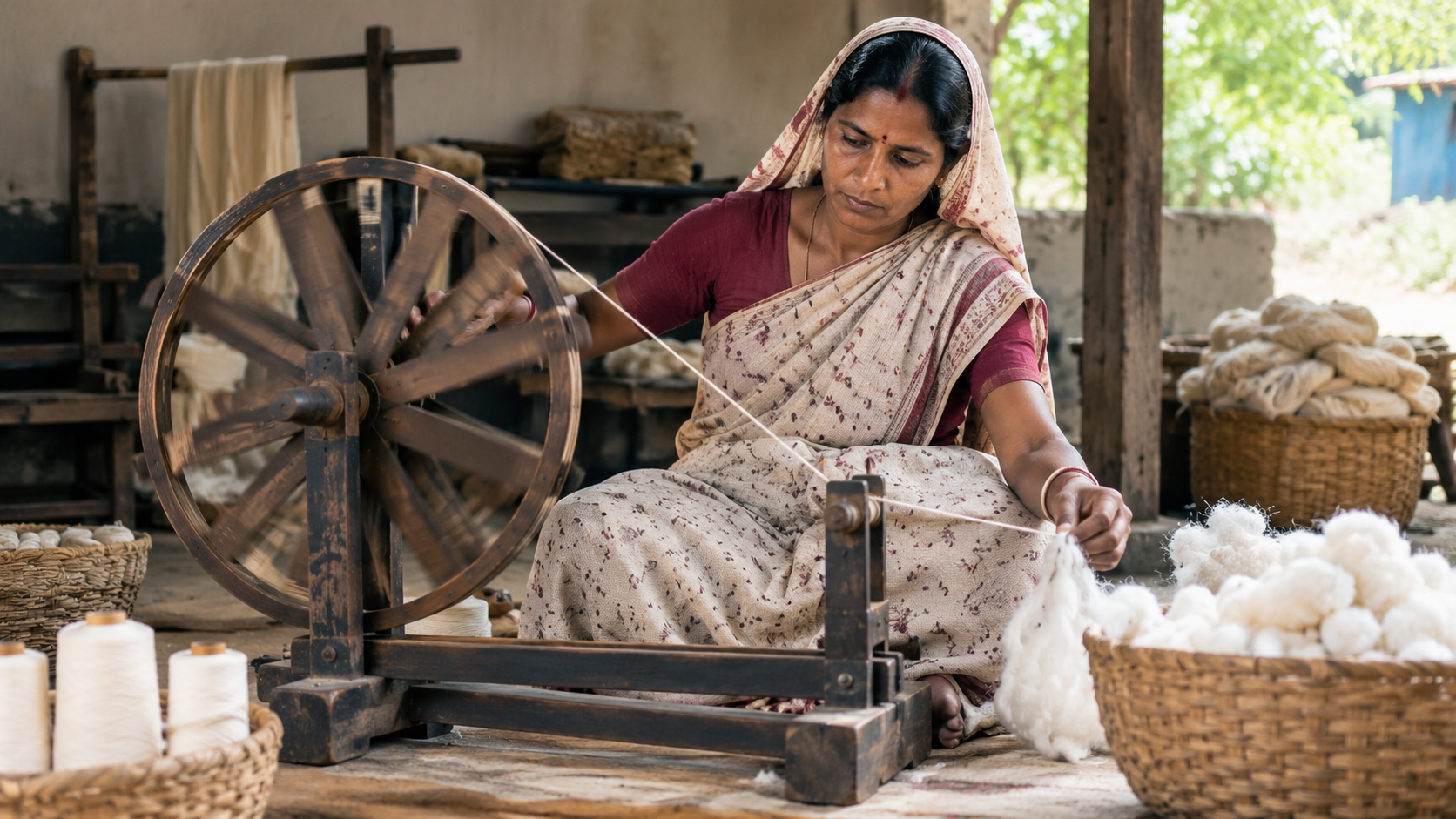
Now picture a woman in a village, sitting at a charkha, turning out yarn. Does she feel 501 per cent richer? Or has the number grown in one place and stayed still in another? That is the question this article is really about.
Start with a small trick of language. KVIC counts “Khadi and Village Industries” as one big family. The family includes honey, bakery items, agarbatti, packaging and herbal products. The actual Khadi cloth, the thing we all picture when we hear the word, sold for ₹7,869 crore in 2025-26. That works out to about four paise of every rupee in the headline.
Khadi cloth is not standing still, to be fair. Since 2013-14, its production has grown from ₹811 crore to ₹3,974 crore, nearly five times, and its sales from ₹1,081 crore to ₹7,869 crore. That is a real revival. It is just a smaller one than the headline suggests.
The rest is village industry, and some of it is genuinely inspiring. Take Jitendra Baitha, who started a bakery unit in Bihar in 2020. It now turns over ₹72 lakh a year and employs 20 people. Or S.P. Singh in Punjab, whose honey and cookies reach 36 countries and keep around 200 workers busy. Both got help from the Prime Minister’s Employment Generation Programme. These are real success stories. But they are the stories of entrepreneurs, not of spinners.
The people numbers tell the same tale. KVIC says the whole sector supports 2.04 crore people. The Khadi sector has around five lakh artisans, and more than 80 per cent of them are women. Those are the hands behind the cloth. That is roughly one in every 40 people in the sector.
So what does that one get? Spinners are paid by the hank, a length of yarn that KVIC puts at 840 yards. In 2013-14, a hank paid ₹4. Today it pays ₹15. A jump of 275 per cent sounds thrilling, until you notice it is ₹11 in actual money.
And ₹11 means different things on different wheels. A 2022 analysis by the Centre for Public Policy Research (CPPR), a think tank, said a traditional charkha produces about two hanks a day, while an eight-spindle new model charkha makes about 20. Do the maths at ₹15, and the old wheel earns ₹30 a day while the new one earns ₹300. That is my own arithmetic, not a KVIC figure. It shows how much the machine matters.
The same analysis was written when the rate was ₹7.50 a hank. It estimated that spinners earned ₹150 to ₹200 a day on average, while unskilled farm work paid ₹362 to ₹400. The rate has doubled since then. I could not find a recent comparison, so it is hard to say where a spinner stands today.
To be fair, things are moving. Spinners’ wages have gone up three times since April 2023. In 2025-26, KVIC trained 79,682 people, and about 59 per cent of them were women. Eligible Khadi institutions can borrow at 4 per cent a year. There is also a scheme to build better workspaces for artisans. But it reached 1,309 artisans up to December 2025, against roughly five lakh in the sector. A good beginning, and a small one.
Then there is a puzzle in the numbers themselves. KVIC says production was ₹1,25,296 crore, yet sales were ₹1,87,105 crore. That is about ₹61,800 crore more sold than made. For Khadi cloth alone, sales of ₹7,869 crore are nearly double the production of ₹3,974 crore. The press release does not explain the gap. There may be an easy answer in how each figure is counted, but it deserves one, in plain words.
So, who really earns from Khadi? Almost everyone in the chain earns something. Entrepreneurs earn from village industries. Khadi institutions earn from sales and support schemes. Artisans earn wages, and those wages are better than they were.
But “something” is doing a lot of work in that sentence. The ₹1.87 lakh crore figure tells us the market is big. It does not tell us what the woman at the charkha takes home when the day ends. Until KVIC shares average daily earnings, how many spinners use the new machines, and how many get work all year, that number is a fine headline and an unfinished answer. So the next time you pay for a Khadi kurta, it is worth asking who made the yarn, and what she was paid for it.
This version is about 816 words and uses the same facts as the checked one. The only new lines are the ones that make the story flow: “one in every 40” is my own calculation, and “four paise of every rupee” is the 4.2% cloth share said in plain words.
Subscribe Deshwale on YouTube
