



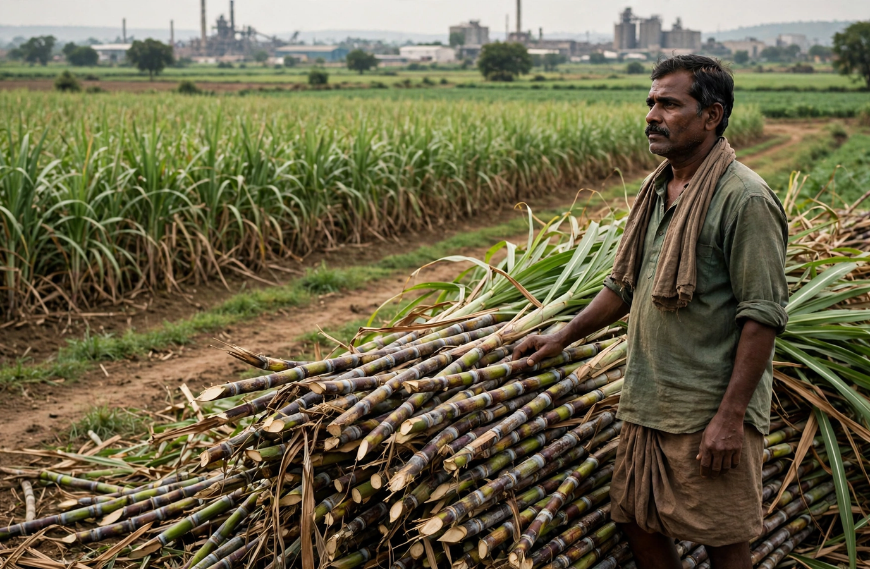
Ask a child what sugarcane is for, and the answer comes quickly: juice, sugar, sweets at festivals. Ask a mill owner, a farmer or a government official, and the answer changes. India grew about 454.61 million tonnes of sugarcane in 2024-25, on roughly 5.4 million hectares of land. That is a huge crop, and many people now want a share of it.
The old uses are still the best known. Cane becomes sugar, jaggery and the cold glass of juice at a roadside stall. Jaggery, made by boiling cane juice until it sets, is still an everyday sweet in many homes. The leaves and tops feed cattle. What is left after crushing is a dry fibre called bagasse, and that is not wasted either. Mills burn it to make steam and electricity for their own use, and some sell extra power to the grid. Scientists at an ICAR institute have even developed a way to make disposable plates from bagasse and banana plant fibre. These are smart uses, and they help the crop go further. But they are not the reason cane is in the news.
The real debate is about ethanol, a fuel made from sugar-rich crops and mixed into petrol. Ethanol made up about 1.5 per cent of petrol in 2013-14. In the 2022-23 supply year the blend was 12.1 per cent; two years later it was 19.2 per cent. The government says India reached 20 per cent blending five years ahead of its original 2030 target. Ethanol blended into petrol has jumped from about 38 crore litres in 2013-14 to about 1,022 crore litres in 2024-25. The government argues that the programme cuts oil imports and helps farmers earn more. Cane juice, syrup and a thick by-product called B-heavy molasses became key raw materials for it.
That has set up a tug of war over the same stalks. A mill can turn cane into sugar for kitchens or ethanol for fuel tanks, but not both from the same juice. Sugar is a daily need, so any shortfall touches every kitchen. Sugar output in 2025-26 fell short of early hopes. Reports say the first estimate of about 34.3 million tonnes was cut to around 30.6 million tonnes, including sugar diverted to ethanol, after crop diseases, waterlogging and bad weather hit key states. About 30 lakh tonnes of sugar went to ethanol. Net output was reported at roughly 279 lakh tonnes, just below the 280 to 285 lakh tonnes the country normally needs.
On 22 October, the Food Ministry told mills they may not make ethanol from cane juice, syrup or B-heavy molasses in the supply year that starts this November. This is not the first swing. In December 2023, the government barred the use of cane juice and syrup for ethanol in 2023-24, then softened the order within about a week, allowing both juice and B-heavy molasses under a cap of 17 lakh tonnes of sugar diversion. For 2024-25, it permitted their use again. How this rule plays out will depend on the next cane crop and on how much ethanol grain can supply.
People read the same facts differently. Government figures show the share of sugar going to ethanol fell from about 12 per cent in 2022-23 to about 9 per cent in 2025-26, which suggests ethanol is not taking a growing share. Others worry that ethanol demand is squeezing sugar supplies. An industry analyst says the 20 per cent target should still be reachable, because grain, including damaged grain and surplus rice, is also allowed as raw material. Both views draw on real numbers, which is why the debate does not end easily.
Water is the cost that rarely makes it onto the list. According to a NITI Aayog report, as cited by Mongabay-India, making one litre of ethanol from sugarcane takes at least 2,860 litres of water. An ICAR-IISR study commissioned by the sugar industry body ISMA puts the figure nearer 2,000 litres, so the number is disputed. Still, farmers like the crop. Mills must pay a minimum price, the fair and remunerative price, and it has risen from ₹285 per quintal in 2020-21 to ₹355 for 2025-26. When a crop pays reliably, it is hard to ask farmers to grow less of it. For a farmer, the question is simple: will the mill buy my cane, and at what price? For a household, it is whether sugar stays affordable. For an oil company, it is how much ethanol it can blend.
So what is sugarcane really for? The honest answer is that it is for many things at once, and those things now compete. Food, fuel, farmers’ incomes and water cannot all be maximised together. Each choice costs something somewhere else. India is the world’s second-largest sugar producer after Brazil, so these choices matter beyond our own borders too.
Next time you drink a glass of cane juice, it may look different. That simple stalk is part of the kitchen, the fuel tank, a farmer’s income and the water table. The question may not be what else we can make from it. It may be what we should make first, and who gets to decide.
Subscribe Deshwale on YouTube
