
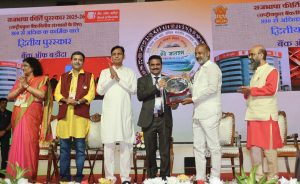





Arijit has won more than 125 awards. Yet the biggest award remains the love of the people. Even most critics and ordinary listeners who tend to look down their noses at new singers hold a positive view of Arijit
Sanjay Vinaychandra Shah
From being a finalist on ‘Fame Gurukul’ in 2005 to securing an unshakable place in the hearts of crores, Arijit Singh took less than a decade. In a short span, he cultivated a long journey, and honestly speaking, a far longer road still lies ahead of him. Yet, at just 38, Arijit has declared ‘enough’ to the world of playback singing. Think about it! In such an influential career, he has lent his voice to only around 800 songs, a conservative estimate. Another estimate puts it closer to 1,200, yet even that figure is not particularly large.
Compare this number with the immortal playback singers of yesteryears. Mohammed Rafi sang over 7,000 songs. Kishore Kumar around 3,000, Mukesh around 1,300, Asha Bhosle around 12,000, and Lata Didi around 6,000. Some claim an even larger figure for Lata Didi, anywhere from 30,000 to 50,000. Perhaps.
Those who reached the pinnacle before Arijit, Udit Narayan and Sonu Nigam, have sung over 2,000 each; Kumar Sanu around 1,800 (though claims are made for far more), and Alka Yagnik over 2,500 so far.
So the question arises: after so few songs, with a glorious career of many more years sparkling before him, why has Arijit chosen retirement?
Consider the average output across his career years. For nearly two decades, he has sung roughly one song per week. Beyond that, he has performed live shows, concerts, and toured domestically and internationally. Unlike many other singers, however, he has avoided overexposure through reality shows and the like. After appearing on ‘Fame Gurukul’, he participated in and won ‘10 Ke 10 Le Gaye Dil’ the following year. Thirteen years later, he became a judge on ‘Indian Idol’ – that’s all. In public events, ribbon-cutting ceremonies for money, meaningless or unrelated statements, or appearances, Arijit has never indulged. A constant aura of mystery and exclusivity has surrounded him. Combined with his powerful voice, this exclusivity has cemented an unshakable place for Arijit in the hearts of his fans.
Arijit has never courted controversy. Yes, in 2014, a controversy did briefly engulf him. That year, he won the Filmfare Best Male Playback Singer award for ‘Tum Hi Ho’ from ‘Aashiqui 2’. When he stepped onto the stage to receive it, Salman casually asked, “So ja rahe the?” Arijit, equally casually, replied, “Aap logon ne sula diya tha…”
His appearance, in the eyes of many purists, was deemed unfit for such an occasion: army-print trousers, a checked shirt, and sandals instead of shoes.
Salman perhaps took Arijit’s reply personally, finding it insulting. For years afterwards, Arijit received no opportunities to sing in Salman’s films. Rumours even circulated in the industry that many films dropped him because of Salman. But there is little substance to that claim. It is possible Salman chose to keep Arijit’s voice away from his films, an entirely personal preference or grudge. Coincidentally, just three or four days before Arijit’s retirement announcement, one of his songs was released, for Salman’s upcoming film ‘Battle of Galwan’.
Returning to Arijit’s so-called retirement: why should this young singer, who sits at the very summit of a field now dominated by fleeting trends, choose to halt playback singing?
When we evaluate Arijit’s career so far, he has undoubtedly remained above average – distinct and elevated from the ordinary.
In his social media announcement and accompanying clarification, Arijit made it clear that stepping away from playback singing does not mean disconnecting from music altogether. Instead, he wishes to focus on a different kind of music. Perhaps the deep hunger for inner creativity is what Arijit has cited as the reason for distancing himself from playback. According to some knowledgeable people, he may now gravitate towards Indian classical music.
Looking back: Arijit once shouldered the responsibility of music composition in the film ‘Paglaait’. Beyond that, he has not worked as a composer. Perhaps now he will move in that direction, who knows? It is also possible he will create and release independent music. Once, Arijit remarked that the film industry does not adequately reward creative talents for their contribution. This comment may indirectly relate to his decision, though it can be said with certainty that Arijit would not take such a major step merely for money. If money were his primary goal, he would not have turned his back on the lucrative world of playback singing. He earns no less than Rs. 10 lakhs per song. Some estimates suggest he commands as much as Rs. 25 lakhs per track!
With two National Awards, eight Filmfare Awards (three separate for Bengali songs), five IIFA, four Screen, 27 Mirchi, five GiMA, seven Zee Cine, and one Times of India award, almost 125 awards in total, Arijit has won them all. Yet the biggest award remains the love of the people. Even most critics and ordinary listeners who tend to look down their noses at new singers hold a positive view of Arijit.
Arijit also runs a restaurant named Heshel in his hometown of Jiaganj, Murshidabad. It has not even completed a year. His father, Gurdayal Singh, manages its operations. The restaurant’s main feature is serving wholesome, nutritious food for just ₹40 (₹30 for students). However, very few details about this restaurant are publicly known, so verifying the accuracy of this information is somewhat difficult.
It is not wrong to accept that Arijit comes from simple roots, but this is not the age to retire from playback singing.
Were there any singers before him who did something similar? Kishore Kumar, in the 1970s–80s, stopped singing for certain producers and directors. He also distanced himself from giving interviews and attending award functions. Yet it was not a complete retirement from singing. In fact, he remained active until his last breath. Before him, Hemant Kumar, in the 1960s, reduced his singing during the height of his shining career and turned instead to music composition. In Bengali, he created a substantial body of non-film music during that period. In the 1970s-80s, Yesudas distanced himself from Hindi film playback singing and focused on classical, devotional, and South Indian music. S. P. Balasubrahmanyam, at one stage, deliberately reduced his singing to make way for younger voices.
The most recent case somewhat close to Arijit’s might be Lucky Ali’s – he refused playback singing after reaching the peak of his career.
The long-term impact of Arijit’s decision will become evident in time. Whether he will reverse his stance and return to playback singing, time alone will tell. What he does next in non-film or at least non-playback singing will also be revealed by time. One thing can certainly be said: Arijit’s decision is unimaginable. The resolve we see in the Arijit we know, or perhaps do not fully know, feels striking. Following his own image and genuine detachment up to now, whatever he does next is likely to be first-rate. That assumption is not misplaced.
All the best, Arijit.