








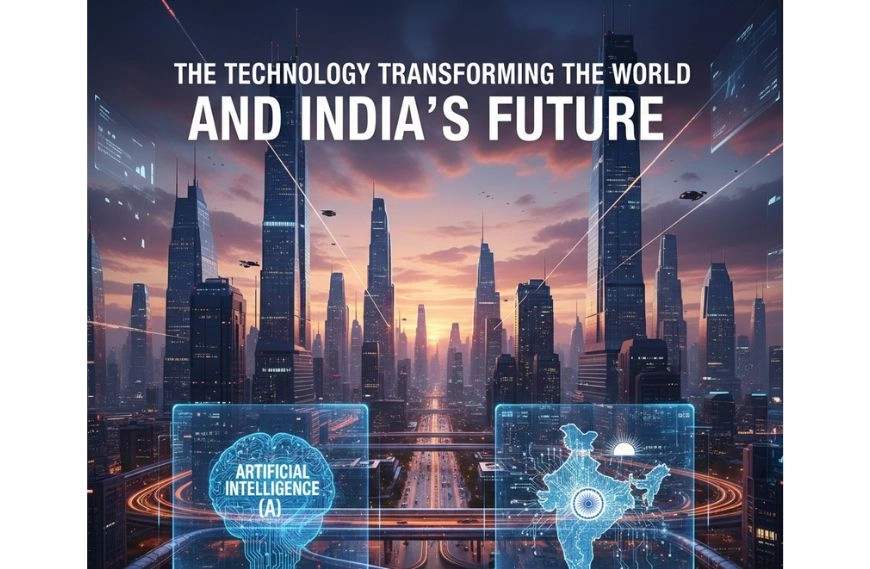
Nowadays, the world is constantly changing, and at the heart of this transformation is Artificial Intelligence (AI), emerging as the most important and powerful technology. AI is a technology where computers learn, think, and make decisions like human intelligence. From smartphone voice assistants to robots used in large industries, AI is leaving its impactful footprint in every sector. This technology is giving new direction to the economy and improving business efficiency.
According to economic analysts, by 2035, AI could increase the global GDP by nearly 15%, which is equivalent to trillions of dollars in contribution. Major countries worldwide, especially the USA, China, and Europe, are competing to advance in this field. By 2025, more than 100 leading AI models will be available globally, with the USA dominating more than 60%. Not only that, China is also advancing intellectually, while India and other European countries are steadily progressing in AI development.
Automation is the primary impact of AI on business transformation. It reduces human labor, saving both costs and time. Use of AI has already reduced operational costs by 20 to 30%. Market trends are analyzed quickly, enabling faster and more accurate decisions. Customer service has also become more personalized and faster because of AI, helping businesses stay competitive. In 2025, the global AI market was valued at $63.8 billion and is expected to reach $368 billion by 2034.
Concerns about jobs and AI are common, but the reality is that AI automates some routine and manual tasks while also creating 92 million new jobs by 2030. New job roles include AI engineers, data scientists, and automation managers. Therefore, AI will not eliminate jobs but will change their nature and type.
Learning AI has become essential for every businessperson because it simplifies market analysis, increases sales, and reduces costs. Leaders who master AI after 2025 will be the ones to succeed in the market. AI’s process includes four primary stages: collecting data, processing through machine learning, producing accurate conclusions, and continuous improvement.
Data centers are crucial for AI. These powerhouses with high-capacity computers train and run AI models. In 2025, there are over 12,000 data centers worldwide, with India playing a significant role. The Gujarat government has started a modern AI data center with a capacity of 40 MW in GIFT City, which is a major achievement for the state.
The USA is the global leader in AI because it invests 75% of global funds and hosts giants like OpenAI and Google. It has the most talented technical teams, and around 70% of American companies use AI technology.
Talking about India, to progress in AI, it is necessary to strengthen skill development, open more data centers, and implement policies like ‘AI for All.’ India has the youth power that can bring revolutionary change in AI. To increase AI usage, technology must be made more accessible.
By 2025, approximately 1.7 to 1.8 billion people will have used AI, including 900 million active users. Eleven percent of the world’s population is now actively using AI. The sectors showing the most growth due to AI are healthcare, finance, manufacturing, retail, and education, where growth potential is estimated at 35%.
Thus, AI is not just a technology but a powerful center for the coming decade. Countries and businesses that adopt AI rapidly will be the future winners. Gujarat and India are advancing quickly in this direction, and the future of this sector looks very bright.


Secretary — InGlobal Business Foundation (IBF)
Director — ReNis Agro International LLP, Ahmedabad, India
Subscribe Deshwale on YouTube