









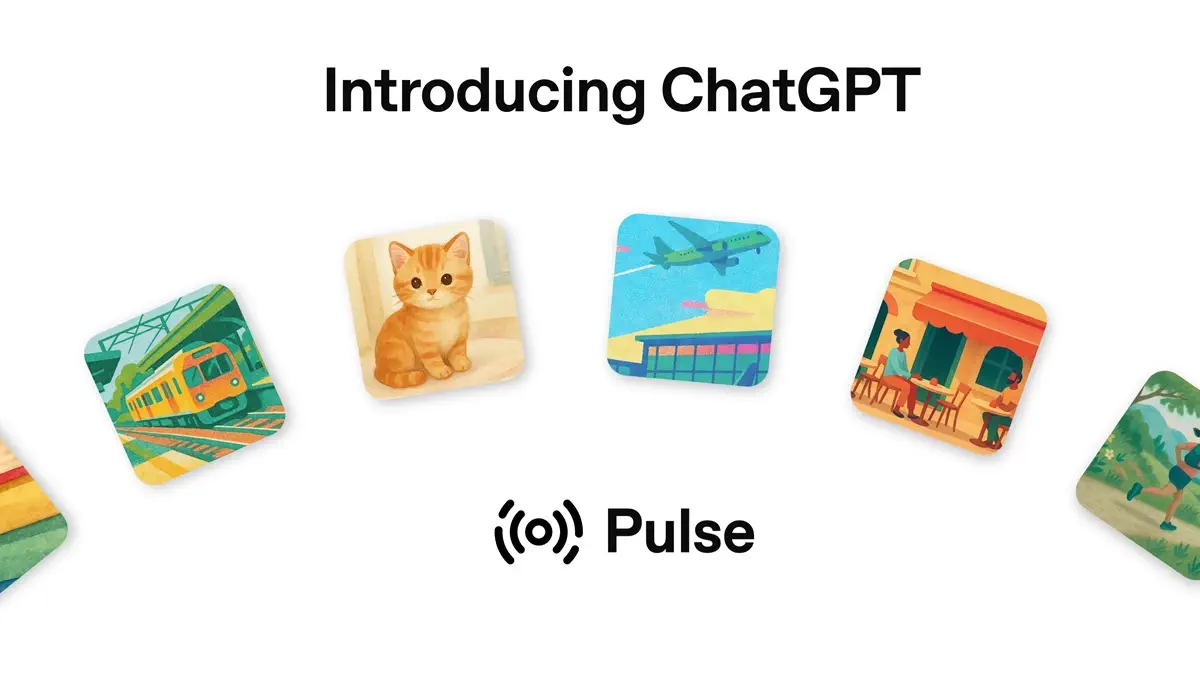
Every now and then, technology takes a step that quietly changes how we interact with it. The launch of ChatGPT Pulse feels like one of those moments. Until now, ChatGPT worked in a reactive way. You asked, it answered. Useful, yes, but limited. With Pulse, that script flips. Instead of waiting for your prompt, it prepares a daily personalised briefing for you. And it does this while you’re asleep, so by the time you wake up, your day already has a head start.
Imagine this. You roll out of bed, pick up your phone, and instead of scrolling through endless feeds of half-relevant content, you see a crisp set of cards. They give you the updates you care about, maybe remind you of a meeting, suggest a recipe, highlight a local event, or flag a news story tied to your interests. That’s Pulse. It’s not just giving you information when you demand it, it’s learning from your habits and nudging forward what you’re likely to need.
The experience is designed to feel simple. You don’t get flooded with paragraphs or technical chatter. Instead, five to ten visual cards appear, each carrying something useful. Over time, you can refine these by giving feedback. A thumbs up, a thumbs down, or using the curation option to cut what feels irrelevant or add what’s missing. It adapts, just like a good personal assistant would.
The real shift here isn’t about a new feature in the app. It’s about what it represents. For years, AI assistants were reactive tools. You typed a question, they produced an answer. That’s handy, but it keeps all the work on your side. Pulse marks the start of a more proactive era. It’s the AI saying, “Here’s what you might want to know before you even ask.” That subtle change has the potential to redefine what an assistant actually means.
Of course, this kind of anticipation raises questions. The first is privacy. For Pulse to be helpful, it has to draw from your activity, past chats, and, if you allow, your calendar or email. The key word there is choice. Nothing is forced. Integrations with tools like Gmail or Google Calendar are optional. You decide if you want AI to peek into those corners of your life. And if at any point you feel uneasy, you can disable memory, unlink apps, or even switch Pulse off entirely.
The second question is reach. Right now, Pulse is limited. It’s being rolled out in preview, available only to Pro users on mobile. It’s not on desktop or web yet, and that’s intentional. Processing these personalised reports is computationally heavy, so early access is being kept tight. Over time, as efficiency improves, it’s likely to reach a broader audience. But at this stage, it’s still a glimpse into what’s coming rather than a universal shift.
And then there’s the question of accuracy. If AI is going to serve up information before you ask, it has to be trustworthy. To handle that, updates are passed through filters designed to avoid misleading or harmful content. It doesn’t mean perfection, but it shows awareness that proactive AI carries more responsibility than reactive responses.
Now, let’s step back. Why does this matter? Because we’re living in an age where information overload is a daily struggle. Notifications, headlines, alerts, endless scrolling — all competing for our attention. The idea of something trimming that noise into a curated set of highlights is appealing. It doesn’t just save time, it saves focus. Instead of searching for what matters, it comes to you.
This is also a sign of where AI is heading more broadly. The dream of an assistant that truly acts on your behalf has been around for decades. But until now, we’ve had glorified search engines that dress as assistants. Pulse may look small today — just some daily cards — but it represents the early steps toward an AI that anticipates needs, plans ahead, and actively collaborates in running your day. That kind of shift will change how we measure productivity, efficiency, and even trust in technology.
The interesting part is how it might blend into culture. Think about how normal it feels now to say, “Just Google it.” One day, we may just as casually say, “Check Pulse.” Because it’s not about searching anymore. It’s about receiving. The role of AI in our lives may shift from tool to companion, from a reactive presence to a proactive partner.
For now, Pulse remains in its early stages. You might not have it yet. You might not even feel you need it. But consider the direction it points to. A future where AI isn’t waiting for you to think of the right question but is already working to give you the right answer. A future where mornings don’t begin with doom-scrolling but with clear, useful updates that matter to you.
That’s the promise here. And it explains why this feature has sparked so much attention. It’s less about what Pulse does today and more about what it signals for tomorrow. The AI world is moving from passive response to active anticipation, from answering to assisting.
ChatGPT Pulse is still just a preview, but it carries weight beyond its current form. It shows a glimpse of how our relationship with technology could change in the next few years. Not as a replacement for our decisions, but as a layer that filters, simplifies, and supports. It’s early, imperfect, and limited. But it’s also exciting. Because for the first time, AI isn’t just reacting to us. It’s preparing for us. And that shift could make all the difference.
Note: ChatGPT pulse is currently available for Pro users on iOS and Android, only.


