 Deshwale
Coloured dots on food packets: a hidden code or just a printing guide?
In brief · AI summary The coloured dots and squares on snack packets are not a secret code but printing and packing marks: colour check patches help printers keep ink consistent, and eye marks guide packing machines where to seal and cut the film. The marks are meant for machines and manufacturers, not buyers, and they say nothing about ingredients, safety or health, which are shown on the label.
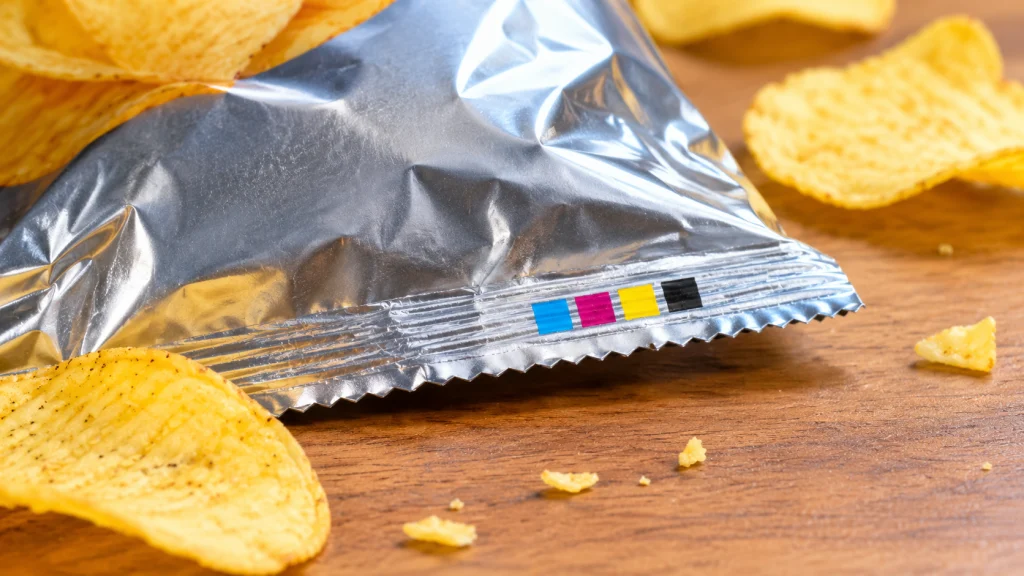
They sit quietly near the edge of your chips, biscuit and namkeen packets. Most of us never look twice. Some people swear they are a secret code. Here is what they actually are.
You are halfway through a packet of chips when you spot them. A row of small coloured squares, or a neat little dot, near the edge of the wrapper. Red, blue, yellow, black. Maybe a green one. For a moment, you wonder. Is this a code? Does the colour tell me something the company does not want me to know?
You are not the only one asking. This question has been going around the internet for years, and the honest answer is simpler, and a bit more interesting, than any secret code.
The rumour usually begins with toothpaste. A widely shared message claims that the coloured square at the end of a toothpaste tube reveals what is inside. Green means “natural”. Blue means “natural plus medicine”. Red means “natural plus chemical”. Black means “pure chemical”. It sounds convincing, which is why it spread. But fact-checkers, including Snopes, Lead Stories and Science Feedback, have looked into it and found it false. Colgate has also said that companies do not use colour squares to hide ingredients from buyers. The same idea then travelled to food packets, and people began reading colours on chips and biscuit wrappers as warnings or labels. There is no such system.
So what are these marks? Different marks on a packet do different jobs, and all of them are meant for the people and machines that make the packet, not for the person who buys it.
The first kind is a colour check patch. Most packaging is printed using four basic inks: cyan, magenta, yellow and black, together called CMYK. By mixing them in different amounts, printers create every picture, logo and shade you see on a packet. The trouble is that ink can drift by a small amount during a long print run. Too much of one colour, and the red of a brand’s logo starts to look different. So printers add small patches of colour, often called process control patches or colour bars. Technicians measure these patches with an instrument called a densitometer, which reads how dense the ink is. If the numbers drift, they adjust the machine. The point is simple: the packet you buy on Monday should look the same as the one you buy next month, even if it was printed in a different batch or at a different factory.
The second kind is the one most people are curious about. It is called an eye mark, or a registration mark. Snack packets are usually made from a long roll of printed plastic film. A packing machine pulls the film forward, shapes it into a tube, fills it with chips, seals it and cuts it into separate packets. All of this happens very fast. But how does the machine know exactly where to seal and cut? Through small printed marks on the film. A sensor, often called a photo eye or electric eye, spots each mark as it passes and tells the machine where the film is, so the cut lands in the right place and the picture on the front is not sliced in half. Think of it like the dotted line on a coupon that says “cut here”, except this one is meant for a machine, not for you.
You may notice that these marks look different on different packets. That is because there is no single standard. The colour, shape and position of the marks depend on the design of the packet and the machine that handles it. Some are small rectangles and some are dots. Some sit in the sealed edge, and some are cut away before the packet reaches you. This is also why trying to “decode” them is pointless. Two packets with the same coloured mark can have completely different contents. The mark tells you about the machine, not the food.
Things get confusing because India does have a colour system on food packets. It just looks different from the printing marks. Under the rules of the Food Safety and Standards Authority of India (FSSAI), packaged food must carry a symbol showing whether it is vegetarian or non-vegetarian. Vegetarian food is marked with a green filled circle inside a square with a green outline. Non-vegetarian food carries a brown filled triangle inside a square with a brown outline. These symbols are meaningful, legally required and clearly printed on the label. The small coloured dots at the edge of the packet are not related to them in any way. One more detail: if a product contains egg as its only non-vegetarian ingredient, the maker has to give a declaration for that, along with the symbol.
Can the marks tell you whether a food is safe or healthy? No. They say nothing about ingredients, preservatives, artificial colours or nutrition. They are simply a tool for printing and packing. If you want to know what is in your food, look at the label. The ingredient list, the nutrition information and the FSSAI veg or non-veg symbol are the places to check, because they are there for you.
The tiny dots on your chips packet are not a secret language. They are the leftover footprints of how your snack was made: a quality check for the printers and a “cut here” signal for the machines. So the next time you spot them, you will know the truth. Nobody is hiding anything from you in that little coloured square. It is just a machine doing its job.
Subscribe Deshwale on YouTube