



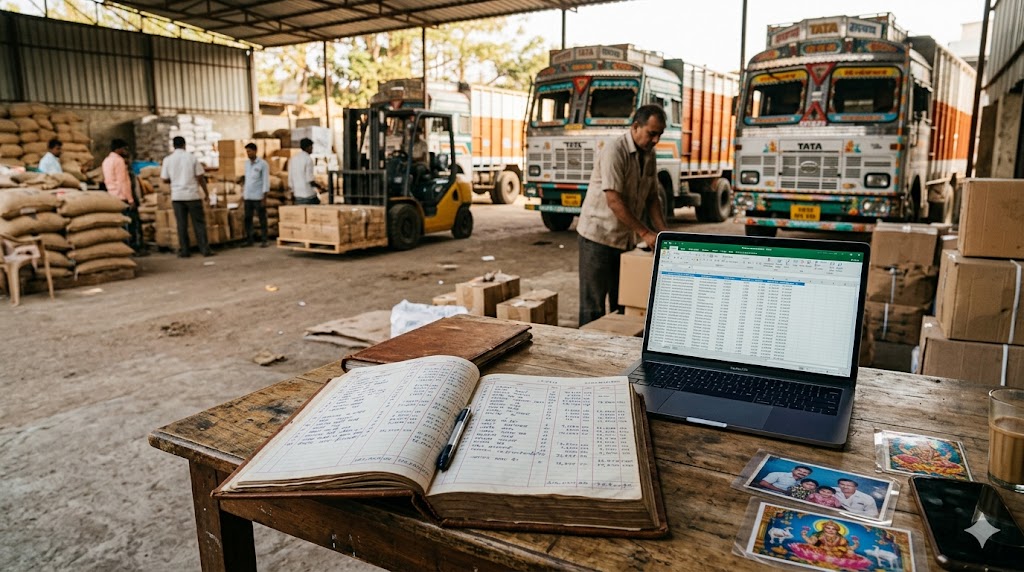
India generates some of the world’s largest volumes of digital data. Yet hardly any Indian business recognises it as an asset on its balance sheet. That is not a minor oversight. It is a slow-motion economic risk.
Ramesh Choudhary runs a mid-sized logistics firm in Nagpur. Over 14 years, he has built 340 employees, 80 trucks and routes across 11 states. His operations software logs 6,000 data points daily, covering delivery times, fuel efficiency, customer complaints, weather impacts and driver behaviour. Most of it sits unused in a server costing 18,000 rupees a month. When his bank sought collateral for a 2 crore rupee loan, Ramesh offered property papers and vehicle lists. Neither he nor the banker considered that his operational data might be worth more.
That is not just Ramesh’s blind spot. It is India’s.
I. The Word Beijing Used First
On 30 March 2020, China’s Central Committee and State Council designated data as the fifth factor of production, alongside land, labour, capital and technology. It was a structural declaration, not rhetoric.
In August 2023, the Ministry of Finance issued accounting standards allowing companies to recognise qualifying data as inventory or intangible assets. By late 2024, dozens of listed companies and more non-listed ones had begun doing so. China Unicom, for instance, reported significant data assets in its earnings. The precedent matters. China looked at what it owned, valued it and put it on the balance sheet.
The rest of the world is still figuring out what to call it.
II. What Is a Digital Asset and Why It Changes Everything
A digital asset is data your organisation legally controls that can be reliably valued and has clear potential to generate economic value. It is not the servers or software. It is the data itself.
For Indian businesses, this means:
- The Surat kirana store’s six-year customer purchase patterns.
- A Chennai hospital chain’s insights from 200,000 procedures.
- A Pune agri-tech firm’s soil and yield data from 40,000 farmers.
- A Tiruppur textile exporter’s quality-control logs that could train superior AI systems.
Few have inventoried it. Fewer have borrowed against it or licensed it.
Placing digital assets on the balance sheet does three things property deeds cannot. It boosts net worth and creditworthiness, unlocks new financing through data-pledge loans and investor premiums, and forces strategic clarity over what you actually own.
The uncomfortable question is this. Do you know what data your company holds, its value and who else might already be using it?
III. The Colonisers Are Already Here
US tech giants built empires by extracting behavioural data, packaging patterns and selling influence back, often through infrastructure India helped build. Google, Meta, Amazon and Microsoft now have major stakes in dozens of long-distance submarine cables, the routes along which India’s data travels outward. In 2010, they owned one. Today, their collective involvement is extensive.
India generates enormous data, driven by more than 800 million internet users, UPI transactions and everyday activity across sectors. Much of it flows offshore, gets processed and monetised abroad, then returns as products with little local wealth retention or taxation. Mukesh Ambani called data the new oil. The difference is that with oil, ownership was clear before extraction. With data, rights were often signed away before awareness.
This is modern resource extraction. The powerful name things cleverly. Extraction becomes “connection” or “innovation.” Reclamation becomes “protectionism.”
IV. The Word Nobody Is Using: Sovereignty
At the heart of this is sovereignty, a people’s right to control what belongs to them.
India’s data belongs to India, not to servers in Oregon, Dublin or elsewhere. The Digital Personal Data Protection Act of 2023 exists, and rules were notified in November 2025, with phased implementation and substantive obligations largely in place by mid-2027. Yet enforcement and supporting frameworks lag. The National Data Governance Framework has remained in consultation stages for years.
China treated data as production. The US treated it as product. India has often treated it as “complicated.” In a data-driven economy projected to contribute substantially to GDP, hesitation carries real costs.
V. What Indian Business Must Do Now
The gap is less about policy than about consciousness. Chinese firms moved because they saw competitive reality. Companies unable to demonstrate data assets will be valued at a discount.
Practical steps for those who wish to act:
- CFOs should conduct a value audit of data holdings, covering inventory, applications including internal use, licensing and AI training, compliance under the DPDPA and conservative valuation.
- Banks should develop data-backed lending frameworks, building on existing models for gold or equipment.
- Startups should treat accumulated proprietary data as a core moat, not a byproduct. Investors should probe data quality and defensibility.
- Government must move beyond drafting. Governance frameworks must be implemented with urgency. India’s digital scale demands action, not aspiration.
The Close
Ramesh Choudhary’s Nagpur server still logs 6,000 daily data points, patterns and predictions hiding in plain sight.
His company is not just logistics. It is a data business that moves goods. Recognising that will decide whether the next generation inherits a thriving enterprise or an outdated operation.
The fifth factor of production has a name. Balance sheets in Beijing and San Francisco are already reflecting it. India’s data, generated by its people, should fuel Indian wealth, not subsidise others.
We have seen this story before. Outsiders arrive with superior tools and the certainty that locals undervalue their own resources. The ships look different now. The certainty has not.
The time to name, value and claim what is yours is now.
