



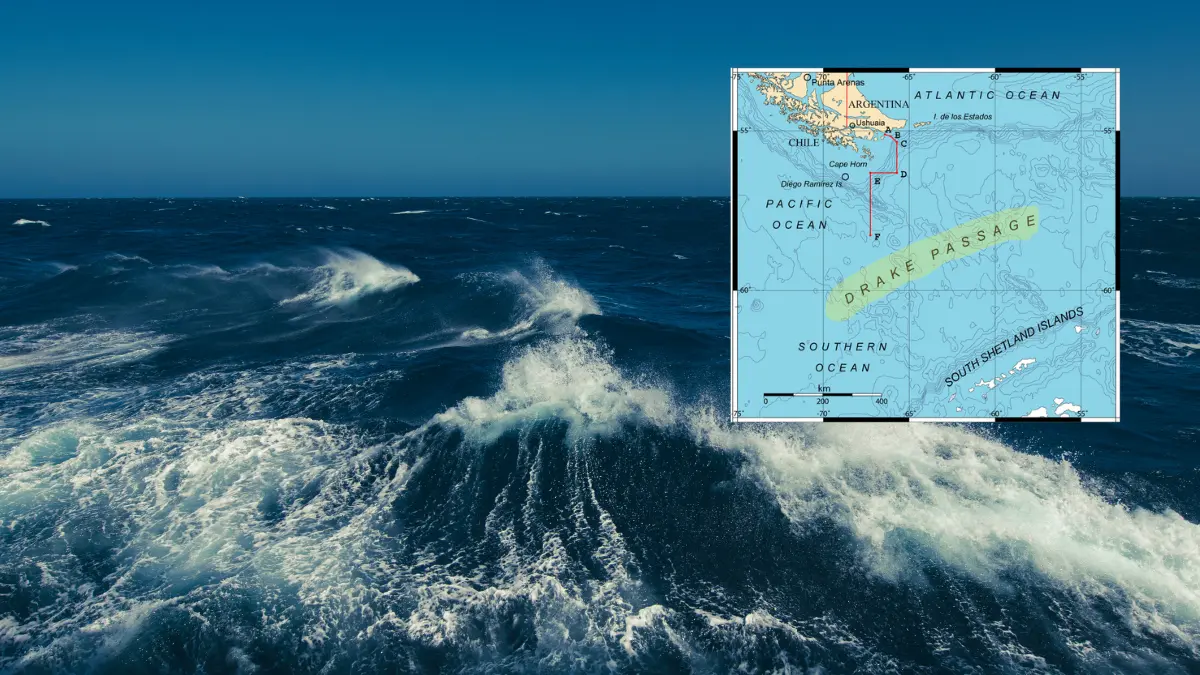
The Drake Passage is one of the most legendary and challenging sea routes in the world. Situated between South America’s Cape Horn and Antarctica’s South Shetland Islands, it is often called the gateway to the White Continent. This narrow stretch of ocean connects the Atlantic and Pacific Oceans, making it a critical passage for explorers, traders, and modern-day adventurers.
A Vital Route in Maritime History
Before the Panama Canal opened in 1914, the Drake Passage was a vital route for trade in the 19th and early 20th centuries. Ships had no alternative but to navigate its stormy seas and icy conditions to round Cape Horn. For the sailing vessels of the time, this was considered a true test of skill, courage, and endurance. The unpredictable weather, fierce winds, and powerful currents made each journey perilous.
Depth and Ocean Floor Composition
The passage has an average depth of about 11,000 feet (3,400 metres), with the deepest regions reaching up to 15,600 feet (4,800 metres) near its northern and southern boundaries. The ocean floor is covered with a mix of sandy and clayey silts near Tierra del Fuego, while closer to Antarctica, ice-rafted materials dominate, carried by icebergs over the centuries. These sediments tell a story of two continents, South America and Antarctica contributing to the passage’s unique geological character.
Climate and Weather Patterns
The Drake Passage is infamous for its harsh weather. Winds predominantly blow from the west, with their strongest force near Cape Horn. Cyclones often sweep across the southern edge of the passage, creating challenging sailing conditions. The mean annual air temperature ranges from 41 °F (5 °C) in the north to 27 °F (−3 °C) in the south. Surface water temperatures vary from 43 °F (6 °C) to 30 °F (−1 °C), with a sharp shift around the Antarctic Convergence at 60° S latitude.
Sea ice cover changes with the seasons. In late summer (February), the passage is mostly ice-free. In September, maximum ice cover occurs, with up to full coverage extending to 60° S and occasional ice floes reaching Cape Horn.
The Power of the Antarctic Circumpolar Current
The waters of the Drake Passage form a crucial part of the Antarctic Circumpolar Current, the largest ocean current in the world. With an estimated flow between 3,400 and 5,300 million cubic feet (95 and 150 million cubic metres) per second, it moves predominantly from west to east. The current accelerates due to the constriction of the passage, reaching its peak around 60° S. Exiting the passage, most water continues eastward, while a branch called the Falklands Current flows north into the South Atlantic.
Rich Marine Life
The Drake Passage is rich in marine biodiversity. Plankton, especially krill, thrive in these nutrient-rich waters and form the foundation of the food chain for blue and fin whales, squid, emperor penguins, and crabeater seals. Antarctic cod is the most common fish here, along with the unique Chaenichthyidae or icefish, which have no detectable haemoglobin in their blood.
Travelling the Drake Passage
Is it safe to sail through the Drake Passage? Modern cruise ships are well-equipped to handle its unpredictable conditions, with stabilisers that reduce pitching and rolling at sea. While the passage is known for strong winds and turbulent seas, crossings are not always rough.
December and January, during the Antarctic summer, are considered the best months for a smoother passage. Early and late in the season, rough seas are more likely.
A Journey Like No Other
For many, crossing the Drake Passage is an adventure in itself. It offers a rare opportunity to witness nature at its most untamed – massive waves, icy winds, and the possibility of calm waters that reveal the serene beauty of the Southern Ocean. Whether braved by sailors of the past or travellers of today, the Drake Passage remains one of Earth’s most fascinating and formidable sea routes.
On Friday, 22 August 2025, a powerful magnitude-7.5 earthquake rattled the Drake Passage, roughly 700 km southeast of Ushuaia, at a shallow depth of around 11 km. The quake serves as a stark reminder: this remote stretch is not only shaped by the capricious sea but also by shifting earth, both forces in constant dialogue.
