



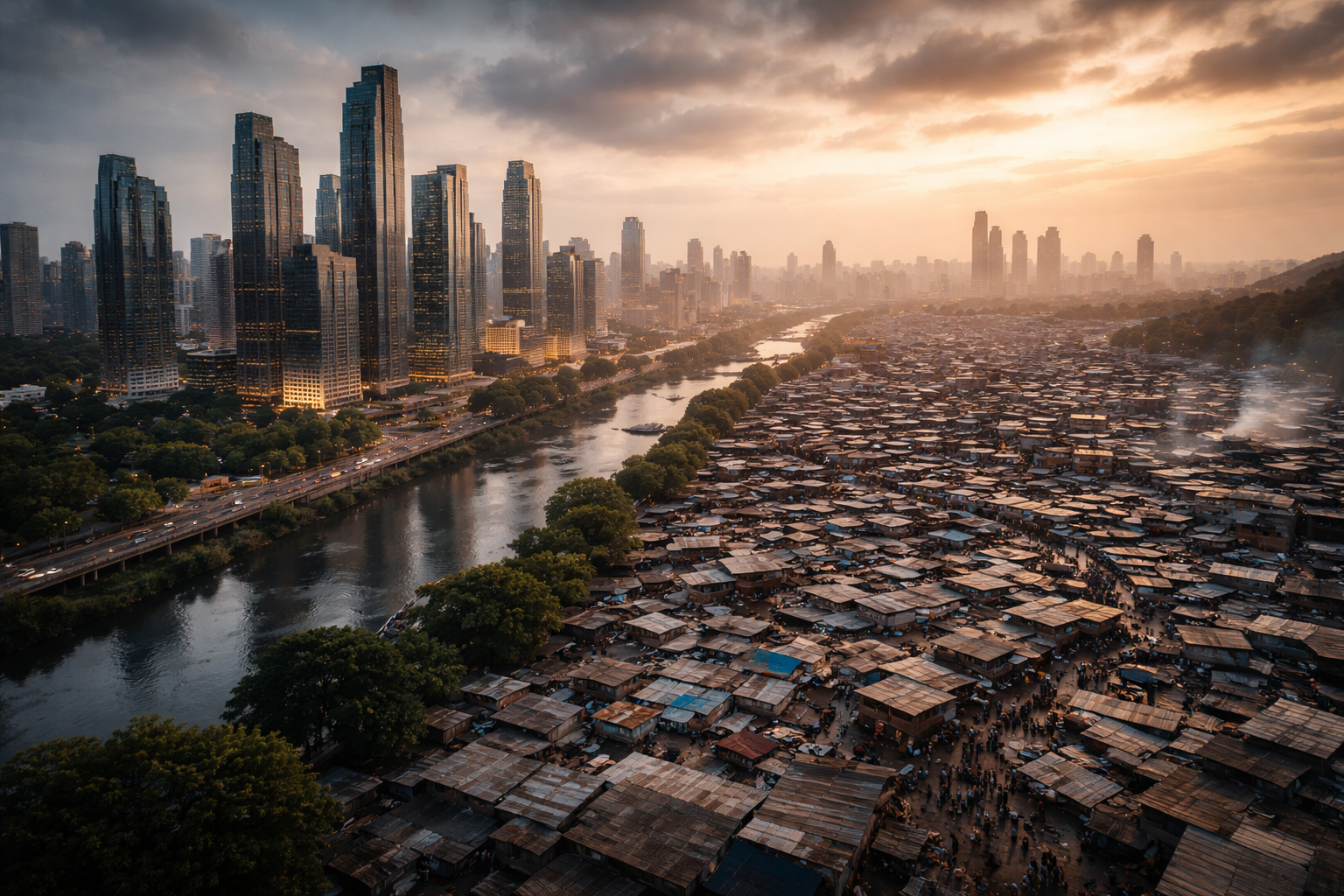
If conflict reveals where the world is breaking, inequality reveals why. Over recent decades, global economic output has expanded dramatically. New technologies have transformed industries. Financial markets have deepened. Yet the distribution of these gains has been strikingly uneven.
A small fraction of humanity now controls a dominant share of global wealth. Meanwhile, billions live with limited savings, precarious employment and minimal social protection. This imbalance is not merely a moral concern; it is a structural fault line shaping political and social stability.
The defining crisis of our age is not war alone, nor poverty alone, but a global system that concentrates power, wealth and security for a few while leaving entire societies including parts of powerful nations vulnerable to instability, division and quiet despair.
In India, this paradox is visible in everyday contrasts. The country has produced world-class entrepreneurs, expanded digital infrastructure, and lifted millions out of extreme poverty. At the same time, informal labour remains widespread, rural distress persists, and access to quality healthcare and education is deeply unequal. Urban skylines may symbolise growth, but they coexist with crowded settlements and uncertain livelihoods.
This pattern is mirrored globally. Advanced economies have seen asset prices soar, enriching those who already hold property or financial investments. But wage growth for many workers has been modest, and job security has eroded in sectors exposed to automation and global competition. Young people, even in wealthy countries, increasingly face high housing costs, student debt and uncertain career paths.
Such disparities shape political life. When large segments of society feel that the economic system does not work in their favour, trust in institutions declines. Voters turn toward parties and leaders who promise to disrupt established arrangements, sometimes with little regard for democratic norms. Polarisation intensifies, making consensus on long-term policy more difficult.
Inequality also intersects with geography. Prosperity often clusters in metropolitan hubs, while smaller towns and rural areas lag behind. This spatial divide fosters resentment and a sense of exclusion from national progress narratives. In India, as in many countries, migration to cities offers opportunity but also strains infrastructure and social services.
Globally, the divide between richer and poorer countries remains significant, though some emerging economies have narrowed gaps. Yet even where national averages improve, internal inequality can widen. Growth without inclusion risks producing islands of affluence surrounded by seas of insecurity.
Economic disparity feeds directly into instability. Youth without prospects are more susceptible to recruitment by extremist movements or participation in unrest. Communities that feel ignored by central authorities may support separatist or populist agendas. Where inequality aligns with ethnic, regional or religious divisions, tensions deepen.
Thus, inequality is not separate from conflict; it is often part of the soil from which conflict grows. Without more inclusive models of development, the cycle of fragility is likely to persist. That brings us to the internal landscapes of nations including powerful ones where social contracts are under strain even in the absence of war.
