



By: Hiren Gandhi
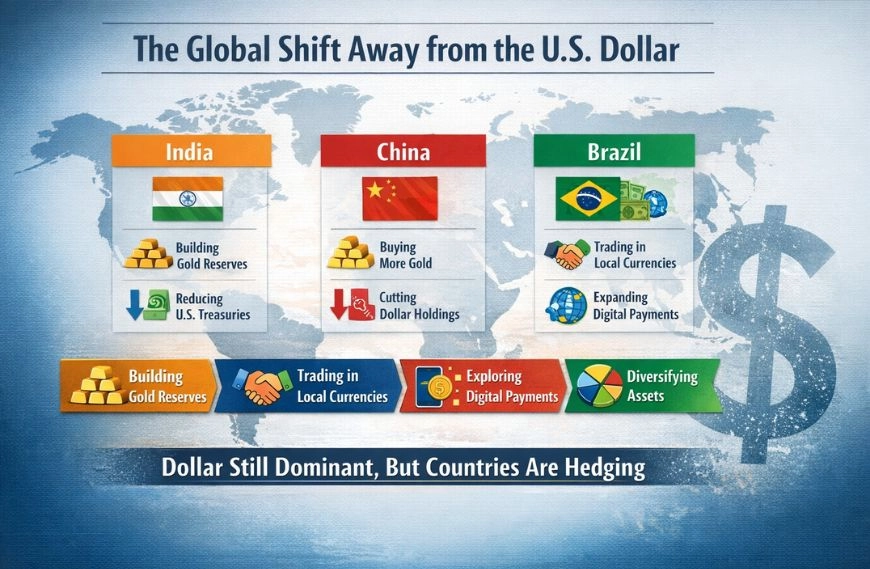
In recent years, several major economies have quietly begun reducing their dependence on the U.S. dollar, signalling a gradual shift in the global financial landscape. Countries such as India, China, and Brazil are not abandoning the dollar entirely but are diversifying their economic exposure to mitigate risk in an increasingly uncertain world.
For decades, U.S. Treasury bonds were considered the safest asset globally, providing central banks with stability, liquidity, and collateral security. However, structural concerns including rapidly growing U.S. government debt, volatile interest-rate cycles, falling bond prices, and the use of financial systems and sanctions as geopolitical tools have prompted nations to reassess their reliance on a single currency.
India has been at the forefront of this strategic diversification. The country has reduced its holdings of U.S. Treasury bonds by approximately USD 50 billion within a single year, representing a decline of over 20%—the first significant annual reduction in recent years. At the same time, India has strengthened its gold reserves, which now total nearly 880 tonnes, accounting for more than 16% of its foreign exchange reserves. Analysts point out that gold provides a secure alternative as it carries no default risk, sanctions risk, or political dependency, reflecting India’s focus on long-term stability rather than hostility toward any nation.
China has pursued a similar path by reducing its U.S. Treasury holdings to their lowest level in nearly 17 years while consistently increasing gold purchases. Brazil, meanwhile, has expanded trade settlements in local currencies and reduced reliance on dollar-based trade mechanisms. Experts suggest that these moves are motivated by the need to build financial resilience through diversification, rather than an outright rejection of the dollar.
Recent geopolitical events, including sanctions and freezes on foreign reserves and sovereign assets, have further reinforced the importance of this approach. Such incidents highlighted that dollar-centric systems are not immune to political or economic disruption, prompting countries to explore alternatives that could safeguard their assets and trade during periods of tension.
BRICS nations are increasingly promoting trade in local currencies, exploring alternative settlement mechanisms, and examining digital currency interoperability for cross-border transactions. These initiatives aim to provide parallel options that reduce vulnerability without dismantling the existing dollar system. Economists note that de-dollarisation is evolutionary, not revolutionary.
Despite these developments, the U.S. dollar remains dominant in global trade, and Treasury markets continue to offer high liquidity. However, the era of unquestioned trust in the dollar appears to be ending. Countries are now focusing on hedging geopolitical risks, diversifying reserves, and strengthening economic sovereignty. Analysts emphasise that these steps should be understood as pro-stability measures rather than anti-American sentiment.
Ultimately, the gradual shift toward de-dollarisation reflects a strategic adaptation to a more uncertain global environment. By diversifying currencies, assets, and settlement mechanisms, countries like India, China, and Brazil are seeking to secure their economic futures while maintaining flexibility in an increasingly unpredictable world.

Secretary — InGlobal Business Foundation (IBF)
Director — ReNis Agro International LLP, Ahmedabad, India
Subscribe Deshwale on YouTube
