







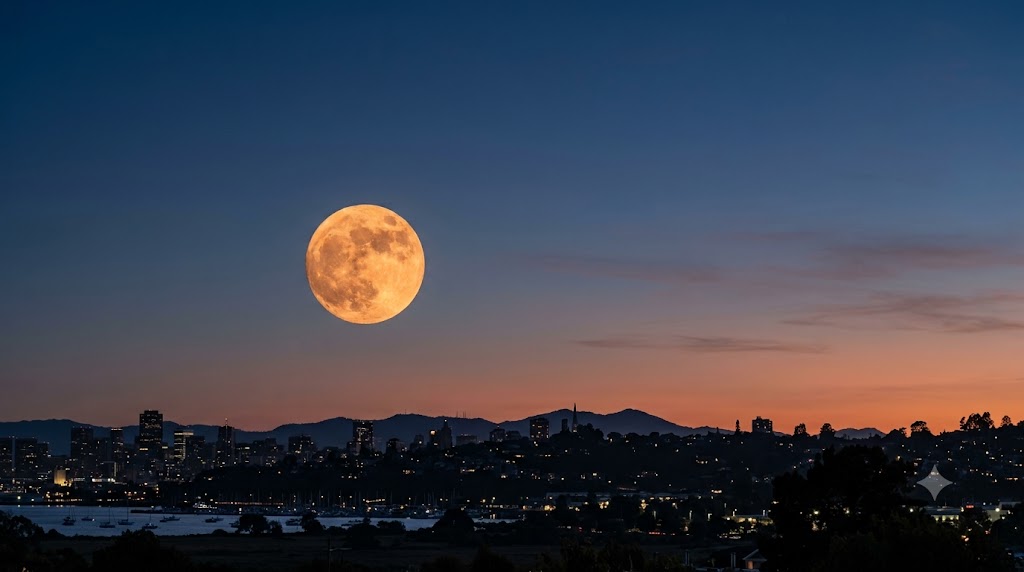
This weekend, if you step outside just after sunset, you’ll see a big, orange Moon climbing up from the eastern horizon. Most people will call it a “supermoon” or say it looks unusually massive. Neither is quite true. What’s actually happening is far more interesting, and it has almost nothing to do with the Moon being special at all.
This is the Harvest Moon of 2026, and this year it comes with a rare companion: the planet Saturn, shining right beside it, just days before reaching the brightest point of its entire year.
What the Harvest Moon Actually Is
Every full Moon has a name, but the Harvest Moon isn’t tied to a specific month. It’s simply the full Moon that falls closest to the September equinox, the point when day and night are roughly equal length. In 2026, that Moon turns exactly full on Saturday, September 26, at 4:49 PM UTC, which works out to 10:19 PM in New Delhi, 12:49 PM in New York, and 5:49 PM in London.
The name goes back centuries, to a time before electricity, when farmers depended on natural light to finish harvesting their crops after sunset. Around this particular full Moon, moonrise happens only a little later each evening instead of the usual near-hour delay. That meant several nights in a row of extra light right after dusk, exactly when farmers needed it most.
Here’s the twist. Almost nobody today uses moonlight to bring in a harvest. Farm equipment runs on electric floodlights, tractors have headlamps, and most harvesting is mechanised and scheduled by the clock, not the sky. So the Harvest Moon is a name that has quietly outlived the very reason it was created. We still call it that purely out of tradition, the same way we still say “sunrise” and “sunset” even though we know the Sun isn’t actually moving around us.
The Real Headline Is Saturn, Not the Moon
While everyone’s attention will be on the Moon this weekend, the more genuinely rare event is happening right next to it. Saturn is approaching opposition on October 4, the point in its orbit when Earth sits directly between Saturn and the Sun. Around opposition, a planet is at its closest, brightest, and most visible for the entire year, staying up in the sky from dusk to dawn.
On the night of September 26, Saturn will appear as a bright, steady, golden “star” just below and to the left of the Harvest Moon, easily visible without any equipment. If you have a small telescope or even strong binoculars, you may even catch a hint of its rings. Neptune is also technically nearby, forming a faint triangle with the Moon and Saturn, but at magnitude 8 it’s far too dim to see without a proper telescope, especially with a bright full Moon washing out the sky.
So while headlines will focus on “when to see the Harvest Moon,” the more accurate framing is that the Moon is your guide this weekend, pointing you toward a planet that won’t look this good again for another year.
Busting the Size-and-Colour Myth
You’ll likely notice the Moon looking unusually huge and orange as it rises. This isn’t a supermoon, and the Moon hasn’t physically grown or moved closer to Earth. Two ordinary optical effects are responsible.
The first is the Moon illusion, a trick of human perception where our brain judges the Moon as larger when it’s near the horizon, close to trees or buildings, than when it’s high in the sky, even though it’s exactly the same size. The second is that near the horizon, moonlight passes through a much thicker layer of Earth’s atmosphere, scattering away the blue light and leaving behind the orange and red hues we see. Within an hour of rising, as the Moon climbs higher, both effects fade and it returns to looking like an ordinary white Moon.
How to Watch It
You don’t need a telescope, a dark countryside location, or any special equipment for this one. Just step outside shortly after sunset, face east, and give it a few minutes for the Moon to clear the horizon. If you’re watching on the 26th or 27th, glance slightly below and to the left of the Moon for Saturn’s steady golden glow.
The Moon will look nearly as full on the nights just before and after the 26th too, so even a cloudy evening doesn’t mean you’ll miss it. What makes this weekend worth stepping outside for isn’t the Moon’s size or colour, both of which are illusions anyway. It’s the rare chance to see two of the sky’s biggest attractions side by side, at exactly the moment each of them is at its best.
Subscribe Deshwale on YouTube


