







At around 8 in the morning, a Mumbai local train can look like a moving wall of people. Office-goers, students, workers, shopkeepers and thousands of others squeeze into coaches, hoping to reach their destination on time. For many Mumbaikars, this is not an unusual sight. It is simply another morning.
But there is something remarkable hidden in this everyday scene. Mumbai’s local train is not merely a mode of transport. Over generations, it has become part of the city’s identity, routine and even its sense of time.
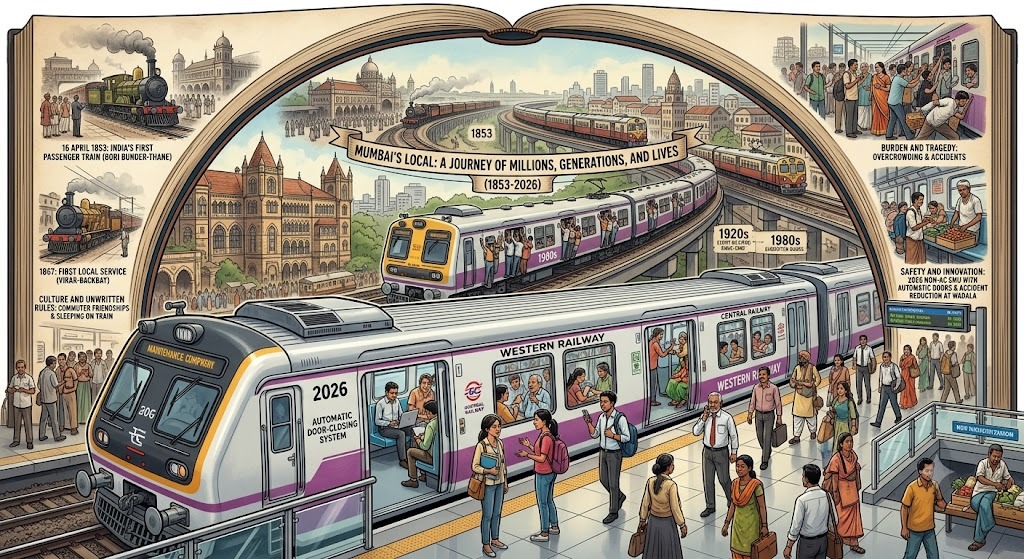
The story began on 16 April 1853, when India’s first passenger train travelled from Bori Bunder in Mumbai to Thane. The 34-km journey took 57 minutes. What began as a historic railway experiment eventually became the foundation of one of the world’s busiest suburban rail systems.
The Western side of the city’s railway story also has deep roots. Western Railway records that a local service between Virar and Backbay began in 1867, with one train running in each direction.
Since then, Mumbai has changed almost beyond recognition. The city has expanded, suburbs have grown and millions of people now travel every day. Yet the basic role of the local remains the same: taking people from home to work, college, markets and back home again.
What makes Mumbai’s local particularly interesting is how much of ordinary life happens around it.
People make friends on the same train. Regular passengers recognise familiar faces without necessarily knowing their names. Someone catches up on sleep, someone reads a newspaper, another person checks emails and another simply stares outside the window after a tiring day.
The train has also created its own unwritten culture. Experienced commuters know where to stand, which coach is likely to be less crowded and when to move towards the door. For a newcomer, these things can seem confusing. For a regular commuter, they become second nature.
But there is another side to this story.
The same system that connects Mumbai also carries an enormous burden. MRVC documents the extraordinary passenger density on Mumbai’s suburban network, with peak-hour trains carrying far more people than their rated capacity. Overcrowding has long been linked with falls, trespassing and other fatal accidents. Safety experiments have shown that even small behavioural interventions can make a difference. At Wadala, one such intervention was reported to have reduced deaths by 75 per cent over a year.
The railway is now changing again. In 2026, the first non-AC Mumbai local equipped with an automatic door-closing system arrived for certification trials, reflecting the continuing effort to address the dangers associated with open-door travel and overcrowding.
For me, that is what makes the Mumbai local fascinating. Its history is not really about trains. It is about people.
The local has witnessed Mumbai becoming bigger, faster and more crowded, while quietly carrying generations through the same city. It has seen first jobs, college admissions, business journeys, friendships, arguments, celebrations and exhausting rides home.
Perhaps that is why calling it simply a “lifeline” does not tell the whole story.
Mumbai’s local train does not merely connect stations. It connects the lives lived between them.
Subscribe Deshwale on YouTube


