









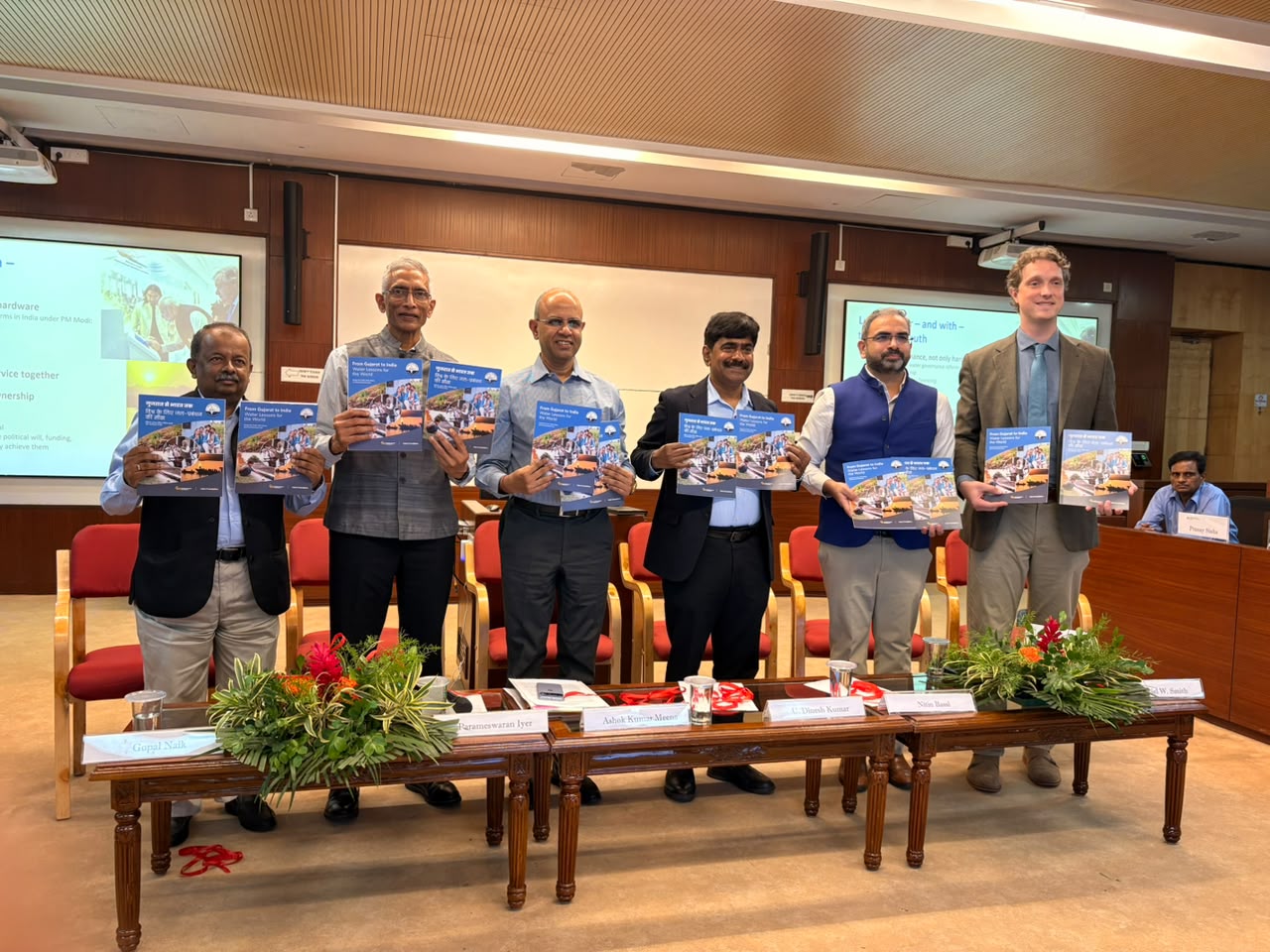
A new case study examining 25 years of water governance in Gujarat and India was launched at the Indian Institute of Management Bangalore (IIMB) on October 7, 2026. Titled From Gujarat to India: Water Lessons for the World, the study examines how Gujarat’s water management experience evolved between 2001 and 2026 and identifies four key lessons for countries seeking to achieve water security at scale.
Daniel W. Smith, Assistant Professor at George Mason University; Nitin Bassi, Fellow at the Council on Energy, Environment and Water (CEEW); and Parameswaran Iyer, former Secretary of the Department of Drinking Water and Sanitation, authored the study. George Mason University and the Gates Foundation published the report.
Gujarat’s Water Governance Journey
The study traces the beginning of Gujarat’s water governance reforms to 2001, when recurring droughts and water scarcity pushed the state to adopt a combination of infrastructure development, groundwater recharge, water conservation and improved water-use efficiency.
Gujarat also introduced institutional reforms and encouraged greater community participation. The state combined the Narmada-based water grid with institutions such as WASMO and village-level Pani Samitis. By 2013, Gujarat had constructed more than 76,000 check dams under the Sardar Patel water conservation programme.
The study describes the period between 2001 and 2014 as an important testing ground for approaches that later expanded to the national level.
From State-Level Reforms to National Programmes
According to the study, several elements of Gujarat’s experience later informed national initiatives, including the Jal Jeevan Mission, Jal Shakti Abhiyan, Namami Gange, Atal Bhujal Yojana, Per Drop More Crop and AMRUT.
The creation of the Ministry of Jal Shakti in 2019 further consolidated the institutional framework for drinking water, sanitation and water-resource management.
The report also points to the expansion of public investment and access. Union water-sector allocations rose from 0.8% of the total Union Budget in 2001-02 to 2.2% in 2025-26. Across rural India, 464 million more people now use safely managed drinking water compared with 2000, while rural household tap-water coverage increased from 17% in 2019 to more than 80% in 2026.
Four Lessons for Water Security
The study identifies four broad lessons for countries across the Global South: lead with governance rather than hardware, manage water resources and water services together, build community ownership and match ambitious goals with political commitment, financing and administrative capacity.
The authors argue that water security requires more than engineering solutions. Strong institutions, sustained investment and community participation must support infrastructure to deliver long-term results.
Focus Shifts to Sustainability and Reuse
The study also highlights the next phase of India’s water journey. It calls for greater attention to reliable service delivery, water quality, groundwater recharge and efficient water use.
Another emerging priority involves developing a circular water economy. This approach would encourage the treatment and reuse of used water while reducing pressure on freshwater resources.
Dr Nitin Bassi said the next phase of water security in India will include greater focus on the optimal use of treated used water, which could also create significant economic opportunities.
Lessons Beyond India
The report positions India’s experience as a potential source of practical lessons for countries facing similar water challenges. Its authors emphasise that nations can adapt these approaches to their own institutional, environmental and social conditions.
With its large rural population, rapidly growing cities, diverse climate and extensive development needs, India offers a significant case study in managing water security at scale. The report concludes that sustaining progress will require continued political commitment, strong institutions and meaningful community participation.
Subscribe Deshwale on YouTube


