









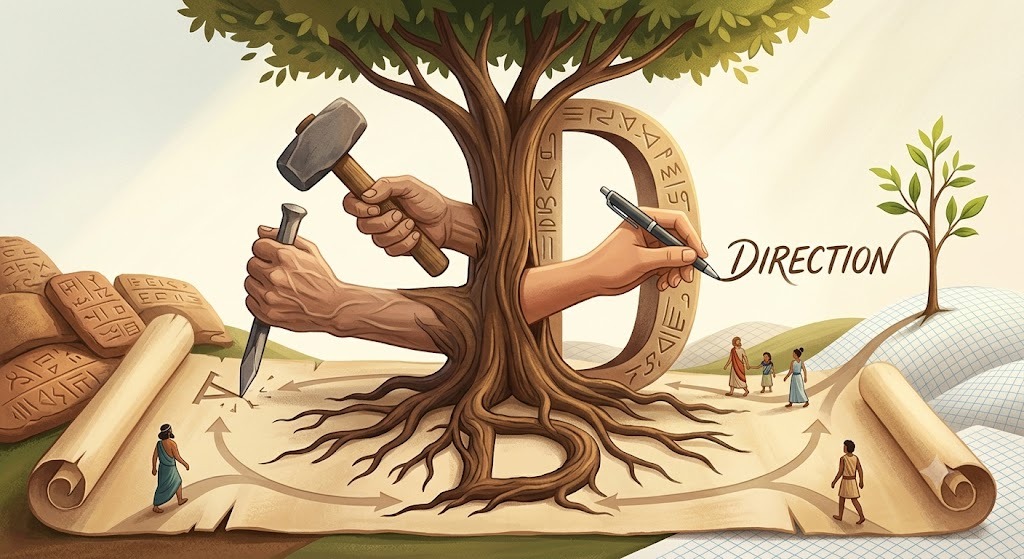
Take a pen and write your name.
Almost without thinking, your hand probably moves from left to right. You learnt it as a child, repeated it in school and have followed the same direction for years. It feels so natural that it is easy to assume writing was always meant to work this way.
But it was not.
There is no universal rule saying that writing must begin on the left. Today, some writing systems move from right to left, while others have traditionally been written vertically. Even ancient writing could change direction from one line to another. What feels like a simple rule is actually the result of thousands of years of human choices.
Before Left and Right Became a Rule
The story behind English begins with the Latin alphabet, which developed from earlier Greek writing. Greek itself was influenced by the Phoenician alphabet. But the Greeks did not immediately settle on left to right.
Some early Greek inscriptions used a fascinating system called boustrophedon. The word roughly means “as the ox turns”, because the writing moved across one line and then came back in the opposite direction, much like an ox moving across a field while ploughing.
Imagine reading one line from left to right and then having to start the next line from the right. Even some letters were reversed to match the direction.
It sounds strange to us because we have become used to one fixed direction. But for ancient writers, there was nothing obviously strange about changing direction.
So Why Did Left to Right Win?
This is where the story becomes less certain.
One popular explanation links writing direction to the tools people used. The Children’s Museum notes that ancient Semitic writing on stone could favour right-to-left movement because a writer could hold a chisel in one hand and a hammer in the other. Later, as writing moved onto materials such as papyrus, different practical considerations came into play.
Another line of research has suggested that the way writing tools interacted with the writing surface, as well as how people physically wrote and read, may have influenced the direction that became established. But historians do not have a single answer that explains every civilisation.
And that is important.
History is often less about one person making a decision and more about habits slowly becoming rules.
Once a writing direction becomes common, children learn it from adults, scribes copy earlier texts, teachers teach the same method and new writing systems inherit older traditions. Over generations, a choice can start to look like nature.
The World Still Writes Differently
Look beyond English and the picture changes.
Arabic and Hebrew are written from right to left. Traditional Chinese and Japanese writing have also used vertical arrangements, with columns progressing across the page. Ancient Egyptian hieroglyphs could be arranged in different directions as well.
So when we write a message from left to right, we are not following a rule written into the human body.
We are following a cultural inheritance.
That is perhaps the most interesting part. Something we perform thousands of times in our lifetime can feel completely natural even though somebody, somewhere, had to develop the habit first.
The next time you write a simple sentence, notice your hand.
Left to right feels obvious.
But history reminds us that “obvious” is often just another word for something we have been taught for a very long time.
Subscribe Deshwale on YouTube


