



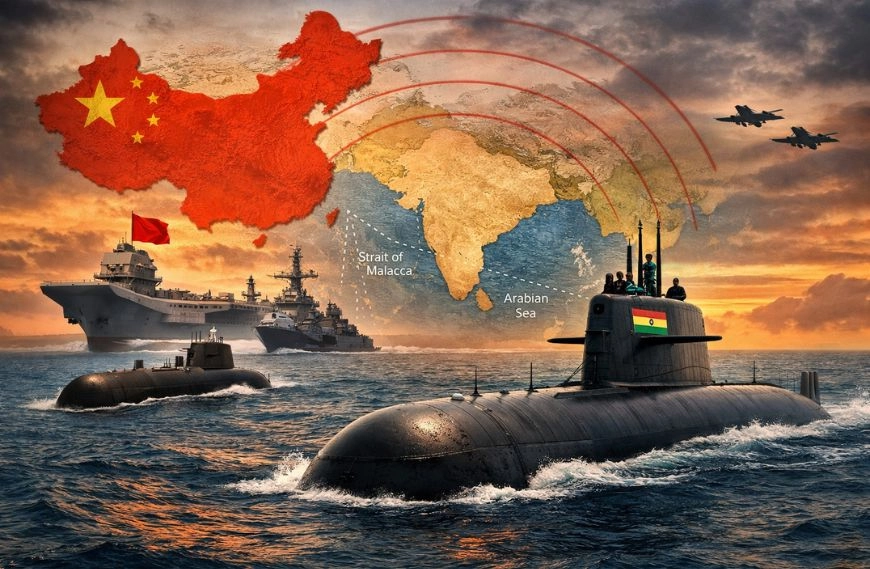
China’s expanding naval footprint in the Indian Ocean has emerged as a growing strategic concern for India. As Beijing strengthens its undersea capabilities and extends its reach across key maritime regions, India is responding by investing heavily in its submarine fleet. At the centre of this effort is Project-75I, an ambitious programme to build six advanced conventional submarines at an estimated cost of $8 billion.
The People’s Liberation Army Navy has steadily increased the number and range of its submarines. Chinese diesel-electric and nuclear-powered submarines are now regularly deployed beyond the Pacific, with patrols and port calls in the Indian Ocean Region. These deployments signal China’s intention to protect its sea lanes, project power, and establish a sustained naval presence close to India’s maritime neighbourhood.
Undersea warfare plays a critical role in modern naval strategy. Submarines operate silently, gather intelligence, and pose a strong deterrent without visible escalation. China’s growing submarine strength, combined with its defence cooperation with regional partners, adds complexity to India’s maritime security environment. Pakistan, with Chinese assistance, is also set to induct new submarines, further changing the regional naval balance.
India’s existing conventional submarine fleet is aging. Several submarines are nearing the end of their service life, creating operational gaps. Project-75I is designed to address this challenge by inducting modern submarines equipped with air-independent propulsion (AIP) systems. This technology allows submarines to remain submerged for longer periods, making them harder to detect and more effective in surveillance and combat roles.
The new submarines will significantly strengthen India’s ability to conduct sea-denial operations, protect critical shipping routes, and monitor strategic chokepoints such as the Arabian Sea and the approaches to the Strait of Malacca. These capabilities are essential in countering increased submarine activity in the region.
Beyond military capability, Project-75I also supports India’s broader defence manufacturing goals. The submarines will be built in India under the Strategic Partnership model, involving technology transfer and participation of Indian shipyards. This approach aims to develop domestic expertise in complex submarine construction while reducing long-term dependence on imports.
By modernising its undersea fleet, India is sending a clear message that it intends to maintain strategic balance in the Indo-Pacific. Project-75I is not only about keeping pace with regional rivals but also about ensuring maritime security, deterrence, and stability in waters that are vital to India’s national and economic interests.
Subscribe Deshwale on YouTube
