






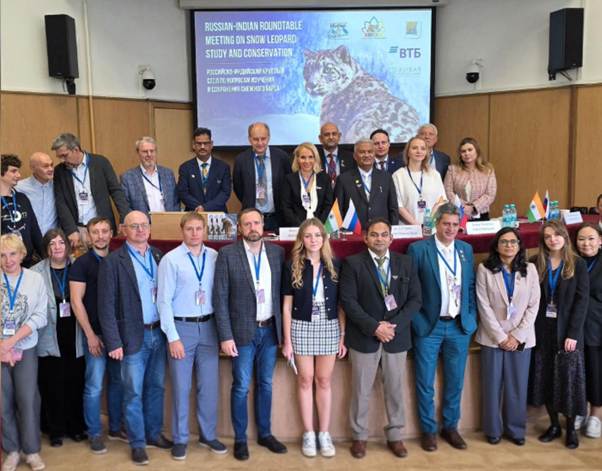
India highlighted its science-based efforts in snow leopard conservation at the Russian-Indian Roundtable Meeting on Snow Leopard Study and Conservation held in Moscow on August 26, 2026.
The meeting took place at the A.N. Severtsov Institute of Ecology and Evolution of the Russian Academy of Sciences. It brought together officials, researchers and conservation experts from India and Russia to discuss ways to strengthen cooperation in snow leopard research, monitoring and conservation.
The meeting was organised under the framework of the Partnership Agreement between the Interregional Association ‘Irbis’ and the International Big Cat Alliance (IBCA). The agreement was signed in December 2025. It aims to promote greater international cooperation in the study and conservation of snow leopards.
India Shares Scientific Progress
The Indian delegation was led by the Ministry of Environment, Forest and Climate Change (MoEFCC), Government of India.
During the meeting, India presented its progress in using scientific methods to support snow leopard conservation. Officials from the Wildlife Institute of India (WII) shared details of several initiatives being used to understand and monitor the species.
These include snow leopard population estimation, radio telemetry and genetic analysis.
Such scientific tools provide valuable information about snow leopard populations and their movement patterns. They also help researchers understand the genetic characteristics of the species.
The use of these methods is becoming an important part of modern wildlife conservation. Reliable scientific information can support better planning and help conservation agencies assess the needs of wildlife and their habitats.
Focus On Population Estimation
One of the key areas highlighted by India was snow leopard population estimation.
Knowing the number and distribution of snow leopards is important for planning conservation measures. Population studies can also help authorities understand changes in the species over time.
India has been strengthening its approach to wildlife monitoring by combining field-based methods with scientific techniques. This helps create a stronger evidence base for conservation planning.
The information collected through such efforts can support decisions related to habitat protection, monitoring and management.
Radio Telemetry Supports Research
Radio telemetry was another important area discussed during the meeting.
This technique helps researchers track the movement of animals and study how they use their habitats. For a species such as the snow leopard, which lives across large and difficult mountain landscapes, monitoring movement can provide important insights.
Radio telemetry can help researchers study movement patterns, habitat use and the areas used by individual animals. Such information can contribute to more effective conservation planning.
The discussion reflected the growing role of technology in wildlife research and the need to continue improving scientific monitoring methods.
Genetic Analysis Adds Insight
India also highlighted the role of genetic analysis in snow leopard conservation.
Genetic studies can provide information about the characteristics and diversity of wildlife populations. This can be useful for understanding population structure and supporting long-term conservation planning.
When combined with population estimation and field monitoring, genetic analysis can provide a broader picture of the status of a species.
India’s presentation at the Moscow meeting demonstrated how different scientific approaches can work together to strengthen wildlife conservation.
Strengthening India Russia Cooperation
The Roundtable included representatives from several Russian institutions and organisations.
These included the Ministry of Natural Resources and Environment of the Russian Federation, the A.N. Severtsov Institute of Ecology and Evolution of the Russian Academy of Sciences, Moscow Zoo and Rosprirodnadzor. Leading experts in snow leopard research and conservation also participated in the discussions.
The participation of institutions from both countries provided an opportunity to exchange knowledge, research findings and practical experience.
The discussions focused on ways to advance collaborative approaches for snow leopard research and conservation. They also underlined the value of international cooperation for studying a species that occupies high-altitude landscapes across several countries.
Building Long Term Conservation
The Moscow Roundtable provided a platform for India and its international partners to discuss the future of snow leopard research and conservation.
India’s focus on population estimation, radio telemetry and genetic analysis reflects the increasing use of science and technology in wildlife conservation. These approaches can help researchers collect better information and support evidence-based conservation decisions.
The meeting also reinforced the importance of cooperation between countries and institutions working to protect snow leopards.
By sharing knowledge, research methods and field experience, conservation agencies can improve their understanding of the species and its habitat. Continued collaboration can also help strengthen monitoring systems and develop more informed conservation strategies.
India’s participation in the Moscow Roundtable therefore highlighted its ongoing commitment to science-based snow leopard conservation and to stronger international cooperation in protecting this important mountain species.
Subscribe Deshwale on YouTube


