



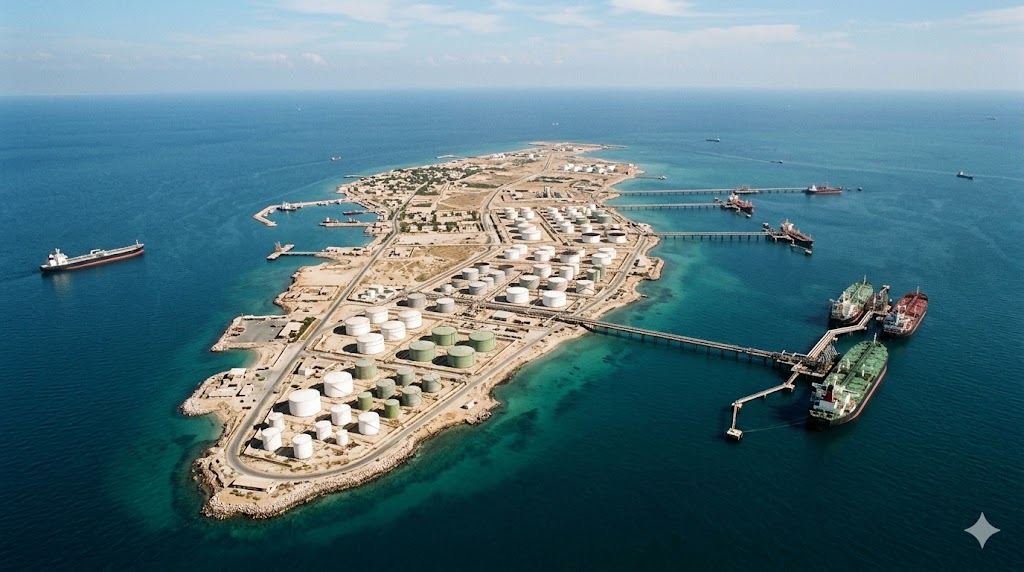
A small coral outcrop in the northern Persian Gulf, just 15 to 20 miles off Iran’s coast near Bushehr, has emerged as one of the most strategically sensitive pieces of real estate in the ongoing US-Iran-Israel confrontation. Kharg Island, also spelled Khark, handles roughly 90 per cent of Iran’s crude oil exports, making it the beating heart of Tehran’s oil economy and a potential chokepoint in any effort to pressure or cripple Iran’s finances.
As of late March 2026, the island has already been struck by US forces, with military targets hit but oil infrastructure reportedly spared, at least for now. Discussions of further raids, blockades or even a ground seizure have intensified amid tensions over the Strait of Hormuz, through which about 20 per cent of global oil supply normally flows.
Here is a comprehensive look at why this modest island, roughly eight kilometres long and four to five kilometres wide, matters so much.
Geography and Infrastructure
Kharg Island sits in deep waters that allow large supertankers, known as VLCCs, to dock, unlike many shallower mainland ports. It features extensive storage tanks with a capacity of around 30 to 34 million barrels of crude and products, pipelines connected to major onshore fields such as Ahvaz, Marun and Gachsaran, and offshore loading terminals capable of handling up to ten supertankers simultaneously, with a historical maximum loading capacity of about seven million barrels per day.
In normal times, Iran’s actual exports are far lower owing to sanctions, running at around 1.5 to 1.7 million barrels per day recently, with the bulk moving via Kharg. The island also supports petrochemical operations and has storage for fertilisers and liquefied gas.
Its location, about 300 miles northwest of the Strait of Hormuz, positions it as the primary gateway for Iranian crude heading to Asian markets, especially China, which has remained a key buyer despite sanctions.
Historical Significance
Kharg has ancient roots as a trading and settlement site with freshwater sources rare among Gulf islands. In the modern era, it rose to prominence in the 1960s when Western companies, including Amoco, developed it as Iran’s main oil export terminal under the Shah.
During the 1980 to 1988 Iran-Iraq War, Iraqi forces repeatedly targeted Kharg, damaging facilities and forcing Iran to reroute some exports temporarily through smaller islands such as Lavan and Sirri. Iran rebuilt and expanded the terminal after the war, turning it into the backbone of its oil export system.
A 1984 CIA assessment described the facilities as “the most vital in Iran’s oil system,” essential to the country’s economic well-being, a judgment that still holds today.
Strategic and Economic Importance in 2026
Oil revenues fund a significant portion of Iran’s government budget, military activities and regional proxies. Disrupting Kharg would directly hit Tehran’s ability to generate foreign currency, especially from sales to China.
The island’s vulnerability stems from its isolation and exposure. It is heavily fortified with military assets, including missile and mine storage, which US strikes in March 2026 reportedly targeted and obliterated, according to US statements. Oil infrastructure was spared, according to President Trump, but he warned that continued Iranian interference with shipping in the Strait of Hormuz could change that.
Analysts note that a full shutdown or seizure of Kharg would be a severe blow to Iran’s economy but carries massive risks.
- Global oil markets: Even partial disruption could spike prices further, given that they are already elevated by the conflict.
- Iranian response: Tehran has threatened fierce retaliation, including asymmetric attacks via proxies, missiles or attempts to close Hormuz more aggressively.
- Military challenges: Any ground operation would expose US or allied forces to drones, missiles and coastal defences. The island is close enough to the mainland for rapid reinforcement, yet far enough to complicate logistics.
Recent reports indicate Iran has reinforced defences on Kharg in anticipation of further threats.
Current Context in the Conflict
As of late March 2026, US strikes on March 13 hit military sites, including missile bunkers and mine storage, on Kharg but left the oil terminal intact. Loading operations have reportedly continued, with tankers still taking on crude.
The island features prominently in US strategy debates, as leverage to force Iran to reopen or keep open the Strait of Hormuz and as a potential target for blockade or limited seizure to cut revenue and pressure negotiations. Trump has linked restraint on oil facilities to Iranian behaviour in the strait, while deploying additional naval and ground assets, including Marines and 82nd Airborne elements, to the region.
Iranian officials assert that exports remain unaffected and security is intact. However, any sustained disruption would compound economic pain amid existing sanctions and war-related pressures.
For India, which imports a large share of its crude and relies on stable Gulf energy flows, developments at Kharg and Hormuz directly affect fuel prices, inflation and economic stability. Disruptions here ripple quickly to Mumbai’s refineries and household budgets.
Risks and Broader Implications
Kharg symbolises Iran’s oil-dependent resilience and vulnerability. Targeting it risks escalation through higher global oil prices, retaliatory closure attempts on Hormuz or wider regional involvement.
Seizing or holding the island would be logistically demanding and politically explosive, potentially creating a quagmire while exposing forces to constant threat. Alternatives discussed include naval escorts through Hormuz or focused pressure on other Iranian assets.
Ultimately, Kharg Island illustrates the entanglement of energy, geopolitics and military power in the Gulf. A tiny coral outpost controls a disproportionate share of one nation’s economic lifeline and, by extension, influences global energy security.
As tensions persist in March 2026, the world watches whether Kharg remains an economic asset, becomes a bargaining chip or turns into a flashpoint for wider disruption.
The island’s deep waters and storage tanks make it irreplaceable in the short term for Iran’s exports. Its fate could help determine not only the trajectory of the current conflict but also the price of oil and stability for economies far beyond the Persian Gulf.
This article draws on reporting from Reuters, The New York Times, Bloomberg, Al Jazeera and other sources as of late March 2026.
