









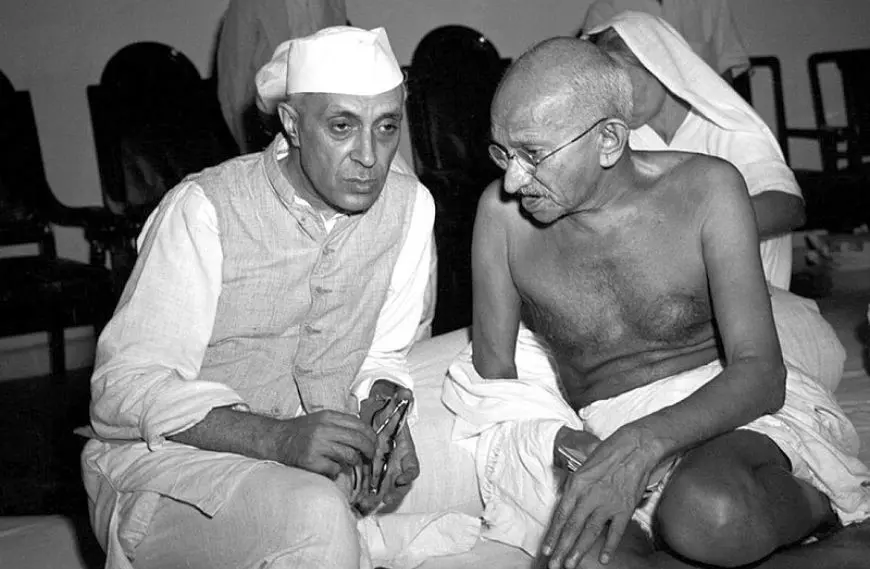
Every year, 2nd October is celebrated as ‘Gandhi Jayanti’ to honour the birth anniversary of Mahatma Gandhi, the Father of the Nation. We all pay tribute to him and remember his philosophy of truth and non-violence. While most people know about his leadership in India’s freedom struggle.
We usually picture Gandhi ji walking with a stick, draped in a simple dhoti, leading India’s fight for independence through peace and truth. But behind this image lies a man of many dimensions, shaped by unique experiences and lesser-known stories about his life.
A family man before a national icon
If you think Gandhi Ji is an only child. This is not true. He had three siblings and he grew up with them. Laxmidas, Raliatbehn, and Karsandas. This family background is rarely discussed, yet it shaped the early years of the boy who would later be called the Father of the Nation.
School days in Rajkot
When Gandhi ji was 11 years old, he joined ‘Alfred High School’ in Rajkot. This institution, one of the oldest in India, remained active for 164 years before being converted into the Mahatma Gandhi Museum. It was also once known as Mohandas Gandhi High School.
An Irish influence on his English
Do you know, one of Gandhi ji’s first teachers was an Irishman. As a result, he picked up English with a slight Irish accent. It’s a quirky detail, often overlooked, but it adds another layer to his global upbringing.
From tailored suits to simple dhoti
It is hard to imagine Gandhi ji in anything other than his humble dhoti and shawl. Yet, during his early years as a lawyer in London and later in South Africa, he wore finely tailored English suits. His transformation from a barrister in Western dress to a leader in simple homespun cloth was symbolic.
Gandhi as an editor and journalist
Long before social media, Gandhi ji used the press as his weapon. In South Africa, he started the newspaper Indian Opinion in 1903, giving a voice to Indians facing discrimination. Later in India, he edited weekly journals such as Young India, Navajivan, and Harijan, spreading his ideas on truth, self-reliance, and reform.
A letter before defiance
Before launching the Salt March in 1930, Gandhi ji wrote to the Viceroy of India. In the letter, he made it clear that if the British did not address India’s plight, he would have no choice but to break the salt laws. This showed his unique brand of moral politics — being transparent even while preparing for defiance.
Rejecting the Two-Nation Theory
When Partition grew louder, Muhammad Ali Jinnah’s demand for Two-Nation Theory. But Gandhi ji stood firmly against it. He saw India as one family with many members — Hindus, Muslims, Sikhs, Christians, and others. For him, dividing the nation along religious lines was unthinkable. His vision of unity remains a reminder of what India could have been without Partition’s scars.
A Nobel recognition that never came
This is unbelievable! You know, between 1937 and 1948, Gandhi ji was nominated for the Nobel Peace Prize five times. Despite his global stature and revolutionary approach to non-violence, he never received the honour. Many historians still view this as one of the Nobel Committee’s greatest oversights.
A funeral like no other
The time of Gandhi ji’s funeral was very sad, but the moment was unpredictable. When Gandhi ji was assassinated in January 1948 by Nathuram Godse, grief swept across India and the world. Over 2 million people joined his funeral procession in Delhi, which stretched for five miles — a reflection of his impact as a moral leader.
Gandhi on the big screen
You may have seen films on freedom fighters like Bhagat Singh and Chandrashekhar Azad, but over a dozen films have been made about Gandhi ji — something unmatched by any other leader’s life story. Each film has tried to capture the essence of his philosophy and struggle. Richard Attenborough’s Gandhi (1982) remains the most famous, winning multiple Oscars. Yet, filmmakers in India and abroad have continued to return to his story, proving that his legacy still inspires the world.
A man beyond the legend
So, these lesser-known facts remind us that Gandhi ji was not born a Mahatma. He was a boy with siblings, a student in a classroom, a lawyer in suits, a journalist with a pen, and a leader who carried the weight of a nation’s hopes. Each phase of his life added a brushstroke to the larger portrait we know today.
Gandhi ji’s life continues to inspire, but looking at these details makes him more human. Someone shaped by experiences, choices, and even contradictions. That humanity, perhaps, is why his message of truth and non-violence still speaks to us across time and borders.
Also Read: Gandhiji’s Legacy: Nonviolence and Truth in Global Movements
Subscribe Deshwale on YouTube


