



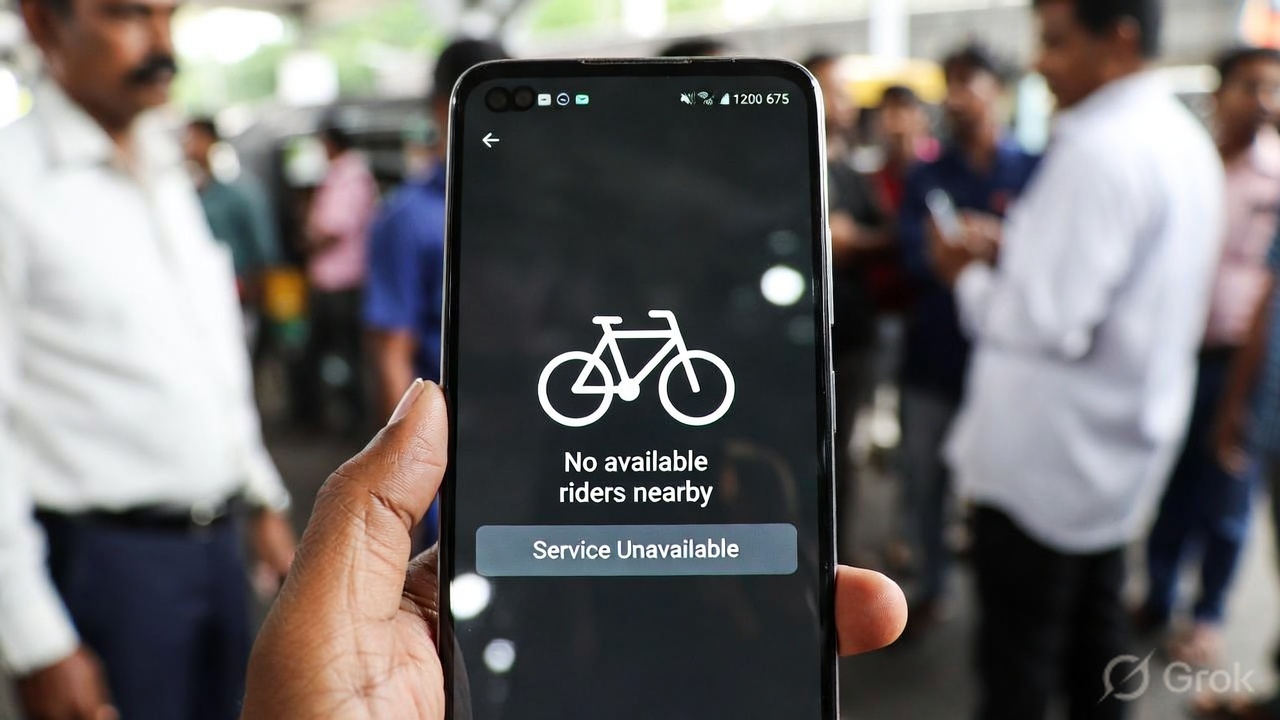
India’s governments cannot build transport that works. They are remarkably efficient at banning transport that does.
Raju leaves home at six fifteen every morning from a chawl in Ghatkopar. He has a job at a logistics firm in Andheri, twelve kilometres away, which in Mumbai might as well be another country. The suburban train gets him close, but close is not there. An auto rickshaw from the station costs him eighty rupees each way. A cab costs double. His daily wage, after a ten-hour shift, is six hundred rupees. The maths of his commute is the maths of his poverty. Every rupee spent getting to work is a rupee that does not reach his family.
For two years, he used a bike taxi. He booked it in forty seconds on his phone. It arrived in four minutes. It cost him thirty rupees. It weaved through the traffic that would have made an auto sit idle for twenty minutes burning his time and the driver’s petrol. He got to work dry in the monsoon, on time in the morning, and home before his children slept. It was, in the language of urban transport policy, a last mile solution. In the language of Raju’s life, it was the difference between managing and not managing.
On 9th March 2026, the Maharashtra government cancelled the licences of Ola, Uber and Rapido and told him, in effect, to go back to the auto.
Nobody asked Raju. Nobody ever does.
I
The official reason is compliance. The companies, the Maharashtra Transport Minister told the Legislative Council, failed to submit necessary documents, continued running petrol bikes after promising electric ones, and received complaints about driver behaviour including, gravely, harassment of women passengers. These are real failures. They deserve to be addressed. Regulatory teeth are not the problem.
The problem is that the government’s answer to a broken rule is to burn the house down.
Consider the timeline, because it tells you everything about how governance actually functions in this country when it is confronted with something it didn’t invent and doesn’t understand. Maharashtra banned bike taxis in January 2023. Rapido went to the Bombay High Court. The state looked foolish. So in April 2025, the cabinet reversed course, bike taxis would be permitted, but only electric ones. Rules were notified in July 2025. Provisional licences were granted in September 2025, with a thirty day window to comply. Six months later, in March 2026, those licences were cancelled because the companies hadn’t fully complied. And tens of thousands of riders lost their income overnight, and millions of commuters lost their most affordable option, and the state issued a press release and called it a crackdown.
This is not regulation. This is a government lurching, banning, unbanning, licensing, revoking, without ever once pausing to ask what the people who actually use these services need, or what the people who actually drive them are supposed to do while the state finds its footing.
It has been three years. The state has not found its footing.
II
Let us be honest about what a bike taxi is, because the legislative debate consistently refuses to be.
A bike taxi is not a luxury. It is not a disruption, in the Silicon Valley sense of the word that politicians like to deploy when they want to sound current. It is a motorcycle with a rider and a passenger and a phone booking the journey. It exists because India’s cities have grown so far beyond their planned boundaries, so far beyond what any bus route, Metro line or auto stand was ever designed to serve, that the distance between where people live and where they need to go has become, for millions of them, the defining problem of their daily existence.
Mumbai’s suburban rail is the spine of the city. But a spine without limbs is just a column of bone. The last mile, the gap between the station and the workplace, the bus stop and the home, the Metro exit and the hospital gate, is where the system fails. And it fails not occasionally but systematically, everywhere, every day, for the people who can least afford the failure.
An auto rickshaw, where one is available, costs two to three times what a bike taxi charges. A cab costs five times more. For a construction worker earning five hundred rupees a day, or a domestic worker earning eight thousand a month, the difference between thirty rupees and eighty rupees is not a preference. It is a calculation about whether the job is worth taking. These are the people the state has just told to find an alternative.
There is no alternative. That is why bike taxis exist.
III
The employment argument deserves its own reckoning, because the government has been remarkably successful at ignoring it.
Rapido alone, before the licence cancellation, had hundreds of thousands of registered bike taxi riders across India. These are not gig workers in the sense that the term is used dismissively, young men between opportunities, doing something temporary. Many of them are the sole earners in their households. Many own their bikes on loan, bought specifically to work the platform. Many had, for the first time in their working lives, something approaching predictable income, not a salary, not security, but enough to plan a week ahead, which for a great number of Indians is the closest thing to stability they have ever had.
When Maharashtra cancelled those licences on 9th March, it did not send those riders a notice. It did not offer them retraining, compensation, or an alternative avenue. It revoked a document in a legislative chamber, issued a statement to the press, and went home. The riders found out the way Raju found out, their app stopped accepting bookings. No explanation. No recourse. The work simply ended.
This is the texture of governance in India for people without lobbyists. It arrives without warning and leaves without apology.
IV
Here is the word that the Maharashtra government would prefer not to use, the one that exposes the entire episode for what it is: cowardice.
Not malice. Cowardice. The particular, endemic cowardice of bureaucracies that would rather prohibit than regulate, ban rather than build capacity, cancel rather than enforce incrementally, because prohibition requires no skill, generates a clean headline, and allows everyone involved to feel decisive without having done anything difficult.
Writing clear rules for bike taxi operations is hard. It requires engaging with the platforms, with drivers, with commuters, with safety researchers, with urban planners. It requires accepting that the world has changed, that an app on a phone has solved a last mile problem that forty years of transport policy could not, and then working with that reality rather than against it. It requires officials who are willing to do the unglamorous, grinding work of making regulation fit for purpose in a city of twenty one million people that did not exist in its current form when the Motor Vehicles Act was last meaningfully updated.
None of that happened. Instead, the state granted provisional licences with a thirty day compliance window, thirty days for companies to retrofit fleets to electric, build control rooms, establish grievance redressal systems, and submit stacks of documentation, then expressed shock when the thirty days passed without full compliance, and cancelled everything. It is the equivalent of giving a man one month to build a house and then citing his incomplete roof as grounds to demolish the foundation.
The electric mandate is worth examining on its own terms, because it is being used as the primary justification and deserves not to be let off easily. Requiring bike taxis to run on electric vehicles is, in principle, the correct policy. EVs produce no tailpipe emissions in a city that is choking. They are cheaper to run per kilometre. They are the future of urban mobility. But the future requires infrastructure, charging stations, affordable EV loans for riders, a second hand electric two wheeler market that actually functions, none of which Maharashtra has built at anywhere near the scale needed. You cannot mandate an electric revolution and then penalise people for not completing it in thirty days when the grid, the finance, and the vehicles are not there to support them.
The policy is correct. The implementation is an abdication dressed as a principle.
V
The contrast with other states is instructive and damning. Delhi legalised bike taxis in November 2023, with an electric mandate and a working regulatory framework. Goa permits them. Telangana permits them. Rajasthan permits them. Uttar Pradesh, not typically cited as a model of progressive governance, permits them. Karnataka’s High Court, in January 2026, lifted the state’s bike taxi ban and directed authorities to register motorcycles as transport vehicles.
Maharashtra, home to Mumbai, the city that more than any other in India needs functional last mile transport, has spent three years banning, allowing, banning again. It has managed to be, simultaneously, too slow to build a workable framework and too fast to destroy the imperfect one that existed. This is a particular talent. It requires effort to be this consistently unhelpful.
Meanwhile, the environment makes its own argument, quietly and without a press release. A bike taxi carrying one passenger uses a fraction of the fuel of a car carrying one passenger. In a country where urban air quality is a public health emergency, where Delhi’s air alone costs years off the lives of its residents, where Mumbai’s particulate counts on bad days rival Beijing at its worst, every petrol car replaced by a shared two wheeler is a small, measurable improvement in the air that children breathe. The transition to electric bike taxis, done properly, with real support for riders making the switch, would be a genuine environmental contribution. Banning bike taxis entirely contributes nothing except the return of those passengers to autos, cabs, and private cars. The air does not improve. The congestion does not ease. Only the compliance paperwork is tidier.
Raju is not waiting for a policy paper. He is not waiting for a legislative committee to convene, or a minister to announce a fresh framework, or a court to rule on a petition filed by a platform with a legal budget larger than his annual income. He is waiting at a bus stop this morning, having already missed the optimal connection, already calculating that today will cost him more than yesterday, already tired before the day has properly begun.
The bike taxi that used to be four minutes away is now illegal. The auto that replaced it is eighty rupees. His wage has not changed.
India’s governments are not short of reasons to restrict, cancel, and prohibit. They are magnificently creative in finding procedural grounds to make the lives of ordinary people harder while calling it governance. What they are short of is something far simpler and far rarer: the willingness to ask, before issuing an order, who gets hurt when this lands.
Raju gets hurt. The rider who bought a bike on a loan to work the platform gets hurt. The woman who used a bike taxi because it was faster and cheaper and she could track the driver’s name and number on her phone, safer, in the real sense, than hailing a stranger on a roadside, she gets hurt too.
They will not hold a press conference about it. They will not be quoted in the Legislative Council. They will simply absorb it, the way they have always absorbed it, quietly, without option, adding it to the long, uncounted ledger of costs that the Indian state has imposed on its poorest citizens in the name of order.
And the minister will move on to the next announcement.
Subscribe Deshwale on YouTube
