



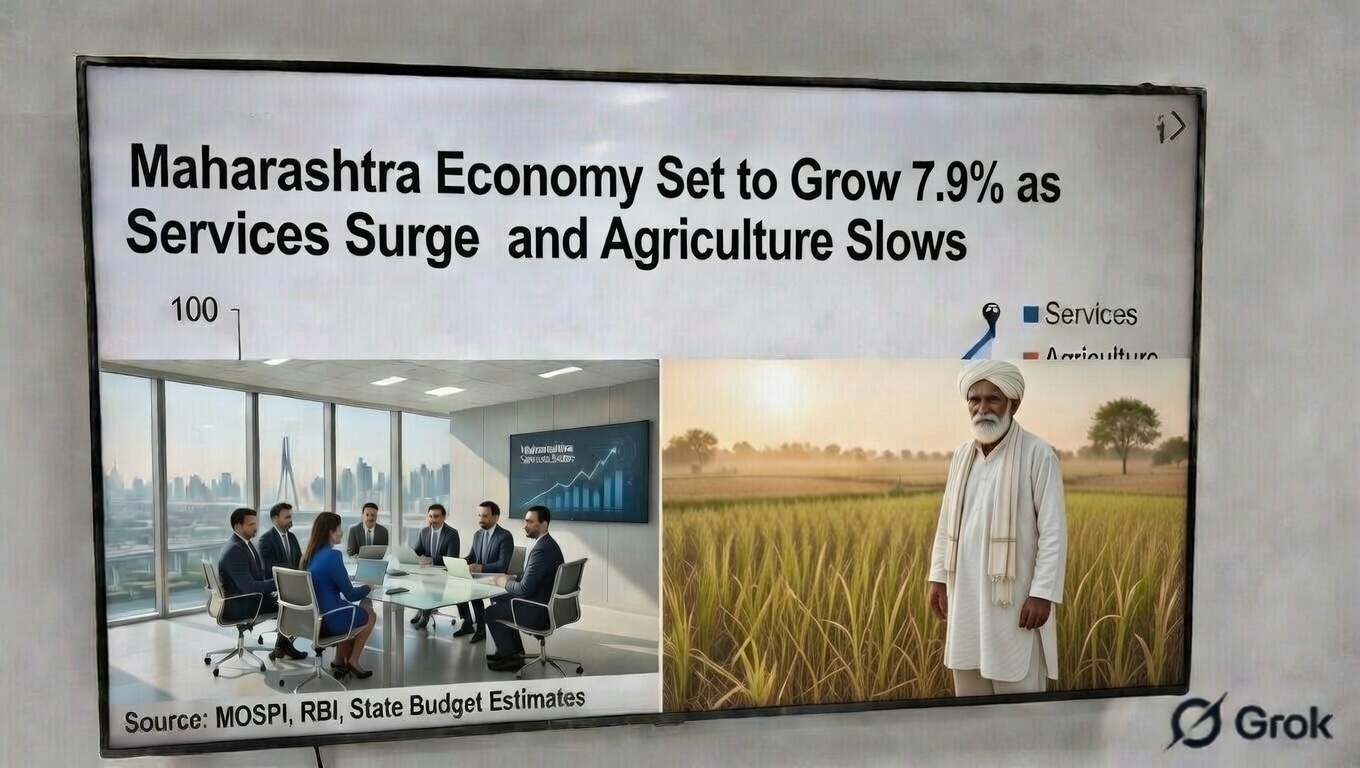
Maharashtra’s economy is expected to grow at 7.9 percent in the financial year 2025-26, according to the state Economic Survey presented before the Assembly. The estimate places the state ahead of the projected national growth rate of about 7.4 percent, and marks a meaningful acceleration from the 7.3 percent growth recorded in 2024-25.
The survey offers a broadly optimistic picture. Services continue to drive the state’s economic engine. Industry is holding its ground. Agriculture, however, faces a sharp slowdown after an unusually strong year, raising familiar questions about how evenly this growth is shared.
The numbers, taken together, reflect the complex structure of a state that is simultaneously an industrial powerhouse, a services giant, and home to millions of farmers living under very different economic conditions.
THE 7.9 PERCENT PROJECTION AND WHAT IT ASSUMES
The advance estimates suggest that Maharashtra’s real Gross State Domestic Product will reach approximately Rs. 28.82 lakh crore in 2025-26, with nominal GSDP touching nearly Rs. 51 lakh crore.
These are advance estimates, and they carry the usual caveats. The methodology relies on partial-year data extrapolated forward, meaning final figures, due in early 2027, can diverge meaningfully. Maharashtra’s own advance estimates for 2023-24, for instance, were later revised both upward and downward across sectors as fuller data came in.
The projection also assumes relatively stable global conditions, continued domestic investment momentum, and a monsoon season that does not materially disappoint. Each of those assumptions is contestable.
The 7.9 percent figure is nonetheless broadly consistent with the state’s medium-term growth trajectory. Over the past decade, Maharashtra’s GSDP growth has averaged around 7 to 8 percent in real terms, punctuated by the sharp contraction of 2020-21 during the pandemic and the rebound years that followed. The current projection, if realised, would suggest the economy has largely normalised to its pre-pandemic trend.
Maharashtra remains India’s largest state economy. When it grows steadily, the national economy benefits. The state contributes roughly 14 to 15 percent of national GDP, more than any other.
SERVICES: THE ENGINE AND ITS LIMITS
The services sector contributes nearly 60 percent of the state’s Gross State Value Added and is projected to expand by around 9 percent in 2025-26. Financial services, real estate and professional services are expected to lead growth, buoyed by continued urbanisation, rising formal employment and ongoing demand for housing in metropolitan corridors.
Mumbai remains the country’s undisputed financial capital. The concentration of banking headquarters, stock exchanges, insurance companies and asset managers in one city creates agglomeration effects that are difficult to replicate elsewhere. Pune has meanwhile emerged as a significant IT and engineering hub, absorbing talent and investment in ways that were less visible a decade ago.
The services sector’s dominance does, however, raise a structural question that economists have debated for years: can a state economy sustain high growth primarily through services, without a correspondingly robust manufacturing base? Services tend to generate high productivity in pockets, among skilled workers in formal employment, while providing relatively fewer pathways into the middle class for workers with lower educational attainment.
Research by the Reserve Bank of India has indicated that Maharashtra’s labour productivity in services has grown at roughly twice the rate of its manufacturing productivity over the past fifteen years, but that service sector employment growth has not kept pace with those productivity gains. Fewer jobs are created per unit of output than comparable manufacturing expansion might have produced. If that pattern holds, its implications for how broadly the state’s economic growth is felt are significant.
INDUSTRY: STEADY BUT UNDER PRESSURE
The industrial sector is projected to grow around 5.7 percent in 2025-26. Manufacturing is expected to expand by approximately 5.9 percent, with construction likely growing faster at 7.8 percent, supported by infrastructure spending and urban real estate demand.
Maharashtra’s industrial base is diverse and resilient. The state hosts major automobile and auto-component clusters around Pune and Nashik, a significant pharmaceuticals and chemicals industry, and a growing electronics manufacturing presence.
Competitive pressure from other states has nonetheless intensified. Gujarat has attracted large-scale semiconductor and electronics investments in recent years. Tamil Nadu has positioned itself aggressively for EV supply chain manufacturing. Telangana has built a credible pharma and life sciences corridor. Maharashtra’s industrial policy, despite periodic updates, has at times been perceived by investors as slower to respond than rival states.
State government officials have pointed to the Samruddhi Expressway corridor and planned industrial nodes along its length as evidence of long-term infrastructure commitment. Whether those nodes translate into manufacturing investment at scale, rather than logistics and warehousing with lower employment multipliers, remains to be seen.
Construction’s projected 7.8 percent growth also warrants scrutiny. A significant portion reflects public infrastructure spending, which is welcome. But it also includes residential real estate activity in cities where affordability has deteriorated sharply for middle-income households. Sustained construction growth built on premium housing, rather than broader demand, can flatter the headline GSDP figure while masking real constraints on household spending capacity.
AGRICULTURE: THE CYCLICAL CORRECTION
Agriculture and allied activities are projected to grow by 3.4 percent in 2025-26, a sharp deceleration from the estimated 9.1 percent recorded in 2024-25.
The previous year’s strong performance was driven substantially by favourable monsoon conditions. Maharashtra reportedly received approximately 109 percent of normal rainfall, which supported crop production across diverse agro-climatic regions. Output in oilseeds, pulses and horticulture benefited disproportionately.
This year’s slowdown is, in part, a normalisation. Base effects alone would have muted the comparison even if conditions remained similar. But farmers in Maharashtra know better than to rely on favourable comparisons.
The state ranks among India’s largest producers of sugarcane, onions, grapes and cotton. It also has a substantial and often underappreciated livestock economy, producing significant volumes of milk, meat and eggs, which provides some income stability across the agricultural cycle. Still, rainfed farming in Vidarbha and Marathwada remains particularly vulnerable to rainfall variability, and farmer indebtedness in these regions has been a persistent policy concern for over two decades.
The 3.4 percent growth projection implicitly assumes a monsoon season broadly in the normal range. If rainfall underperforms, and seasonal forecasts carry substantial uncertainty, agricultural output could fall short, with consequences for both rural incomes and state revenues.
STRUCTURAL SHIFTS: THREE ECONOMIES IN ONE STATE
The Economic Survey’s sectoral breakdown tells a longer story. Services account for approximately 63 percent of Gross State Value Added, industry for around 26 percent, and agriculture for roughly 11 percent.
This composition reflects a structural transformation underway for three decades. In the early 1990s, agriculture’s share of the state economy was substantially higher. The shift toward services and urban economic activity mirrors patterns seen in East Asian economies during their development periods, though Maharashtra’s transition has been uneven in ways that differ from those historical comparisons.
The most visible dimension of that unevenness is geographic. Mumbai’s per capita income is estimated to be several multiples of the state average. Districts in eastern Maharashtra, including Gadchiroli, Washim and Osmanabad, consistently record some of the lowest economic output per capita in the state, comparable in absolute terms to some of the country’s poorer states.
Per capita income for the state as a whole stands at approximately Rs. 3,17,801, placing Maharashtra fifth among Indian states. This figure masks a distribution that looks quite different depending on where one stands. For a software engineer in Pune’s Hinjewadi or a fund manager in Bandra Kurla Complex, the economic conditions implied by the survey feel broadly accurate. For a cotton farmer in Yavatmal, they may feel like a description of a different state entirely.
INVESTMENT AND THE LONG GAME
Maharashtra continues to attract significant domestic and foreign investment, supported by its financial infrastructure, port connectivity, skilled labour pool and deep industrial ecosystem. The state has historically led in foreign direct investment inflows, though recent data suggests that other states are closing the gap.
Policymakers have articulated ambitions around technology manufacturing, data centres, green energy and logistics as priority sectors for the next investment cycle. These are credible focus areas, and Maharashtra’s existing infrastructure gives it genuine advantages in each.
The scale of the state’s economic journey is not lost on its leadership. Speaking to the Maharashtra Legislature during the Budget Session, Chief Minister Devendra Fadnavis noted that the state’s economy has grown from Rs. 13 lakh crore in 2012-13 to Rs. 51 lakh crore today, and that the next ambition is to reach Rs. 90 lakh crore, crossing the one trillion-dollar threshold. He also pointed to Maharashtra maintaining the best debt-to-GDP ratio in the country, with the state’s share in national GDP rising to an estimated 14 percent. It is the kind of long arc that economic surveys, focused on a single year, rarely capture on their own.
The more difficult question is whether policy execution will match policy ambition. Maharashtra has a reputation, not always undeserved, for complex regulatory environments and slower-than-average single-window clearance processes relative to states like Gujarat and Karnataka. Addressing that perception, and the underlying reality, may matter as much as any specific sector strategy for attracting the next wave of investment.
THE ROAD AHEAD
Overall, Maharashtra’s economic trajectory looks stable heading into 2025-26. Growth near 7.9 percent would represent an improvement on recent years, keep the state ahead of the national average, and confirm that the post-pandemic recovery has consolidated into a sustainable expansion.
The survey’s numbers should nonetheless be read with appropriate caution. They are advance estimates, not final accounts. They aggregate trends that look very different at the district level. And they project forward into a year in which global growth uncertainty, monsoon variability and domestic fiscal pressures each represent genuine risks.
Maharashtra’s economic engine is running. The question, as it has been for a generation, is whether the growth it generates reaches the parts of the state that need it most, and whether the policy choices made today position the state to sustain its lead in the decade ahead.
Those are harder questions than any economic survey can fully answer. But they are the right ones to ask.
Subscribe Deshwale on YouTube
