



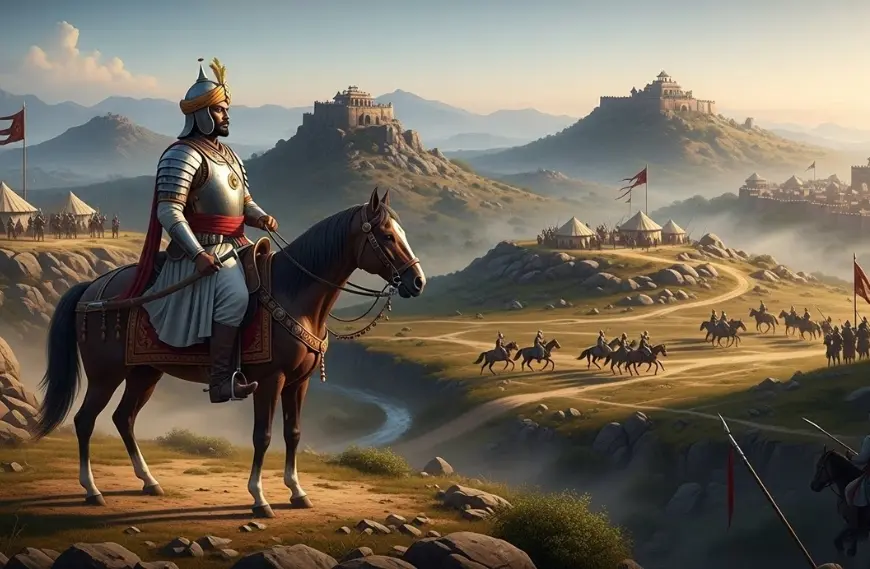
The sun was just rising over the Harar plains in Ethiopia. A young boy, barely ten, squinted against the golden light, unaware that his world was about to be torn apart. Chains clinked. Voices shouted. Foreign soldiers approached. “Pack him! Move him fast!” the overseer barked in a language the boy didn’t understand. And just like that, Malik Ambar’s life was uprooted, sent across deserts, seas, and empires, from Ethiopia to Baghdad, and finally to the bustling, chaotic courts of India.
He was a slave, yes, but even in captivity, there was a spark in his eyes. One merchant, noticing the boy’s alertness, muttered, “This one… he is not like the others. Remember him.” And remember him, the Deccan would, in ways nobody could foresee.
The Deccan beckons
By the 1570s, the Ahmadnagar Sultanate was in chaos. Mughal armies were expanding southward, and local sultans scrambled to maintain their thrones. Malik Ambar, now a young man, had been trained in strategy, languages, and administration, skills few in the sultanate possessed. One night, in the candle-lit hall of the palace, he whispered to a fellow officer, “Hum chhoti sena ke saath bhi badi jeet la sakte hain. Mughalon ko humara darr hamesha rahega.” (Even with a small army, we can win big. The Mughals will always fear us.)
And so began the legendary campaign that would make him a name etched in history.
Guerrilla tactics and midnight raids
The Mughal generals, confident and armored, marched through the Deccan plains. Yet every morning, they awoke to find supplies missing, villages burning, and messages in the sand: “Ambar ne aapko haraya.” (Ambar has defeated you.)
“How can a small army do this?” one Mughal officer muttered, staring at the smoldering remains of his camp.
“The land itself fights for them,” another replied.
Ambar had perfected what historians would later call guerrilla warfare: fast-moving cavalry, hidden fortresses, and attacks like sudden lightning strikes, unpredictable and devastating. He knew every hill, every river crossing. The Deccan was his chessboard, and the Mughals were pawns who could not anticipate his moves.
The visionary administrator
But Ambar was more than a soldier. In the quiet moments, he poured over scrolls and maps. He spoke to his advisers: ‘Revenue collection should help the people, not crush them. If farmers prosper, the sultanate prospers. Aur shahar bhi, humare log bhi… sab khush rahein.’
He reorganized the tax system, established efficient courts, and even started public works projects. Aurangabad, which he founded, was not just a military outpost, it was a city of water channels, bustling markets, and homes for all communities. The African-born slave had become a builder of cities, a shaper of society.
Alliances and diplomacy
‘We cannot fight alone,’ Ambar told his Maratha allies one moonlit night. ‘Bijapur and Golconda… hum unke bina nahi jeet sakte. Aur dhyaan rahe, Portuguese aur Dutch ko bhi apne taraf rakhna hoga.’
He forged alliances, not just with armies but with hearts. Maratha chiefs, wary of outsiders, trusted him. Persian and African mercenaries followed him across rivers and hills. His genius lay not just in battle, but in uniting diverse forces under one vision, a Deccan free from Mughal domination.
The Mughals feel his wrath
Akbar and later Jahangir could not ignore him. Generals brought massive armies, elephants, artillery. But Ambar was always one step ahead. One evening, after repelling a siege, he reportedly told his officers: “Yeh Mughals samajhte hain ki bas sena aur hathiyar chahiye. Par strategy aur zameen ka gyaan… yahi asli shakti hai.” (The Mughals think armies and weapons are enough. But strategy and knowledge of the land… that is the real power.)
And indeed, for decades, the Deccan remained unconquered, a testament to his brilliance.
The African son of India
Malik Ambar’s story is also one of identity. He was Ethiopian by birth, African by heritage, Muslim by faith, Indian by destiny. In a land of multiple cultures, languages, and faiths, he carved out a space where merit mattered more than origin. His soldiers came from Persia, Africa, and Maharashtra, yet they were united by loyalty to him and to the land.
Even today, echoes of his life resonate, in the forts he strengthened, in the cities he built, and in the stories parents tell their children in Maharashtra, Telangana, and Karnataka.
Final days and enduring legacy
Malik Ambar passed away in 1626, but his legend lived on. The cities he nurtured, the armies he trained, the alliances he built, all became part of the Deccan’s enduring legacy. Shivaji and later Maratha leaders walked the path he had carved, proving that even a slave could become a kingmaker, a visionary, and a strategist whose mind was sharper than the finest sword.
As modern leaders, including PM Modi, recall his life, they highlight a story that bridges continents, celebrates resilience, and honours talent that knows no boundaries. Malik Ambar’s life is a reminder: from the chains of slavery to the halls of power, the journey of a determined soul can reshape history.
Subscribe Deshwale on YouTube
