



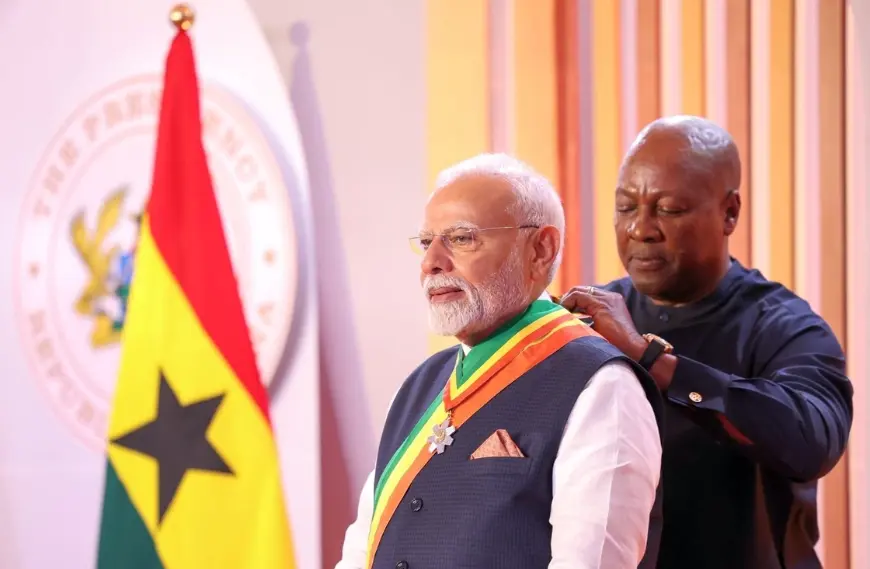
Prime Minister Narendra Modi’s eight-day diplomatic tour from July 2 to July 9, 2025, spanning Ghana, Trinidad and Tobago, Argentina, Brazil, and Namibia, marks a pivotal moment in India’s foreign policy. This ambitious journey, the longest in Modi’s tenure, underscores India’s commitment to deepening ties with the Global South. The tour aims to enhance cooperation in trade, energy, technology, and multilateral engagement, reinforcing India’s leadership among developing nations. Desh Wale is proud to bring you a series of articles exploring India’s relationships with each of these five nations, delving into their historical bonds, current dynamics, and future possibilities. This article provides a comprehensive overview of the tour, offering insights into what India can expect from these engagements.
India’s relations with Ghana, Trinidad and Tobago, Argentina, Brazil, and Namibia are rooted in shared histories of anti-colonial struggles and solidarity. Ghana and Namibia, key African partners, share India’s legacy of resisting British and South African colonialism, respectively. Trinidad and Tobago, home to a 180-year-old Indian diaspora, reflects cultural ties forged through indentured labour. Argentina and Brazil, major Latin American economies, align with India’s vision for a reformed global order, cemented through forums like the Non-Aligned Movement (NAM), Commonwealth, and BRICS.
Modi’s visit builds on decades of diplomatic engagement. In Ghana, the last Indian Prime Ministerial visit was in 1995. Trinidad and Tobago hosted Prime Minister P.V. Narasimha Rao in 1999. Argentina welcomed Rajiv Gandhi in 1985, while Brazil has seen frequent exchanges, including Modi’s visits for BRICS summits. Namibia, a newer partner since its 1990 independence, benefited from India’s support during its liberation struggle. These historical ties provide a foundation for Modi’s 2025 tour, which seeks to elevate bilateral and multilateral cooperation.
Modi’s tour begins in Ghana (July 2–3), where he will engage with President John Dramani Mahama and address the Ghanaian Parliament. The focus will be on trade, digital infrastructure, and critical minerals. In Trinidad and Tobago (July 3–4), Modi will meet Prime Minister Kamla Persad-Bissessar, leveraging diaspora ties to boost energy and trade cooperation. Argentina (July 4–5) follows, with discussions with President Javier Milei on agriculture, lithium, and G20 collaboration. Brazil (July 5–7) hosts Modi for the 17th BRICS Summit, alongside bilateral talks with President Luiz Inácio Lula da Silva on trade and renewable energy. The tour concludes in Namibia (July 7–9), where Modi will engage with President Netumbo Nandi-Ndaitwah on minerals and regional security.
Each stop reflects India’s strategic priorities: strengthening economic ties, securing energy resources, advancing technology, and amplifying the Global South’s voice in global governance. The tour’s diverse destinations—spanning Africa, the Caribbean, and Latin America—highlight India’s ambition to bridge continents.
India’s economic relations with these nations offer significant potential. Bilateral trade with Ghana reached $2.6 billion in 2024, driven by gold exports and Indian investments in pharmaceuticals and agriculture. Trinidad and Tobago, with $250 million in trade, is a prospective LNG supplier. Argentina’s $2 billion trade with India focuses on agriculture, with lithium partnerships emerging. Brazil, a BRICS partner, boasts $12 billion in trade, spanning soybeans, oil, and technology. Namibia’s $200 million trade includes uranium and diamonds, with potential for lithium collaboration.
Modi’s tour is expected to yield trade agreements and investment deals. In Ghana, India aims to secure lithium and cobalt for clean energy technologies. Trinidad and Tobago offers opportunities for LNG imports and digital infrastructure like UPI. Argentina’s lithium reserves and agricultural exports align with India’s energy and food security goals. Brazil’s ethanol expertise and mineral resources will support India’s renewable energy ambitions. Namibia’s uranium and lithium reserves are critical for India’s nuclear and clean energy sectors. Indian firms like Tata, Mahindra, and Khanij Bidesh India Limited (KABIL) are poised to expand investments across these nations.
The tour will strengthen India’s strategic partnerships. Ghana’s role in the African Union (AU) and Economic Community of West African States (ECOWAS) offers India a gateway to West Africa. Trinidad and Tobago’s leadership in the Caribbean Community (CARICOM) facilitates regional engagement. Argentina’s position in Mercosur and the G20 aligns with India’s global governance priorities. Brazil, a BRICS and IBSA partner, is a key ally in counter-terrorism and climate initiatives. Namibia’s influence in the Southern African Development Community (SADC) enhances India’s African outreach.
Modi’s engagements will focus on UN reforms, particularly Security Council expansion, where all five nations support India’s aspirations. Defence cooperation, including training and maritime security, will advance in Ghana, Trinidad, and Namibia. The BRICS Summit in Brazil will address global challenges like terrorism, with India’s Operation Sindoor gaining support. Agreements on cybersecurity and intelligence-sharing are expected across the tour, reflecting shared security concerns.
Energy security is a cornerstone of Modi’s tour. Ghana and Namibia offer critical minerals like lithium, cobalt, and uranium, vital for India’s clean and nuclear energy goals. Trinidad and Tobago’s LNG reserves align with India’s energy diversification strategy. Argentina’s lithium and shale gas reserves attract Indian firms. Brazil’s ethanol and biofuel expertise complements India’s renewable energy ambitions. The International Solar Alliance (ISA), led by India, will drive solar and wind energy projects across these nations.
Technology cooperation is another priority. India’s Unified Payment Interface (UPI) is poised for adoption in Ghana and Trinidad and Tobago, enhancing digital connectivity. Space collaboration with Argentina and Brazil, including satellite technology, will advance scientific ties. India’s IT firms, such as TCS and Infosys, are expanding in Argentina and Brazil, fostering innovation and job creation.
Cultural ties strengthen India’s relations with these nations. In Ghana, the Indian Cultural Centre in Accra promotes yoga and Bollywood. Trinidad and Tobago’s Indian diaspora, nearly 40% of the population, celebrates Divali and Hosay as national festivals. Argentina and Brazil embrace Bollywood and yoga, with Indian cultural centres fostering exchange. Namibia’s small diaspora is active in commerce and education. Modi’s engagements with Indian communities across these nations will reinforce cultural bonds, enhancing India’s soft power.
Educational initiatives, including ITEC scholarships and e-Visa schemes, facilitate people-to-people connections. Indian universities host students from all five nations, particularly in medicine and engineering, fostering long-term ties.
Challenges persist across these partnerships. Trade imbalances, with India importing more from Ghana, Brazil, and Namibia, require diversification. Logistical barriers, such as limited direct connectivity, hinder investment. Geopolitical competition, particularly with China’s infrastructure and mining investments in these regions, poses a challenge. India’s focus on capacity-building, non-extractive partnerships, and diaspora ties offers a competitive edge.
Modi’s tour presents opportunities to address these challenges. Trade agreements will diversify exports, while improved transport links will boost investment. By leveraging historical solidarity and mutual benefit, India can strengthen its position against competitors, fostering trust and collaboration.
Modi’s tour is a testament to India’s ambition to lead the Global South. By engaging with Africa, the Caribbean, and Latin America, India bridges diverse regions. Ghana and Namibia amplify India’s African outreach through AU, ECOWAS, and SADC. Trinidad and Tobago strengthens India’s Caribbean presence via CARICOM. Argentina and Brazil enhance India’s Latin American influence through Mercosur, G20, and BRICS. The tour aligns with India’s G20 presidency priorities, amplifying developing nations’ voices in global forums.
India can expect significant outcomes from Modi’s tour. Economically, trade agreements and investments in critical minerals, LNG, and agriculture will enhance energy and food security. Strategically, support for UN reforms and counter-terrorism initiatives will bolster India’s global influence. Technologically, UPI adoption and IT partnerships will drive innovation. Culturally, diaspora engagement and educational exchanges will strengthen soft power. The BRICS Summit in Brazil will reinforce India’s leadership in multilateral forums, with declarations on terrorism and climate change.
Long-term, the tour will position India as a trusted partner in the Global South, fostering sustainable development and equitable governance. Challenges like trade imbalances and geopolitical competition will require sustained efforts, but India’s focus on mutual benefit ensures a positive outlook.
Deshwale is bringing you an exclusive series of articles exploring India’s relationships with Ghana, Trinidad and Tobago, Argentina, Brazil, and Namibia. Each article delves into the historical bonds, current dynamics, and future possibilities of these partnerships. From Ghana’s critical minerals to Trinidad’s diaspora-driven ties, Argentina’s agricultural prowess, Brazil’s BRICS synergy, and Namibia’s strategic minerals, our series offers a deep dive into India’s Global South vision. Stay tuned for insights into how these nations and India can shape a prosperous future together.
Modi’s 2025 tour to Ghana, Trinidad and Tobago, Argentina, Brazil, and Namibia is a bold step toward strengthening India’s Global South leadership. Rooted in historical solidarity, the tour promises economic, strategic, and cultural dividends. As India engages with these diverse nations, it will forge partnerships that enhance trade, energy security, and global influence. Desh Wale invites you to explore our series on these nations, uncovering the potential of India’s global outreach. This journey, though brief, carries the weight of history and the promise of a collaborative future.
From anti-colonial struggles to modern economic synergies, India and Ghana share a rich legacy. The 2025 visit, with its focus on trade, energy, technology, and multilateral engagement, promises to elevate this relationship to new heights. As Modi engages with Ghanaian leaders and the Indian diaspora, he will underscore India’s commitment to a prosperous and equitable global order. This journey, though brief, carries the weight of history and the promise of a collaborative future.
