



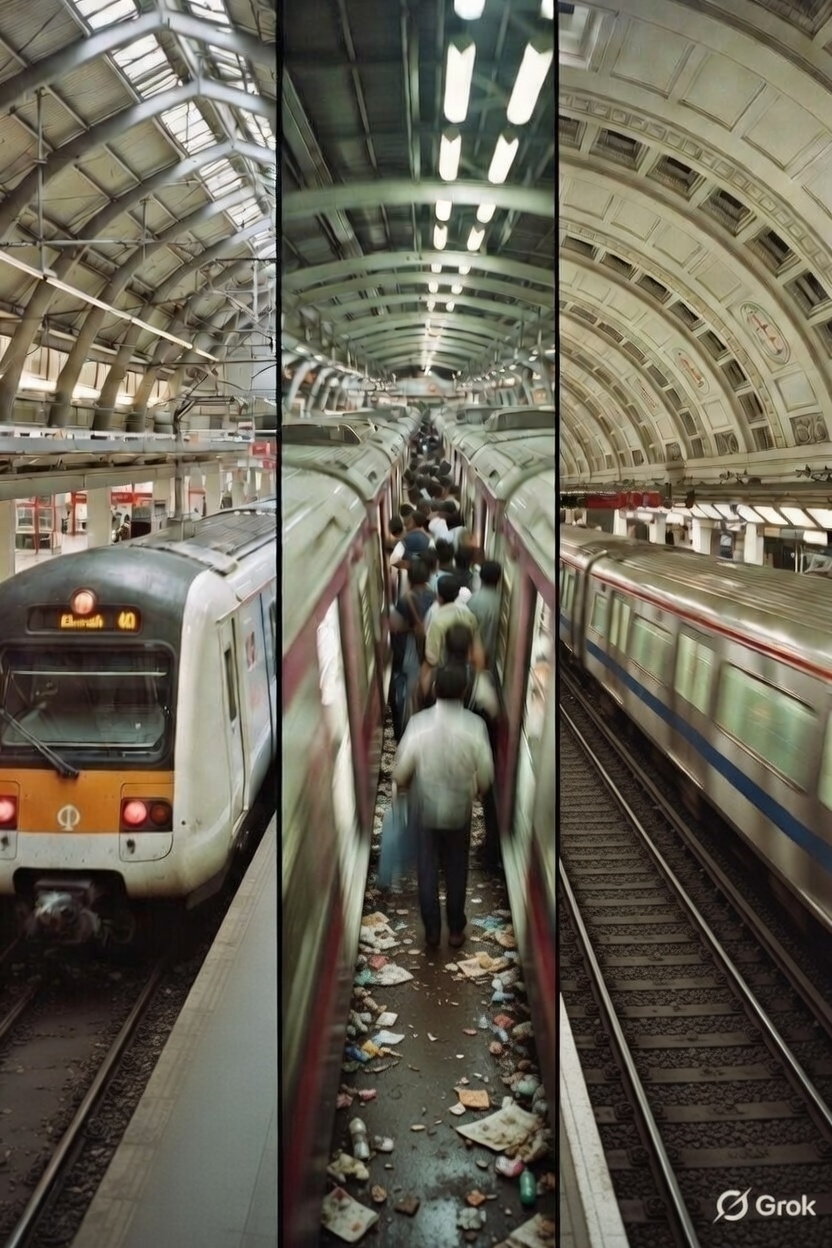
A policy examination of three cities, one shared inheritance, and two very different destinies
Mumbai’s suburban railway began in 1853. It is not merely old – it is foundational. One of the earliest commuter corridors in the world and still among the busiest, it is operated by Indian Railways and carries a weight of history that few transit systems anywhere can claim.
Only a handful of cities share comparable antiquity. Two matter most in any serious structural comparison: London and New York City.
All three cities inherited Victorian-era alignments. All three faced explosive urbanisation. All three ran trains at crush loads on infrastructure built for another century.
But only two of them systematically rebuilt their commuter rail ecosystems to match 21st-century demands.
Mumbai, despite extraordinary throughput, has modernised in fragments.
This is not an exercise in praise or blame. It is an examination of policy choices – and missed ones.
The historical starting point: comparable age, divergent trajectories
London
Suburban rail corridors expanded from the 1830s onward. By the late 19th century, London had dense radial commuter lines feeding the City. Victorian railways, however, choked the capital by the mid-20th century.
London responded with structural reform – not sentimentality.
What London did
- Created integrated transport governance through Transport for London
- Standardised electrification across its network
- Integrated fares through Oyster and contactless payment
- Delivered major capacity projects, most notably Crossrail (the Elizabeth line)
- Systematically upgraded safety infrastructure and signalling
London did not preserve its 19th-century railways. It rebuilt them repeatedly.
New York
The Long Island Rail Road and Metro-North corridors date to the 1830s and 1840s. By the 1970s, commuter rail had decayed under severe fiscal stress.
New York, too, responded structurally.
What New York did
- Created the Metropolitan Transportation Authority (MTA) to consolidate oversight
- Introduced long-term capital improvement plans
- Implemented systematic fleet replacement cycles
- Deployed Positive Train Control (PTC) following federal mandate
- Delivered major capacity projects, including Grand Central Madison
New York’s system still struggles with delays and funding politics, but safety, signalling and rolling stock modernisation proceeded on a defined institutional track.
Mumbai
Mumbai electrified suburban services in 1925 ahead of most Asian peers. It built a quadruple-track system on key corridors and later expanded to 12- and 15-car rakes.
But structurally, the system remains dependent on its 19th-century right-of-way.
Incremental additions – new rakes, platform extensions, corridor segregation – improved capacity. Yet governance, safety, and station architecture did not undergo the same systemic overhaul seen in London or New York.
Mumbai increased output without fully redesigning the machine.
Where Mumbai has failed – plainly
1. Safety architecture
London and New York closed their doors to open-travel conditions decades ago. Platform surveillance, fencing, automatic signalling and strict track discipline are now baseline norms in both cities.
Mumbai still runs open-door trains in peak conditions. Trespassing deaths remain tragically routine.
This is not a resource inevitability. It is a policy prioritisation failure. Safety upgrades have consistently lagged behind capacity expansion.
2. Governance fragmentation
A structural comparison
City Governance model London Centralised under Transport for London, a city authority New York Consolidated under the MTA Mumbai Managed by Indian Railways, a national operator spanning 68,000+ route kilometres
Urban commuter rail requires metropolitan governance logic. Mumbai never received it. Its suburban railway remains a high-output division within a national system whose priorities extend far beyond any single city.
3. Station design philosophy
London built integrated interchange nodes. New York renovated its commuter hubs. Mumbai’s station precincts remain constrained and chronically overcrowded.
Station redevelopment has begun, but decades were lost to ad hoc platform extensions rather than systemic redesign. Passenger circulation engineering- foot overbridges, concourses, vertical mobility – was reactive, not anticipatory.
4. Fare policy and the financial model
Mumbai’s fares remain politically suppressed. This keeps rail affordable, a genuine achievement in equity terms, but it starves capital reinvestment capacity.
London and New York both operate layered fare models supported by substantial state subsidies tied explicitly to capital planning cycles.
Mumbai relies heavily on central allocations without a robust metropolitan financing mechanism. Low fares without high reinvestment create infrastructure stagnation. That is precisely what has occurred.
5. Signalling and automation
London’s commuter corridors have progressively upgraded their signalling systems over decades. New York implemented Positive Train Control following a federal mandate.
Mumbai has introduced modern signalling on certain corridors, but network-wide transformation has been slow. When daily ridership approaches eight million, signalling upgrades are not technical luxuries – they are structural necessities.
Where Mumbai still excels
To ignore Mumbai’s strengths would be intellectually dishonest.
Mumbai’s remarkable operational record
- Moves more passengers per kilometre than most Western networks
- Maintains an extraordinarily low cost per passenger kilometre
- Operates at globally remarkable frequency under legacy infrastructure constraints
- Functions as the economic backbone of an entire megacity
Mumbai did not collapse under demographic pressure. It adapted. That endurance is real, and it deserves acknowledgement.
But adaptation is not the same as transformation.
Why London and New York evolved – and Mumbai did not
The difference is not merely money.
It is governance design and political prioritisation.
London treated commuter rail as part of an integrated urban mobility ecosystem. New York institutionalised capital planning cycles tied to long-term funding authorisations. Both cities localised accountability – placing decision-making power close to the populations being served.
Mumbai treated suburban rail as a high-output division within a national railway. Accountability was centralised rather than localised. That structural choice, made over decades, across successive governments, shaped every outcome that followed.
What Mumbai must learn — realistically
Five structural shifts
Metropolitan control over suburban rail: A Mumbai-focused transport authority with genuine financial autonomy would align planning with the city’s own growth patterns, rather than national railway priorities.
Safety first, not capacity first: Automatic door closure systems, fencing, platform redesign and signalling upgrades must precede further capacity expansion.
Fare reform with safeguards: Gradual rationalisation combined with targeted subsidies can increase reinvestment capacity without harming low-income commuters.
Station urbanism: Stations must be redesigned as engineered passenger-flow systems, not treated as incremental extensions of colonial-era platforms.
Predictive expansion: Instead of reacting to congestion after it becomes critical, corridor augmentation must anticipate population growth — as London did with Crossrail.
The hard truth
Mumbai’s suburban railway is heroic. But heroism is not policy.
It survives through resilience rather than systemic foresight. London and New York inherited similarly aged 19th-century networks. They did not preserve them nostalgically. They rebuilt them politically, financially, and institutionally.
Mumbai expanded capacity but delayed structural reform. That is why the comparison today is uncomfortable, not because Mumbai failed to build, but because it did not rebuild.
Final assessment
Mumbai’s suburban railway remains one of the world’s oldest and busiest commuter systems. The city has the ridership, the economic imperative, and the engineering competence.
What it needs is institutional courage – the willingness to treat suburban rail not as inherited infrastructure to be maintained, but as the central nervous system of India’s financial capital to be actively reinvented.
Age alone does not confer excellence. Two of Mumbai’s historical peers evolved into safer, better-governed, and more technologically advanced ecosystems.
If 1853 was the birth of this system, the next decade must be its reinvention.
Otherwise, history will record not just that Mumbai built early – but that it modernised too late.
Mumbai’s suburban railway is operated by Indian Railways. The Elizabeth line (Crossrail) opened in phased stages from 2022. Grand Central Madison opened in January 2023. Positive Train Control was federally mandated for US commuter railroads following the 2008 Rail Safety Improvement Act.
Subscribe Deshwale on YouTube
